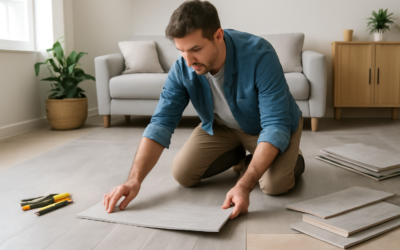
If you love the elegance of marble, slate, or travertine but not the price tag or the cold, unforgiving feel underfoot, LVT stone look flooring deserves a spot on your shortlist. A well-made LVT stone look plank or tile captures the veining, grout lines, and matte texture of natural stone while staying warmer, quieter, and far more forgiving than the real thing.
Luxury vinyl tile has come a long way since the peel-and-stick squares of decades past. Today’s photographic layers and embossed surfaces fool the eye and, increasingly, the fingertips. Below you’ll find how these products are built, which stone styles translate best, what installation involves, and roughly what you should budget per square foot.
- What “Stone Look” Actually Means in LVT
- Popular Stone Styles and Who They Suit
- Rigid Core vs. Flexible LVT
- How to Install LVT Stone Look Flooring
- Grout Lines and the Group Look
- Cost, Durability, and Value
- Cleaning and Long-Term Care
- Where Stone-Look LVT Works Best
- Common Mistakes to Avoid
- Frequently Asked Questions
What “Stone Look” Actually Means in LVT
Manufacturers build luxury vinyl tile in layers. A clear wear layer sits on top, protecting a high-resolution printed film that carries the stone image. Beneath that lives a rigid or flexible core, then a backing. When people say “stone look,” they mean that printed film plus a texture press that gives the surface a slightly rough, honed, or riven feel.
Registered embossing is the detail worth paying for. On premium tiles, the surface texture lines up exactly with the printed veins and pits, so a travertine’s little holes actually dip where the picture shows them. Cheaper tiles use a generic texture that doesn’t match, which reads as fake the moment sunlight hits it at an angle.
Popular Stone Styles and Who They Suit
Not every stone look fits every room. Choosing a pattern that matches your light levels and lifestyle matters more than chasing the trendiest option.
- Marble: Dramatic gray or gold veining on a white field. Best in bathrooms, powder rooms, and open kitchens where you want a luxury focal point. Large-format tiles (12×24 inches or bigger) show the veins off best.
- Slate: Charcoal, rust, and green-gray tones with a cleft, rocky texture. Forgiving of dirt and foot traffic, so it shines in mudrooms and entryways.
- Travertine: Warm beige and cream with characteristic pitting. A classic in Mediterranean and transitional homes; pairs well with wood cabinetry.
- Concrete and cement: Flat, industrial gray. Popular in modern lofts and laundry rooms where a minimalist backdrop is the goal.
- Limestone: Soft, uniform neutrals that keep a space calm and bright without demanding attention.
Rigid Core vs. Flexible LVT
Two core types dominate the stone-look market, and the right pick depends on your subfloor. SPC (stone plastic composite) uses a dense mineral core that resists dents and hides minor subfloor imperfections. It’s the go-to for busy households and for slabs that aren’t perfectly flat.
Glue-down flexible LVT, by contrast, is thinner and bends easily. It bonds directly to the subfloor with adhesive, delivering the most convincing, seamless stone appearance and the quietest, most solid feel underfoot. Commercial spaces lean on it, and so should you if you want the closest thing to real stone and don’t mind the extra prep. Expect glue-down to demand a smoother subfloor, flat within about 3/16 inch over a 10-foot span.
How to Install LVT Stone Look Flooring
Click-together SPC is well within reach for a confident DIYer, while glue-down is better left to a pro unless you’ve laid vinyl before. Here’s the general sequence for a floating rigid-core install:
- Acclimate the boxes flat in the room for 48 hours at normal living temperature, ideally between 65 and 85°F.
- Clean and level the subfloor. Fill low spots with patch compound and let it cure fully.
- Roll out an underlayment pad if the planks don’t have one attached, unless you’re installing over radiant heat, in which case follow the maker’s specific guidance.
- Snap the first row along your straightest wall, leaving a 1/4-inch expansion gap around the perimeter.
- Stagger seams by at least 6 to 8 inches row to row so grout lines look random, like real stone.
- Cut tiles with a sharp utility knife (score and snap) or a fine-tooth jigsaw for curves.
- Reinstall baseboards or add quarter-round to cover the expansion gap.
Pro tip: dry-lay a few rows first without clicking them fully home. Stone-look products often ship with several print variations, and mixing planks from three or four different boxes prevents an obvious repeating pattern.
Grout Lines and the Group Look
Some stone-look LVT ships with beveled edges that create a shadow line mimicking grout, and a subset accepts real vinyl grout you trowel into the joints after installation. Grouting adds realism and a genuinely tiled feel, but it also removes the floating floor’s ability to expand, so only grout products rated for it and follow the temperature range on the label. For most homeowners, factory beveled edges deliver 90 percent of the look with none of the mess.
Cost, Durability, and Value
Budget stone-look LVT starts around $2 per square foot, mid-range products run $3 to $5, and premium registered-emboss lines with thick 20-mil wear layers reach $6 to $8. Professional installation typically adds $2 to $4 per square foot depending on subfloor prep and whether you choose glue-down.
Compare that to natural stone tile, which can run $10 to $30 per square foot installed once you factor in the mortar bed, waterproofing, and labor. LVT wins decisively on price, warmth, and slip resistance, and it won’t crack if you drop a cast-iron pan. Natural stone still holds an edge in resale prestige and in extreme heat resistance, but for the vast majority of kitchens, baths, and living areas, the vinyl trade-off is easy to accept.
Look for a wear layer of at least 12 mil for residential use and 20 mil for homes with pets or heavy traffic. A thicker wear layer is the single best predictor of how long the floor keeps its finish.
Cleaning and Long-Term Care
Day-to-day upkeep is refreshingly simple. Sweep or vacuum grit, then damp-mop with a pH-neutral vinyl cleaner. Skip steam mops, abrasive pads, and oil soaps, all of which can dull or warp the wear layer over time. Wipe spills promptly, though the sealed surface tolerates water far better than sealed natural stone.
Place felt pads under furniture legs and walk-off mats at exterior doors to keep sand from scratching the finish. Done right, a quality stone-look LVT floor holds its appearance for 15 to 25 years, which is why so many homeowners now choose it over the material it imitates.
Where Stone-Look LVT Works Best
Room by room, stone-look vinyl solves problems that real stone creates. In kitchens it offers a soft, slip-resistant surface that won’t shatter your dropped stoneware and won’t crack a wine glass on contact. Bathrooms benefit from its 100 percent waterproof rating and its warmer feel against bare feet stepping out of the shower.
Entryways and mudrooms are natural homes for slate and concrete looks, which hide tracked-in grit and road salt between cleanings. Basements, long a graveyard for wood and laminate, take rigid-core stone LVT beautifully because it tolerates the humidity swings and occasional dampness of below-grade spaces. About the only place to think twice is a sunroom with hours of direct, unfiltered sunlight, where you’ll want a UV-stabilized wear layer to prevent long-term fading.
Common Mistakes to Avoid
Two errors sink otherwise good installs. The first is skipping subfloor prep; rigid cores forgive minor dips, but a slab out of flat by more than 3/16 inch over 10 feet will telegraph through and stress the click joints. The second is installing planks straight from a single box, which produces an obvious repeating stone pattern. Pull from at least three or four boxes at once and shuffle the planks, exactly as a mason would vary real tile, so no two identical prints land side by side.
Frequently Asked Questions
Is LVT stone look cold like real stone? No. Vinyl conducts far less heat, so it stays closer to room temperature and feels comfortable barefoot, even in winter.
Can I install it in a bathroom? Yes. Most rigid-core stone-look LVT is 100 percent waterproof and is a strong choice for full baths, though you should still seal around tubs and toilets.
Does it work with radiant heat? Generally yes, provided you keep the surface temperature under about 85°F and confirm compatibility with the manufacturer before installing.
Prefer to explore on your own?
See how new flooring looks in your actual room in seconds — free, no signup.
Try the free Floor Studio →