Marble has put up with bathroom traffic since Roman builders started laying Carrara in caldarium floors two thousand years ago, and it still delivers a look porcelain tile can imitate but never quite match. Marble flooring bathroom installs reward the homeowner who maintains the surface and frustrate the one who treats it like ceramic. After spec’ing marble in dozens of master baths and powder rooms across the Northeast, I have seen what works, what etches, and which marble varieties hold up better in wet conditions. Here is the honest buyer’s perspective on choosing, installing, and living with marble underfoot in a bathroom.
Part of our Countertops guide — explore the full guide →
What Marble Actually Is
Marble is metamorphosed limestone, made of calcium carbonate crystals that recrystallized under heat and pressure deep in the earth. The same chemistry that gives it veining also makes it vulnerable to acidic substances. Vinegar, lemon juice, hair spray, and even mineral-heavy water can etch the polished surface.
That said, bathroom floors face less acid exposure than kitchen counters. The main threats are shampoo residue, hard water mineral spots, and the constant moisture that loosens grout if not properly maintained. Bathrooms are actually one of the more sustainable rooms for residential marble.
Best Marble Varieties for Bathrooms
Carrara from Italy is the classic. White-gray background with soft veining, widely available, $7 to $14 per square foot for 12 by 24 inch honed tile. It is also the softest of the common bathroom marbles and shows etching most clearly.
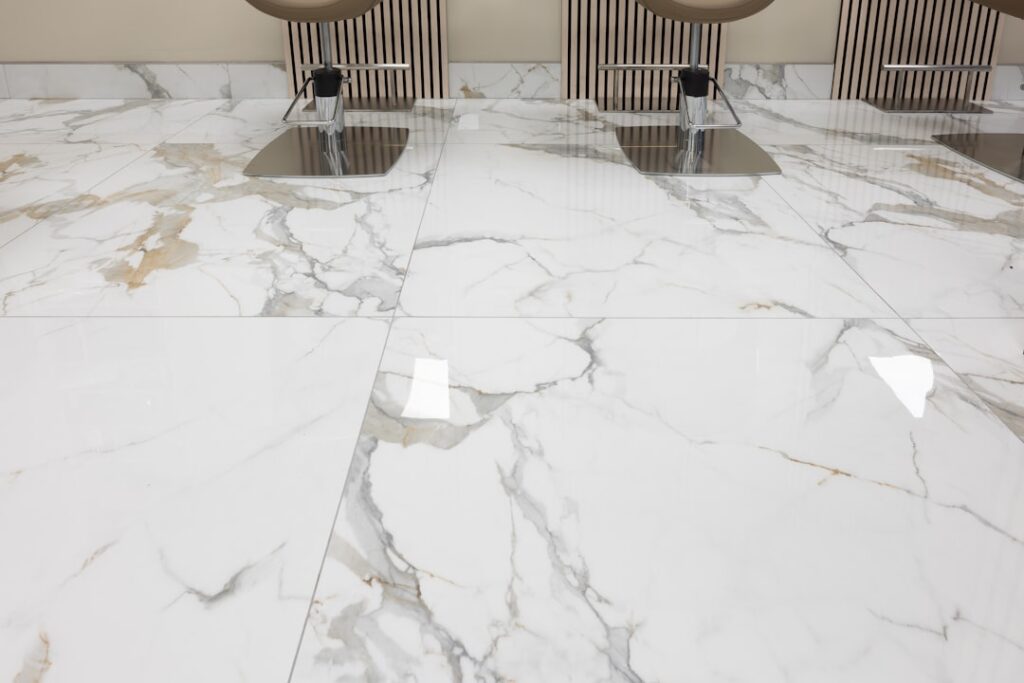
Calacatta carries more dramatic veining on a whiter background. Premium-tier pricing at $14 to $30 per square foot. Better suited to powder rooms where polished finish makes sense; in primary baths, choose honed Calacatta to reduce slip risk.
Crema Marfil is a beige Spanish marble that conceals etching better than white marbles thanks to the warmer base color. Prices run $9 to $15 per square foot. A practical choice for families.
Statuary marble (also Italian) sits between Carrara and Calacatta in pricing and pattern. Very white background, bold gray veining. Best for honest luxury baths.
Honed vs Polished Finish
Polished marble is high-gloss, shows etching dramatically, and feels slippery when wet. It belongs on walls, not floors, in bathrooms. Honed marble has a matte satin surface that hides etching, provides better wet slip resistance (typically COF above 0.6 wet on textured-honed), and disguises minor scratches that polished surfaces would amplify.
For nearly every residential bath floor, specify honed. Polished works for shower walls, wainscot, and accent strips where slip is irrelevant.
Pricing Snapshot
- Honed Carrara 12×24 tile: $7 to $14 per square foot material
- Honed Calacatta 12×24: $14 to $30 per square foot material
- Honed Crema Marfil 18×18: $9 to $15 per square foot material
- Hexagonal marble mosaic 12×12 sheet: $14 to $25 per square foot material
- Installation by experienced tile setter: $10 to $18 per square foot
- Sealer initial application: $0.50 to $1.50 per square foot
A typical 50 square foot master bath floor in honed Carrara lands at $1,200 to $2,200 installed.
Installation Best Practices
Marble requires a stiffer subfloor than ceramic tile. Deflection limit is L/720 (versus L/360 for ceramic). On wood subfloors, install a minimum 1/4 inch cement backer board over plywood and use a polymer-modified thinset rated for natural stone.
Tile saws cut marble cleanly, but always with a continuous-rim diamond blade made for stone. A standard tile saw blade chips the edge and creates work for the polisher later. Lay the tiles in a balanced pattern, with cut tiles distributed evenly around the perimeter rather than all on one wall.
Grout in a matched or one-shade-darker color with an unsanded grout for tile joints under 1/8 inch. Stain-resistant epoxy grout (Laticrete SpectraLock or Mapei Kerapoxy) saves later cleaning frustration.
Sealing Schedule
Marble bathroom floors need a penetrating sealer (Miracle 511, Stone Tech BulletProof, or Aqua Mix Sealer’s Choice Gold) applied right after install and at the grout. Wipe excess off the surface within 5 minutes. The sealer fills the porosity and slows acid penetration, buying you time to wipe spills before they etch.
Re-seal annually in a primary bath, every two years in a powder room. The water bead test tells you when it is time: drip a teaspoon of water on the tile. If it beads, the seal is intact. If it darkens the marble within 60 seconds, re-seal soon.
Slip Safety
Honed marble passes ANSI A137.1 slip resistance with a dynamic coefficient of friction (DCOF) typically between 0.45 and 0.60 wet, which clears the residential threshold of 0.42. For elderly clients or wheelchair-accessible baths, consider a mosaic field tile with more grout lines per square foot. The grout itself adds slip resistance.
A teak shower mat or bath rug at the tub exit also helps. Skip rubber-back rugs that trap moisture against the stone and can leave staining marks.
Pros and Cons
- Pros: Unmatched visual character, cool underfoot in summer, holds value at resale, repairable through professional honing
- Cons: Etches from acids, requires annual sealing, cold underfoot in winter without radiant heat, more expensive than porcelain
When To Choose Porcelain Marble-Look Instead
If you have small children, pets, or low maintenance tolerance, marble-look porcelain delivers most of the visual without the etching risk. Brands like Marazzi, Florim, and Mirage produce 12 by 24 and 24 by 48 inch tiles with veining patterns that pass for natural marble at conversational distance, for $5 to $9 per square foot material.
Choose real marble when the project budget and your maintenance habits both support it, when resale value matters, or when the room is a feature space where the genuine material is part of the design story.
Final Take
A properly specified, sealed, and maintained marble flooring bathroom installation rewards every dollar with a surface that looks better five years in than the day it was installed. Cut corners on the sealing schedule, choose polished over honed, or pair it with the wrong cleaning products and the same floor will frustrate you within a year. Pick honed Carrara or Crema Marfil, hire an experienced stone setter, seal it on schedule, and you will have a bathroom floor that earns admiration for decades.
Prefer to explore on your own?
See how new flooring looks in your actual room in seconds — free, no signup.
Try the free Floor Studio →