Walk into most primary bedrooms and you will find the same mistake: a queen bed against a bare wall with one undersized print floating awkwardly above the headboard. Good master bedroom wall decor follows a handful of measurable rules about scale, height, and placement that designers use on every job, and once you know them, the difference is dramatic. The bedroom is also the one room where you can take risks, because guests rarely see it. This guide covers the proven approaches, the actual dimensions to work with, and where your budget does the most good.
Start With the Wall Behind the Bed
The headboard wall is the focal point of the room, and everything else should defer to it. The classic rule for art above a bed: the piece or grouping should span 60 to 75 percent of the bed’s width. Over a 60-inch queen headboard, that means artwork 36 to 45 inches wide. Over a 76-inch king, look for 48 to 57 inches. Hang the bottom edge 8 to 10 inches above the headboard so the two read as one composition rather than strangers on the same wall.
If a single large canvas is outside the budget, a matched pair or triptych solves the width problem cheaply. Two 20 x 30 inch framed prints hung with a 3-inch gap cover 43 inches, perfect over a queen. Oversized round mirrors, woven wall hangings, and horizontal wood art all work in the same footprint. The one thing to avoid directly over the bed is heavy glass in earthquake-prone regions; use cleat-mounted canvas or fabric pieces there instead.
Accent Walls: Paint, Wood, and Wallpaper
An accent wall behind the bed delivers the biggest visual change per dollar in the whole room. A gallon of quality paint runs $35 to $70 and covers the job with plenty left over. Deep, low-glare colors work best in bedrooms: navy, charcoal, forest green, and warm clay tones all recede at night and make bedding pop during the day. Use a matte or eggshell finish, since anything glossier telegraphs every drywall flaw once the bedside lamps rake light across it.
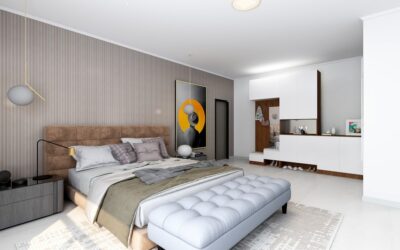
Wood treatments raise the stakes and the cost. A board-and-batten grid in primed MDF costs roughly $150 to $400 in materials for a 12-foot wall and takes a weekend with a miter saw, level, and brad nailer. Slat walls made from 1 x 2 strips over a painted dark background have dominated recent bedroom remodels for good reason: they add texture and even modest sound dampening. Peel-and-stick wallpaper is the renter-friendly option at $30 to $50 per roll, and modern versions remove cleanly, but take your time aligning the pattern repeat or it will bother you nightly.
- Paint only: $50 to $100, one afternoon, fully reversible
- Board and batten or shiplap: $150 to $500 in materials, one to two weekends
- Wood slat wall: $300 to $900 depending on species and wall size
- Traditional or peel-and-stick wallpaper: $100 to $600 per wall depending on the paper
Gallery Walls Without the Chaos
Gallery walls fail in bedrooms when they get too busy for a room meant to be restful. Limit the palette: matching frames in black, white, or natural wood, and art that shares a color family or subject, like botanical prints or black-and-white family photos. Keep 2 to 3 inches of spacing between every frame, consistent throughout, and treat the whole cluster as a single shape whose center lands at 57 to 60 inches from the floor, standard gallery height.
Lay the arrangement out on the floor first, or cut kraft-paper templates and tape them to the wall for a day before committing to nails. On the wall opposite the bed, a horizontal grid of six or nine identical frames reads calm and intentional. Save the loose, organic salvage-style arrangement for a den; in a sleep space, order beats spontaneity.
Mirrors: Function, Light, and Placement Rules
A mirror does double duty in a bedroom, bouncing morning light deeper into the room and serving the getting-dressed routine. A full-length leaner mirror, typically 65 to 71 inches tall, propped against the wall near the closet is the easiest win and runs $80 to $250. Anchor it to a stud with the included strap; a 40-pound tipping mirror is not a risk worth taking in any home with kids or pets.
Placement matters for sleep quality, too. Many people genuinely dislike facing a mirror from bed, waking to unexpected movement in low light. Position mirrors perpendicular to the bed or above a dresser instead. Hang a dresser mirror so its center sits at eye level, about 60 to 65 inches from the floor, and keep it within the dresser’s width so the pair reads as one furniture moment.
Layer in Texture: Beyond Framed Art
Flat art on flat paint can leave a bedroom feeling like a hotel. Dimensional pieces fix that. Woven baskets arranged in a cluster, a large macrame or fiber hanging, quilted textile art, or a vintage rug hung from a wooden dowel all absorb a little sound and add shadow lines that shift with the light through the day. Fabric-wrapped acoustic panels, sold in 12 x 12 inch and 24 x 48 inch sizes for $15 to $60 each, are a quiet-room upgrade disguised as decor, useful when the bedroom shares a wall with a living room or a neighbor.
Floating shelves give you a changeable display without new nail holes every season. A pair of 24-inch wood shelves above a dresser holds framed photos, a small plant, and a lamp, and restyling them costs nothing. Keep shelf contents to odd-numbered groupings, three or five objects with varied heights, and leave a third of each shelf empty. Crowded shelves read as clutter, and clutter is the enemy of a restful room.
Lighting as Wall Decor
Wall-mounted lighting is decor that earns its keep. Swing-arm sconces flanking the bed free up nightstand space and put light exactly where you read. Mount them so the bottom of the shade sits roughly 30 to 36 inches above the mattress top, centered over each nightstand. Hardwiring runs $150 to $300 per sconce with an electrician, but plug-in sconce versions with a cord cover install in 20 minutes and cost $40 to $120 each.
LED strip lighting behind a headboard or along the top of a slat wall adds a soft glow for evenings, and battery or plug-in picture lights over key artwork create a gallery effect for $25 to $80. Put any of these on a smart plug or dimmer; the ability to drop the room to 10 percent brightness at night is worth more to sleep quality than any single piece of art you will buy.
Common Mistakes That Flatten the Room
Nearly every underwhelming bedroom wall shares one of the same few problems, and all of them are fixable in an afternoon.
- Art hung too high. Center pieces at 57 to 60 inches from the floor, or 8 to 10 inches above the headboard, not at picture-rail height.
- Pieces too small for the wall. A 16 x 20 print alone on a 12-foot wall disappears. Go bigger or group.
- Ignoring the ceiling line. Leave at least 6 to 12 inches between tall decor and the ceiling so the wall can breathe.
- Too many focal points. One statement wall; the others play supporting roles.
- Skipping wall anchors. Anything over 20 pounds goes into a stud or a rated toggle anchor, especially above a bed.
A Budget Roadmap That Works
You can transform the room in stages without wasting money on placeholders you will replace. Spend the first $100 on paint for the headboard wall and proper hanging hardware. The next $200 to $400 goes to one genuinely large piece over the bed, whether that is a commissioned print, an oversized mirror, or a DIY slat panel. After that, add plug-in sconces, then layered texture pieces as you find ones you love.
Resist finishing the room in a single weekend order from one retailer; matched-set decor is why so many bedrooms feel generic. The rooms that photograph well and feel personal are assembled over months, with each piece chosen because it fits the scale rules and the mood. Master bedroom wall decor rewards patience more than budget, and the sleep-space payoff lasts for years.