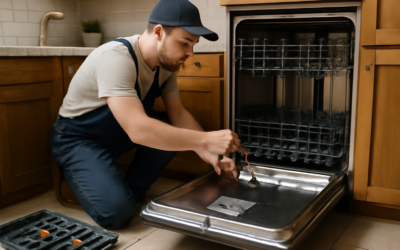
A Miele dishwasher repair is worth doing carefully because these are premium machines, most owners paid $1,200 to $2,500, and a good one lasts 20 years. When it stops draining, won’t start, or throws an F-code, the fix is often a $15 part and 30 minutes, not a $200 service call. This guide walks you through the most common Miele dishwasher repair jobs a homeowner can handle safely.
Before you touch anything internal: cut the power at the breaker or unplug the unit, and shut off the water supply valve under the sink. Miele machines hold a small pool of water in the sump by design, so keep a towel and shallow pan ready.
- Safety First: Power and Water Off
- Most Common Problem: Not Draining
- Reading Miele Fault Codes
- Dishwasher Won’t Start
- Poor Cleaning and Cloudy Glasses
- Common Miele Parts and Prices
- Leaking From the Door or Base
- Odor and Standing Water Between Cycles
- Draining the Machine Before Service
- When to Call a Technician
- Keep It Running for Two Decades
Safety First: Power and Water Off
Every repair below starts the same way. Kill the circuit at the breaker panel, don’t just rely on the control lock. Then close the hot-water supply valve feeding the dishwasher, usually under the sink where the braided line tees off. Miele’s inlet uses a Waterproof System (the WPS AquaStop valve) built into the hose, so you’ll be disconnecting at the valve, not mid-hose. Verify the machine is dead by confirming the display is dark before you pull any panel.
Most Common Problem: Not Draining
A Miele that finishes with an inch of gray water in the bottom is the single most frequent complaint, and it’s almost always one of four things. Work through them in this order because it goes cheapest and easiest first.
1. Clogged Filter
The triple filter sits in the floor of the tub. Twist the cylindrical filter counterclockwise and lift the whole assembly out. Miele’s design catches food, glass chips, and grease here. Rinse it under hot water, scrub the mesh with an old toothbrush, and clear the flat plastic microfilter underneath. A gummed-up filter starves the pump and mimics a drain failure. Clean it monthly and this problem often disappears on its own.
2. Blocked or Kinked Drain Hose
The drain hose runs from the pump to your sink drain or disposal. With power and water off, pull the machine out, check that the hose isn’t crushed behind it, and disconnect the lower end. Blow through it or run a wire; a slug of grease or a stuck olive pit is common. Miele recommends the hose loop rises to at least 24 inches to prevent backflow, so make sure it isn’t lying flat.
3. Garbage Disposal Knockout Plug
If you just installed a new disposal and the dishwasher won’t drain, this is your culprit almost every time. New disposals ship with a solid knockout plug in the dishwasher inlet nipple. Someone has to tap it out with a screwdriver and pull the plastic disc out of the disposal, or the drain hose is connected to a sealed dead end. Two minutes to check, and it fixes a “broken” machine that was never broken.
4. Clogged Drain Pump
If the filter, hose, and disposal are all clear, the drain pump impeller may be jammed. On most Miele models you remove the filter, then lift out the white pump cover in the sump floor. Look for a shard of glass, a fruit sticker, or a toothpick wedged in the impeller. Clear it by hand, spin the impeller to confirm it turns freely, and reassemble. A failed pump motor itself runs $80 to $180 for the part.
Reading Miele Fault Codes
Miele shows fault codes as an “F” followed by a number. A few you’ll actually see:
- F11 / F12: Water intake or drainage fault, points straight back to the filter, hose, and pump checks above.
- F14: Water intake pressure issue, check the inlet valve and supply pressure.
- F70: Water level sensor fault, often a clogged sump or float switch.
- F24: Heater circulation fault.
Codes reset when you fix the underlying cause and cycle the power. If a code returns immediately after clearing, the sensor or valve it points to likely needs replacement.
Dishwasher Won’t Start
If the display lights but nothing runs, check the door latch first, the machine won’t fill until the latch microswitch confirms the door is closed. A worn latch is a $20 to $40 part. Next, confirm the child lock isn’t engaged and that a delay-start timer wasn’t set by accident. If the display is completely dead, test the outlet with a known-good appliance; Miele’s electronics rarely fail before the door switch or a tripped breaker does.
Poor Cleaning and Cloudy Glasses
When dishes come out gritty, the spray arms are usually blocked. Pull the upper and lower spray arms (they unclip or unscrew by hand) and poke each jet clear with a toothpick. Hard-water scale is the other cause, run a Miele descaler or citric-acid cleaning cycle, and refill the salt reservoir and rinse aid. Cloudy glassware often means you’re out of dishwasher salt, which the water softener needs to function.
Common Miele Parts and Prices
- Triple filter assembly: $30-$60
- Drain pump: $80-$180
- Inlet valve / AquaStop hose: $90-$200
- Door latch/switch: $20-$50
- Circulation pump: $150-$300
- Spray arm: $25-$70
Order by your exact model and serial number, which are on the sticker along the right edge of the door. Miele part numbers change across generations, so the serial matters.
Leaking From the Door or Base
Water on the kitchen floor after a cycle usually traces to the door gasket or the base. Start with the door seal, run your finger around the rubber gasket and look for hardened spots, tears, or trapped debris. A tired gasket no longer compresses and lets water weep out the bottom corners; replacement runs $30 to $80 and presses into the channel by hand. If the leak is at the base, Miele’s models with the Waterproof System trip a float in the pan and cut the water when they sense a leak, which is why a leaking machine sometimes just refuses to run and shows a fault. In that case the leak is internal, a cracked sump, a loose hose clamp, or a failed pump seal, and it needs to be traced with the machine pulled out.
Odor and Standing Water Between Cycles
A little water sitting in the sump is normal, Miele keeps the seals wet on purpose. But a foul smell means food is decomposing somewhere the water isn’t reaching. Nine times out of ten it’s the filter and the sump area under it. Pull the triple filter, scrub the sump basin with a brush, and wipe the door edges and the underside of the bottom rack where scraps collect. Run a hot cleaning cycle with a Miele machine-care tablet. If the smell persists, check the drain hose loop, a hose that sags below the sink drain lets sewer gas creep back into the tub.
Draining the Machine Before Service
Any repair that involves the sump, pump, or filter goes smoother if you drain the standing water first. Run a rinse or drain-only cycle before you cut power so the pump clears most of the sump. Whatever’s left, an inch or so, sponge out with a cup and a towel once the machine is dead. Skipping this step means water pours out the second you loosen a hose clamp, and on a Miele the WPS float may need a full dry-out and reset before the machine will run again.
When to Call a Technician
Handle filters, hoses, spray arms, and the disposal plug yourself, they’re safe and cheap. Call a certified Miele technician for anything involving the main control board, the circulation pump motor, a leaking AquaStop valve, or a heater fault that keeps returning. A service call runs $120 to $200 before parts, but on a machine this expensive it’s worth protecting. If your dishwasher is under Miele’s warranty, don’t open sealed components yourself, you’ll void coverage.
Keep It Running for Two Decades
Most emergency calls are preventable. Clean the filter every month, run a descaling cycle quarterly, keep the salt and rinse-aid reservoirs topped off, and scrape plates before loading. Do that, and your Miele dishwasher repair needs will stay limited to the occasional filter rinse rather than a parts replacement. These machines reward maintenance, treat the sump and filter as routine upkeep and you’ll rarely see a fault code.