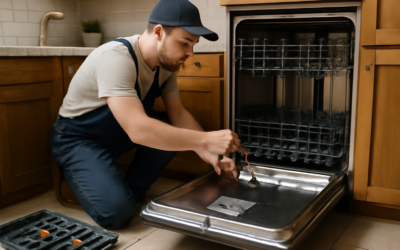
A Thermador dishwasher repair follows the same logic as any other machine, but these are premium, Bosch-built units with tighter tolerances and their own quirks. Before you diagnose a thing, cut power at the breaker or unplug the unit and shut off the water supply valve under the sink. Reaching into the sump with live power and standing water is how good repairs turn into bad ones.
Thermador and Bosch share the same parent company and much of the same engineering, so parts, error codes, and procedures overlap heavily. If you understand one, you largely understand both. Here’s how to work through the failures owners see most.
- Know Your Machine First
- When It Won’t Drain
- The Leak-Detection Pan and E15 Error
- Poor Cleaning and Drying
- Reading Thermador Error Codes
- Tracking Down Leaks
- When It Won’t Start or the Panel Is Dead
- Fill and Aquastop Problems
- Drying Problems in Depth
- Typical Parts and Costs
- When to Repair vs. Replace
- Spray Arm and Sump Cleaning
- Preventive Maintenance
Know Your Machine First
Find the model and serial number on the tub’s inner door edge. Thermador dishwashers, like Bosch, use a hidden bottom sump filter, a leak-detection pan, and often the StarDry condensation drying system rather than a heating element. Those design choices change how you troubleshoot, so identify your exact series before ordering any part.
When It Won’t Drain
Standing water at the end of a cycle is the most common complaint. Bail out the water with a cup, sponge the rest, and lay towels down. Then work in order:
- Filter cylinder: Twist out the round filter in the tub floor and rinse the mesh. On Thermador units this is fine and clogs fast with grease and food.
- Sump and pump cover: Under the filter is a white pump cover. Lift it and clear debris, glass, or a stuck check valve underneath. Never with power on.
- Drain hose: Trace the hose to the disposal or sink tailpiece and check for kinks and clogs.
- Disposal knockout: A newly installed garbage disposal with its knockout plug still in place blocks the dishwasher completely.
- Drain pump: With power off, spin the impeller. A hum with no water movement means a jammed or failed pump.
The Leak-Detection Pan and E15 Error
This is the classic Thermador and Bosch quirk. There’s a shallow plastic pan under the machine with a foam float and a switch. If any water drips into that base, the float rises, the switch trips, and the dishwasher throws an E15 error, runs its drain pump nonstop, and refuses to start.
To fix it: pull the machine out, tip it back gently, and remove the water from the base pan with a towel. Find and stop the actual drip first, usually a loose hose clamp, a cracked spray arm bearing, or a worn door seal, or the error returns. Once the pan is dry and the float drops, the error clears. Don’t just reset it and walk away; the leak will come back.
Poor Cleaning and Drying
If dishes come out gritty, check the spray arms for clogged nozzles, clean the fine filter, and confirm the sink water reaches 120°F before starting. A blocked spray arm or a scaled-up filter recirculates dirty water.
Drying complaints are different on Thermador. Many models use StarDry with a mineral called zeolite plus condensation drying instead of a hot element, and they rely on rinse aid. If plastics come out wet, refill the rinse-aid reservoir and select the extra-dry or Sanitize option. Skipping rinse aid is the single biggest cause of “it won’t dry” calls on these machines.
Reading Thermador Error Codes
These units display E-codes that pinpoint the fault:
- E15: water in the base pan, leak-detection triggered (see above).
- E24 / E25: drain fault, blocked filter, hose, or pump.
- E22: filter or water-return problem, clean the filter and sump.
- E09: heating element or flow-through heater fault.
- E01 to E05: control and electronic faults, often cleared by a power reset.
To reset, cut the breaker for five minutes, restore power, and start a rinse cycle. Clearing a phantom code after a power blip is often the whole repair.
Tracking Down Leaks
Because a leak trips the E15 lockout, finding the source matters more here than on most machines. Check the door gasket for cracks and hardening, the spray arm bearings for wear, and every hose clamp at the pump and inlet valve. A common culprit is the tub-to-pump seal or a hairline crack in the sump. Wipe everything dry, run a short cycle, and watch closely to catch the drip in the act.
When It Won’t Start or the Panel Is Dead
A Thermador that won’t begin a cycle sends you through a short checklist before you blame the electronics:
- Door not latched: these units are precise about the door switch. If the door isn’t seated firmly, the control won’t start. On panel-ready models, a heavy custom cabinet panel that’s misaligned can prevent full closure.
- Child lock: hold the lock button to disable it; a locked panel looks like a dead one.
- Power: check the breaker and the hardwire or plug connection, especially after a storm.
- Delay start or remaining-time display: confirm no delayed cycle is set.
- E15 lockout: if the base pan holds water, the machine refuses to start and runs the drain pump. Dry the pan and fix the leak first.
Fill and Aquastop Problems
If the cycle starts but no water enters, the Aquastop system is often involved. Thermador and Bosch use an Aquastop inlet hose with a valve at the faucet end and flood protection built in. A tripped Aquastop shuts off supply entirely, and once triggered it usually must be replaced rather than reset, running $60 to $150. Also confirm the supply valve under the sink is fully open and the inlet screen isn’t clogged with sediment, which is common in hard-water homes and starves the fill.
Drying Problems in Depth
Because Thermador leans on condensation drying and, on some models, the zeolite-based StarDry system rather than a hot exposed element, “wet dishes” complaints are usually about technique, not a failed part. Confirm the rinse-aid reservoir is filled and the dosage isn’t set to minimum, select the extra-dry or Sanitize option, and unload the bottom rack first so water pooled on upper items doesn’t drip down. Plastic items resist condensation drying and will always come out damper than glass and ceramic, which is normal for this drying method rather than a fault to repair.
Typical Parts and Costs
Thermador parts run pricier than mass-market brands, but many repairs are still DIY-friendly:
- Drain pump: $50 to $130
- Door gasket / seal: $25 to $60
- Water inlet valve / Aquastop hose: $60 to $150
- Circulation pump: $150 to $300
- Control module: $150 to $350
The Aquastop inlet hose has a built-in valve, so a leaking supply line often means replacing the whole hose assembly rather than just a washer.
When to Repair vs. Replace
Filters, hoses, gaskets, spray arms, and drain pumps are worth doing yourself. Given that Thermador dishwashers cost $1,500 to $3,000 new, repairing them makes financial sense far longer than a budget machine. Call a Thermador-authorized technician for control-board failures, circulation-pump replacement, or a leak you genuinely can’t find, especially while the unit is under warranty, since DIY work can void coverage.
Spray Arm and Sump Cleaning
Poor cleaning on a Thermador almost always traces to the spray arms or the sump, and both are easy to service. Pull the lower spray arm, which usually lifts or unclips, and the upper arm, then hold each up to the light and clear every nozzle hole with a toothpick or a thin wire. Hard-water scale and food fragments plug these tiny jets and rob the machine of pressure. While the arms are off, reach into the sump under the filter and clear any glass, seeds, or debris resting against the pump inlet. A ten-minute cleaning here restores cleaning performance more often than any replacement part, and it’s the first thing to try before ordering a circulation pump.
Preventive Maintenance
Keep these habits and you’ll rarely need a repair at all:
- Clean the filter every two to four weeks.
- Keep the rinse-aid reservoir filled for proper drying.
- Wipe the door gasket and leave the door ajar to dry between cycles.
- Run a monthly cleaning cycle with a dishwasher cleaner to fight scale, which is hard on these precision pumps.
- Scrape plates but skip aggressive pre-rinsing, since the sensors need some soil to gauge the cycle.
Handle any Thermador dishwasher repair in this order, power and water off, leak pan checked, filter and drain cleared, code read, cheapest fix first, and you’ll solve most problems without a service visit. Reassemble completely and confirm the base is dry before restoring power, then run a rinse cycle to verify.