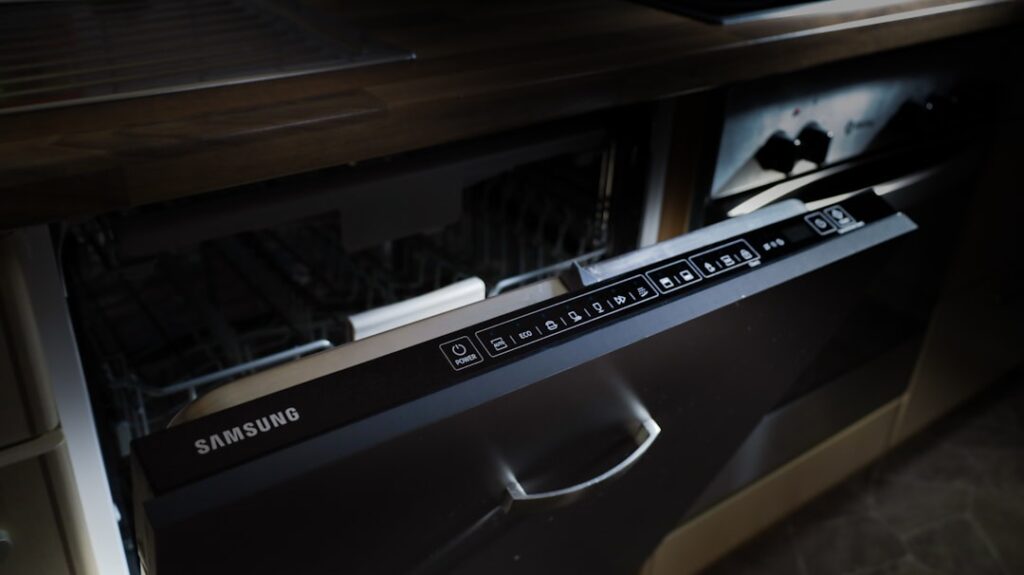
Most Samsung dishwasher repair jobs come down to five or six culprits, and you can knock out the majority of them at the kitchen counter with a Phillips screwdriver, a shop towel, and a flashlight. Before you spend $180 on a service call, know that a flashing error code or a bowl of standing water usually points to something as simple as a clogged filter or a kinked hose. This guide walks the fixes I actually use in the field.
- Kill Power and Water First
- Tools You’ll Want on Hand
- Read the Error Code Before You Wrench
- Samsung Dishwasher Won’t Drain (5C / 5E)
- No Power or Won’t Start
- Dishwasher Won’t Heat or Dry
- Not Cleaning or Not Filling (4C / 4E)
- Leaks and the LC Sensor
- Odd Noises and What They Mean
- Preventive Maintenance
- Parts, Prices, and Timelines
- When to Call a Pro
Kill Power and Water First
Every repair starts the same way. Pull the plug or flip the breaker — Samsung units draw on a dedicated 15-amp circuit, so it’s usually a single breaker in the panel. If the dishwasher is hardwired, shut off that breaker and confirm the control panel is dead before you touch anything. Then close the hot-water supply valve, which is almost always under the sink where the braided line tees off the faucet feed. Water and 120 volts are both waiting in that cabinet, and skipping this step is how people get hurt. Lay a towel down; there’s always a cup of water somewhere.
Tools You’ll Want on Hand
None of this requires a specialty kit. A #2 Phillips and a flat-head screwdriver cover nearly every fastener. Add a pair of channel-lock pliers for hose clamps, a small flashlight or headlamp, a multimeter if you plan to test switches and thermistors, and a shop towel plus a bucket for the water that always spills when you pull a hose. A quarter-inch nut driver speeds up the kickplate screws. Keep a Ziploc bag for screws so nothing rolls under the cabinet. That’s the whole loadout for 90% of Samsung dishwasher repair work.
Read the Error Code Before You Wrench
Samsung’s error codes tell you exactly where to look, so decode before you disassemble. These are the ones I see most:
- 4C or 4E — water supply fault. The unit isn’t filling. Check the supply valve, the inlet screen, and for a kinked fill hose.
- 5C or 5E — drain fault. Standing water it can’t pump out. Filter, drain hose, or drain pump.
- LC or LE (or 1E on newer models) — leak detected. The Waterwall or base pan sensor tripped. Look for a real leak before assuming a bad sensor.
- OC or oE — overfill. Usually a stuck float or a drain problem letting water back up.
- tC or 3C — thermistor/temperature sensor fault.
- bE or 6E — a button is stuck on the panel.
Write the code down, then reset by holding Start for 3 seconds or cutting power for 5 minutes. If it clears and stays cleared, you got lucky. If it comes back, chase the specific fault below.
Samsung Dishwasher Won’t Drain (5C / 5E)
This is the single most common call. Standing water in the bottom and a 5C code means the pump can’t clear the tub. Work it in this order:
- Clean the filter. Twist out the cylindrical filter assembly at the bottom center — quarter turn counterclockwise — and rinse the mesh under hot water. A single olive pit or a wad of label paper will block it. Do this first, every time.
- Check the drain hose. Pull the kickplate and inspect where the corrugated hose runs to the disposal or standpipe. Kinks behind the unit are common after someone slides it back into the cabinet.
- Confirm the disposal knockout plug is gone. If a new garbage disposal was installed and the dishwasher never drained since, the molded plug in the disposal inlet is still in place. Knock it out with a screwdriver and pull the plastic disc — it’s a coin-sized piece that will float away and clog you again if you drop it.
- Clear the drain pump. After removing the filter, look down into the sump. Glass shards and toothpicks jam the impeller. Rotate it by hand with the power off.
Nine times out of ten the water is gone before you touch the pump itself.
No Power or Won’t Start
A dead panel isn’t always a dead board. Confirm the breaker, then check the door latch — Samsung won’t run with the door even slightly ajar, and a warped latch or a full lower rack blocking the door will read as “no power” to the user. If the panel lights but the cycle won’t launch, you may have Child Lock or Delay Start engaged; hold the two buttons marked with the lock icon for 3 seconds. Persistent no-power after the breaker checks out points to the door latch switch or, less often, the main control board (part numbers in the DD82 series on many models). A board runs $90 to $160.
One overlooked cause: a tripped GFCI. If your dishwasher shares a circuit with a countertop or garage outlet, a tripped GFCI upstream kills the unit while the breaker still looks fine. Walk the nearby outlets and press any reset button before you assume the worst.
Dishwasher Won’t Heat or Dry
Cold, wet dishes at the end of the cycle usually mean the heating element or its circuit. Samsung condensation-dry models rely on a final hot rinse and residual heat rather than an exposed element, so first confirm your incoming water is actually hot — run the kitchen faucet until it’s hot before starting a cycle so the dishwasher isn’t fighting a slug of cold water in the line. A tC or 3C thermistor code points to the temperature sensor giving the board bad readings; it’s an inexpensive part, usually under $30, mounted in the sump. If the water heats but dishes stay wet, add a rinse aid — the drying performance on these units drops off sharply with an empty rinse-aid reservoir. Check that first before condemning any part.
Not Cleaning or Not Filling (4C / 4E)
Dishes coming out gritty is usually spray, not soap. Pull both spray arms — they lift and unclip by hand — and poke a toothpick through each nozzle. Hard-water scale plugs them over time. Run an empty hot cycle with two cups of white vinegar in a bowl on the top rack once a month if you’re on well water. A 4C fill fault means water isn’t getting in: verify the supply valve is fully open, then unscrew the fill hose at the inlet and clean the small screen where it meets the valve. Sediment collects there and starves the fill.
Leaks and the LC Sensor
An LC/LE code fires when the leak sensor in the base pan gets wet. Sometimes it’s a phantom trip from a past overfill that left residual moisture; tip the unit back gently and let the pan dry for a few hours, then retest. If it’s a genuine leak, the usual suspects are the door gasket (rinse the fold, it traps gunk that breaks the seal), the spray-arm seal, or a loose hose clamp. Don’t just disconnect the sensor to silence the code — that pan fills for a reason, and you’ll warp your floor.
Odd Noises and What They Mean
Sound is a useful diagnostic. A grinding or buzzing during the wash phase is almost always a foreign object in the chopper or circulation pump — glass, a cherry pit, or a bit of bone. Pull the filter and lower spray arm and inspect the sump. A rhythmic knocking is usually a spray arm hitting a tall pan or utensil; rearrange the load. A loud hum with no water movement during drain is a jammed drain pump, not a dead one — clear the impeller before buying parts. A high-pitched whine that comes and goes points to a bearing starting to fail in the circulation motor, which is a bigger job worth pricing against replacement.
Preventive Maintenance
Most repairs I get called for are preventable. Pull and rinse the filter every two to four weeks — it’s a 60-second job that heads off the most common drain fault. Once a month, run an empty hot cycle with a Samsung-approved dishwasher cleaner or two cups of white vinegar to cut grease and dissolve hard-water scale on the spray arms. Wipe the door gasket and the fold beneath it, where food and mold collect and eventually break the seal. Leave the door cracked open between cycles so the interior dries and doesn’t grow mildew. Do these three things and you’ll stretch years out of the machine before any real Samsung dishwasher repair comes due.
Parts, Prices, and Timelines
Keep expectations realistic on cost. A drain pump for most Samsung models runs $40 to $75 and takes about 45 minutes with the unit pulled out. A door gasket is $25 to $50. A leak sensor is under $30. The main control board is the expensive one at $90 to $160, and I’d get a second opinion before replacing it — boards are blamed far more often than they fail. Have your model number ready (it’s on the tub edge behind the door) so you order the exact part.
When to Call a Pro
Honest advice: if the tub itself is cracked, if you smell burning from the motor, or if a leak persists after you’ve replaced the obvious seals, stop. A professional Samsung dishwasher repair on a control board or circulation pump runs $150 to $350 installed. On a unit older than eight years, weigh that against a new dishwasher in the $500 to $800 range — sometimes replacement is the smarter money. For everything else in this guide, an afternoon and $50 in parts will get you back to washing dishes.