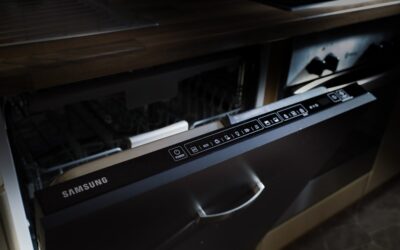
Most Samsung dishwasher repairs come down to a small, cheap part and an afternoon, not a new appliance. Learning which Samsung dishwasher parts fail, what the error codes mean, and how to replace them keeps hundreds of dollars in your pocket. These machines throw helpful diagnostic codes, which is a real advantage, but the codes only point you in the right direction if you know how to read them.
Every repair starts the same way, no exceptions. Cut the electrical power, then shut the water off. Unplug the unit or flip the breaker for the kitchen circuit, and turn the supply valve under the sink clockwise until it stops. Confirm the control panel is dead before you remove a single screw. Live current and standing water sit close together in these units, so this step protects both you and your floor.
- Power Off, Water Off, Every Time
- Reading Samsung Error Codes First
- Not Draining: Filter, Hose, Then Pump
- Leaks and the LC Error
- Spray Arms and Dirty Dishes
- Door Latch, Water Inlet Valve, and Heating
- Matching the Right Part Number
- Racks, Rollers, and Small Parts
- Basic Tools for the Job
- When to Stop and Call Someone
Power Off, Water Off, Every Time
Samsung dishwashers are usually hardwired to a junction box behind the toe kick or plugged into an outlet in the neighboring sink cabinet. If you cannot find a plug, treat it as hardwired and use the breaker. The water shutoff is the small valve on the hot line feeding the unit. Once both are off, keep a towel and a low pan ready, because the sump and hoses hold a cup or two of water that spills the moment you open them.
Reading Samsung Error Codes First
Before you buy anything, let the machine tell you what is wrong. A few codes cover most calls I get.
- 4C or 4E: Water supply problem. Check that the valve is open, the inlet hose is not kinked, and the inlet screen is not scaled shut.
- 5C or 5E: Drain problem. Points you straight at the filter, drain hose, or drain pump.
- LC or LE: Leak detected. The base tray float has tripped; there is water in the pan under the tub.
- OC or 0C: Overfill, usually a stuck float or a failing drain path.
These codes narrow the job from “the dishwasher is broken” to a specific system, which saves you from ordering the wrong Samsung dishwasher parts.
Not Draining: Filter, Hose, Then Pump
A 5C or 5E code, or just standing water in the sump, means the drain path is blocked. Work it in order. Twist out the bottom filter assembly by hand, rinse it under hot water, and scrub the mesh with a toothbrush; a clogged filter is the single most common cause and it is free to fix. Clear any glass or food from the sump while you are there.
Next, check the drain hose for a kink or clog, especially where it connects to the disposal or the sink drain. If you added a garbage disposal recently, make sure the interior knockout plug was punched out, because that blocks the dishwasher completely. If the path is clear and water still sits, the drain pump has failed. Samsung drain pumps typically twist into the sump and run $35 to $80. Tip the machine back, access the pump from below, unclip the wiring harness, swap it, and reseat. Give yourself an hour the first time.
Leaks and the LC Error
An LC or LE code means the leak sensor in the base pan has gotten wet. Do not just reset it and hope; find the water. Pull the machine out with power and water already off, and look underneath. The usual culprits are a loose or cracked hose clamp, a worn pump housing gasket, or the door gasket letting water past the front.
The door gasket, the rubber seal around the tub opening, stiffens with age and stops sealing; replacements run $20 to $50 and press into a channel. Soak a new one in warm water so it seats. Sometimes the leak sensor itself fails and reports water that is not there; that part is inexpensive but only replace it after you have confirmed the pan is genuinely dry.
Spray Arms and Dirty Dishes
Dishes coming out gritty usually means clogged spray arm jets, not a broken machine. Both Samsung spray arms detach easily, the lower one lifts off and the upper one unclips or unscrews. Hold each up to the light and clear every nozzle with a toothpick, then flush under the tap. Mineral scale and food seeds are the typical offenders.
If an arm is cracked, it sprays at the wrong angle and half the rack stays dirty. Replacement spray arms run roughly $20 to $50 and clip in without tools. Check the bearing that lets the arm spin, too, since a gummed bearing stops rotation and leaves one zone unwashed.
Door Latch, Water Inlet Valve, and Heating
If the dishwasher will not start but has power, the door latch switch may not register the door as closed. The latch assembly is a cheap part, $15 to $40, reached by removing the inner door panel screws. Test it for continuity with a multimeter before buying if you can.
A 4C or 4E fill code that persists after you confirm the supply is open usually means the water inlet valve is scaled or failed. That valve sits at the bottom front behind the kick panel, runs $25 to $60, and is a straightforward swap with the water already off. If dishes come out cold and wet, the heating element or its relay on the control board is the suspect; the element is testable for continuity and moderately priced, but board-level failures push you toward calling a pro.
Matching the Right Part Number
Find your model number on the sticker inside the door edge, something like DW80R followed by a suffix, and match that full string against the manufacturer’s parts diagram. Parts that look identical often mount differently between models, so the exact match, suffix included, is what prevents a return.
- Filter assembly: $20 to $45
- Drain pump: $35 to $80
- Spray arm: $20 to $50
- Door gasket: $20 to $50
- Water inlet valve: $25 to $60
- Door latch: $15 to $40
Racks, Rollers, and Small Parts
Beyond the major systems, the parts that wear out first on an older Samsung are the rack components. Lower-rack rollers crack and let the rack derail, and the adjustable upper-rack sliders that raise and lower the top basket seize or snap. Roller kits run $10 to $25 and clip on without tools; the upper-rack adjuster assemblies run $20 to $45 and are sold as left and right pieces, so check which side you need against the diagram. The fold-down tines are cheap molded parts sold by position too.
The detergent dispenser deserves a look if dishes come out dirty but everything else checks out. When the wax motor that pops the dispenser door fails, detergent releases at the wrong time or not at all. A dispenser assembly runs $30 to $65 and mounts behind the inner door panel, the same screws you pull for the door latch, so tackle both together while the door is apart.
Basic Tools for the Job
None of this needs specialty gear. A Phillips screwdriver, a T15 or T20 Torx bit, a nut driver, pliers, and a multimeter handle almost every Samsung repair. The meter is the one tool I insist on, because checking a latch switch, inlet valve solenoid, heating element, or pump winding for continuity confirms the failure before you spend a dime. That habit is what keeps you from ordering the wrong Samsung dishwasher parts and waiting a week for a return. Hang on to the model’s install sheet for the harness routing when you put it back together.
When to Stop and Call Someone
Filters, pumps, spray arms, gaskets, latches, and inlet valves are all fair game for a careful DIYer with the correct Samsung dishwasher parts. Where I draw the line is the main control board and any code that keeps returning after you replace the obvious component. A $200-plus board on a machine older than eight years rarely justifies itself against a new unit. For everything else, shut off the power and water, read the code, and fix the one part that is actually failing.