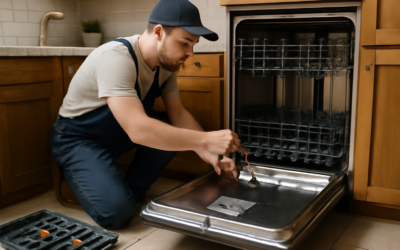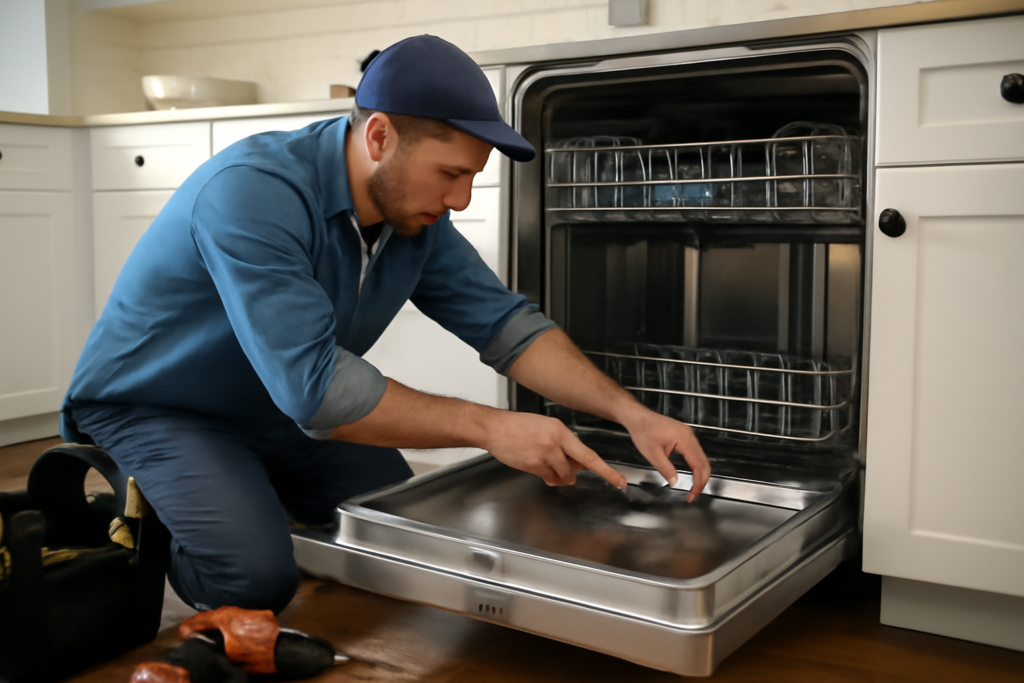
Most Maytag dishwasher repair jobs come down to a handful of predictable failures: it won’t drain, it won’t clean, it leaks, or it flashes a code and quits mid-cycle. Before you diagnose anything, switch off the breaker or unplug the unit and shut the water supply valve under the sink. Water and live electronics don’t mix, and half these fixes involve reaching into the sump.
Maytag machines are built by Whirlpool, so parts and procedures overlap with Whirlpool, KitchenAid, and Amana. That’s good news for you: parts are cheap and widely stocked. Here’s how a seasoned repair tech works through the common complaints.
- Start With the Model Number and the Symptom
- Fixing a Maytag That Won’t Drain
- Fixing Poor Cleaning
- Chasing Down Leaks
- Reading Maytag Error Codes
- Fixing a Dishwasher That Won’t Start
- When It Won’t Fill With Water
- Dealing With Odors and Hard-Water Buildup
- Common Parts and What They Cost
- The Reset Every Maytag Owner Should Know
- When to Call a Professional
- Preventing the Next Breakdown
Start With the Model Number and the Symptom
Open the door and find the sticker on the tub edge or the left side jamb. That model number is your key to the right filter, pump, and control board. Then pin down the exact symptom, because “it’s broken” covers a dozen different repairs. Note error codes, whether the motor hums, whether water fills at all, and where any leak appears.
Fixing a Maytag That Won’t Drain
Standing water after a cycle is the most common call. Bail out the water with a cup and sponge, then work this order:
- Filter: Pull the lower rack, twist out the cylindrical filter at the sump, and clean the mesh. Grease and glass collect here and choke the drain.
- Drain hose: Check the corrugated hose from the pump to the disposal or sink tailpiece for kinks and clogs.
- Disposal knockout: If a new garbage disposal was installed and never had its dishwasher knockout plug punched out, the machine can’t drain.
- Air gap: Clean the chrome cylinder on the sink deck; it clogs with food debris.
- Drain pump: With power off, spin the impeller. A jammed or dead pump won’t move water and usually needs replacing.
Ninety percent of no-drain problems are solved by the filter, hose, or disposal, none of which cost a dime.
Fixing Poor Cleaning
When dishes come out gritty or spotted, water isn’t spraying where it should. Check these in sequence:
- Spray arms: Pull the lower and upper arms and clear the tiny nozzle holes with a toothpick. Hard-water scale and food plug them.
- Chopper and filter: A clogged filter recirculates dirty water. Clean it every few weeks.
- Water temperature: Dishwashers need 120°F water. Run the sink hot before starting, and check that the heating element isn’t burned out.
- Wash pump / impeller: If the arms don’t spin, the wash motor or a stuck check valve may be the cause.
- Detergent and rinse aid: Old detergent clumps and won’t dissolve; refill the rinse-aid dispenser to cut spotting.
Chasing Down Leaks
Water on the floor has a short list of suspects. Look first at the door gasket, the rubber seal around the tub opening. Wipe it clean and check for cracks or hardened spots; a replacement seal costs $15 to $40 and presses into a channel. Next check the door latch and hinges, since a door that doesn’t close square will weep at the bottom corners.
Underneath, inspect the hose clamps at the pump and the fill valve. A slow drip at a clamp is an easy tighten. A leak from the pump body itself usually means a failed seal and a new pump. Overfilling that spills out the door often traces to a stuck float switch or a faulty water inlet valve letting in too much water.
Reading Maytag Error Codes
Maytag control panels blink or display codes that narrow the problem fast. A few common ones:
- Blinking clean light / F8 E4: water fill or flow fault, often the inlet valve or float.
- F9 E1: long drain, meaning the water isn’t leaving in time. Go straight to the drain checklist above.
- F2 E2: user-interface control fault.
- F6 E4: flood or overflow detected. The overfill switch tripped.
To clear a stuck code, cut power at the breaker for five minutes, restore it, and run a rinse cycle. A hard reset resolves a surprising number of one-time control glitches.
Fixing a Dishwasher That Won’t Start
A dead panel or a machine that won’t begin a cycle is its own troubleshooting path. Work through these before assuming the control board is toast:
- Power: confirm the breaker isn’t tripped and, for hardwired units, that the junction-box connection is tight. A surge can trip the breaker.
- Door latch: the machine won’t run if it doesn’t sense the door is fully closed. A worn latch or a failed door switch is a common no-start cause.
- Control lock: Maytag panels have a child-lock feature that disables the buttons. Hold the lock button for a few seconds to clear it.
- Delay-start: confirm you didn’t accidentally set a delayed cycle.
- Thermal fuse: a blown thermal fuse on the control board kills power to the panel and is a cheap fix if you’re comfortable with a multimeter.
When It Won’t Fill With Water
If the cycle starts but no water enters, the problem is upstream. First confirm the water supply valve under the sink is open, since it gets bumped closed during other repairs. Then suspect the water inlet valve, the solenoid that lets water into the tub. A clogged inlet screen or a failed solenoid stops the fill; the valve runs $25 to $60 to replace. A stuck-open float or a tripped overfill switch can also fool the control into thinking the tub is already full, so check that the float in the tub floor moves freely.
Dealing With Odors and Hard-Water Buildup
Not every Maytag repair is mechanical. A machine that smells like a swamp usually has a filthy filter and grease coating the sump and hoses. Pull and scrub the filter, then run an empty hot cycle with two cups of white vinegar in a bowl on the top rack, followed by a rinse with a cup of baking soda sprinkled on the tub floor. In hard-water areas, white scale builds on the heating element and spray arms and hurts both cleaning and drying. A monthly cleaning cycle with a dishwasher descaler keeps scale off the pump and element, which are the expensive parts to replace.
Common Parts and What They Cost
Keeping expectations realistic helps you decide whether to repair or replace. Typical DIY part prices:
- Drain pump: $30 to $90
- Water inlet valve: $25 to $60
- Door gasket: $15 to $40
- Wash pump / circulation motor: $80 to $180
- Heating element: $25 to $70
- Control board: $100 to $250
Match every part to your model number. A pump for one Maytag series won’t seal correctly in another, and mismatched parts cause the very leaks you’re trying to fix.
The Reset Every Maytag Owner Should Know
Before ordering parts, try the factory reset. On many models, press the buttons in a Heated Dry, Normal, Heated Dry, Normal sequence within a few seconds; on others, simply cutting the breaker for five minutes does it. A reset re-syncs the control board and clears phantom faults after a power surge, which is the cheapest Maytag dishwasher repair there is.
When to Call a Professional
Do it yourself for filters, hoses, spray arms, gaskets, and pumps. Bring in a licensed appliance tech when you’re dealing with control-board replacement, wiring damage, or a leak you can’t locate. On a machine older than 10 years, weigh a $250-plus repair against a new dishwasher starting around $500. If two major components have already failed, replacement usually wins.
Preventing the Next Breakdown
Most repairs are preventable with small habits:
- Scrape plates of big scraps; skip heavy pre-rinsing but keep bones and paper out.
- Clean the filter every two to four weeks.
- Run an empty vinegar cycle monthly to cut grease and scale.
- Leave the door cracked after cycles so the gasket dries and doesn’t mildew.
Approach any Maytag dishwasher repair methodically, power and water off first, symptom identified, cheapest fix tested before the expensive one, and you’ll handle the vast majority of failures without paying for a service call. Reassemble fully and dry before restoring power, then run a short cycle to confirm the fix.