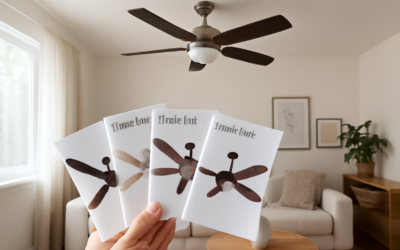
Sleek, sculptural, and built for large rooms, the Minka Aire Light Wave ceiling fan F845 is a designer statement piece that pairs a curved, contemporary look with serious air-moving performance. If you’re weighing it for a great room, primary bedroom, or covered patio, it helps to understand the specifications, the motor technology, the sizing, and the installation quirks before you commit. This guide covers what you get, how it performs, and whether it earns its premium price.
Design and First Impressions
The Light Wave stands out for its blade design. Instead of flat paddles, it uses gently curved blades that give the fan a soft, wave-like silhouette, hence the name. The look is modern and architectural, the kind of fixture that reads as intentional design rather than a purely functional appliance. It comes in finishes that suit contemporary interiors, and its clean lines flatter minimalist and transitional spaces.
At a substantial blade span, this is a large-room fan. That scale is central to its appeal and also its main constraint, because it overwhelms small bedrooms and needs adequate ceiling height and floor area to look and perform its best.
Motor and Performance
Minka Aire equips this fan with a DC motor, and that choice matters. DC motors draw significantly less power than traditional AC motors, often 60 to 70 percent less, while delivering strong airflow. They also run quieter and offer more speed settings, typically six forward speeds plus a reverse function for winter circulation.
The reverse mode is worth understanding. In summer, the fan spins to push air down and create a cooling breeze. In winter, reversing the direction gently pulls air up and redistributes warm air trapped near the ceiling, which can trim heating costs in rooms with tall ceilings. The multiple speeds let you fine-tune between a barely-there whisper and a strong breeze.
Key Specifications at a Glance
- Motor: Energy-efficient DC motor with multiple speed settings.
- Control: Handheld remote included, with reverse and speed control.
- Blade design: Signature curved, wave-profile blades.
- Room size: Best suited to large rooms given its wide span.
- Mounting: Downrod mount for standard-to-tall ceilings.
- Airflow direction: Reversible for year-round use.
Always confirm the exact blade span, downrod length, and any light kit compatibility against the current spec sheet for the F845, since manufacturers occasionally revise finishes and included accessories.
Sizing the Fan to Your Room
Getting the size right is the difference between a fan that looks balanced and one that dominates or disappears. As a general rule, a large fan like this suits rooms of roughly 400 square feet or more. In a great room, open-concept living space, or oversized primary bedroom, the wide blade span moves air effectively across the whole area.
Ceiling height matters just as much. Blades should hang at least 7 feet above the floor for safety and ideally 8 to 9 feet for optimal airflow. On a standard 8-foot ceiling you’ll want the shortest downrod, while vaulted ceilings call for a longer downrod to bring the fan down into the occupied zone where you’ll actually feel the breeze.
Installation Considerations
Because this is a large, heavier fan, installation is more involved than a small bedroom unit. The electrical box in the ceiling must be a fan-rated box securely fastened to structure, not a standard lightweight box, to safely carry the weight and handle the motion. If your box isn’t fan-rated, replacing it is a required first step.
The general process involves mounting the bracket, hanging the motor via the downrod and ball joint, wiring the fan and any light kit, attaching the blades, and pairing the remote. DC fans include a control module that must be wired correctly. If you’re comfortable with basic electrical work and the box is already rated, a confident DIYer can handle it in a couple of hours. If you’re unsure about the box or wiring, hiring an electrician is money well spent given the fan’s size and cost.
Living With the Fan
Owners of DC Minka Aire fans generally praise how quiet they run and how much air they move on the lower settings. The remote makes daily use convenient, and the multiple speeds mean you rarely need the top setting. The reverse function is a genuine, if underused, energy-saver in winter.
Maintenance is minimal. Dust the blades periodically with a microfiber cloth or a dedicated fan duster, and check that the mounting hardware stays snug over time, since any large fan generates vibration. Keep the remote’s battery fresh, and if the fan ever stops responding, a battery swap or a power-cycle re-pair usually restores control.
Is It Worth the Price?
Minka Aire sits in the premium designer tier, and the Light Wave carries a price to match, typically well above builder-grade fans. What you’re paying for is the DC motor efficiency, the quiet operation, the multi-speed remote, and above all the distinctive curved-blade design. For a showcase room where the fan is part of the decor, that combination justifies the cost for many buyers.
If you just need to move air in a small or utilitarian space, a basic fan does the job for far less. But in a large, design-forward room where you want a fixture that performs quietly and looks intentional, the F845 delivers on both fronts. Match it to a big enough space, mount it on a proper fan-rated box, and it becomes a comfortable, efficient centerpiece.
DC Motors Versus Traditional AC Fans
Understanding why the DC motor matters helps justify the fan’s price. Traditional ceiling fans use AC motors that connect directly to household current and typically offer three speeds via a pull chain or basic control. DC motors, by contrast, convert the incoming power and run more efficiently, drawing a fraction of the wattage to move the same amount of air.
The practical benefits stack up: lower energy use, notably quieter operation with less of the hum some AC fans produce, more speed increments for finer control, and a lighter motor housing that allows sleeker designs. The trade-offs are a higher purchase price and a control module that must function for the fan to run, so if a DC fan ever fails, the culprit is often the receiver or module rather than the motor itself. For a fan you’ll run daily in a large room, the efficiency and quiet usually justify the premium over its operating life.
Troubleshooting Common Issues
Like any remote-controlled fan, the F845 can occasionally stop responding, and the fixes are usually simple. If the fan ignores the remote, start with the handheld’s battery and confirm the wall switch feeding the fan is on. A power-cycle re-pair, cutting power for ten seconds and restoring it, often resyncs the remote with the receiver after an outage.
If the fan runs but wobbles, check that all blades are tightly fastened and that the mounting is secure on a fan-rated box, since a large fan magnifies any imbalance. A slight wobble can sometimes be corrected with a blade-balancing kit. Should the fan stop entirely despite good power and a fresh battery, the DC control module or receiver is the most likely suspect, and Minka Aire’s customer support can supply the correct replacement part for the F845.
Frequently Asked Questions
What size room does the F845 suit?
Its wide blade span makes it best for large rooms of roughly 400 square feet or more, such as great rooms and oversized bedrooms. It would overpower a small bedroom or bathroom.
Does the Light Wave fan use a DC motor?
Yes. The DC motor draws far less power than a traditional AC motor, runs quietly, and offers multiple speeds plus a reversible direction for year-round use.
Can I install it myself?
A confident DIYer can, provided the ceiling has a fan-rated electrical box securely mounted to structure. Because it’s a large, heavier fan, hire an electrician if you’re unsure about the box or wiring.
The Minka Aire Light Wave ceiling fan F845 combines an efficient DC motor, quiet multi-speed operation, and a striking curved-blade design into a premium fixture built for large rooms. Size it to a generous space, hang it on a fan-rated box at the right height, and you get a fan that cools quietly in summer, circulates warmth in winter, and looks like part of the architecture.