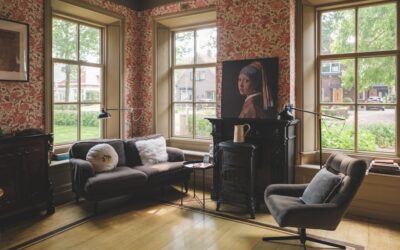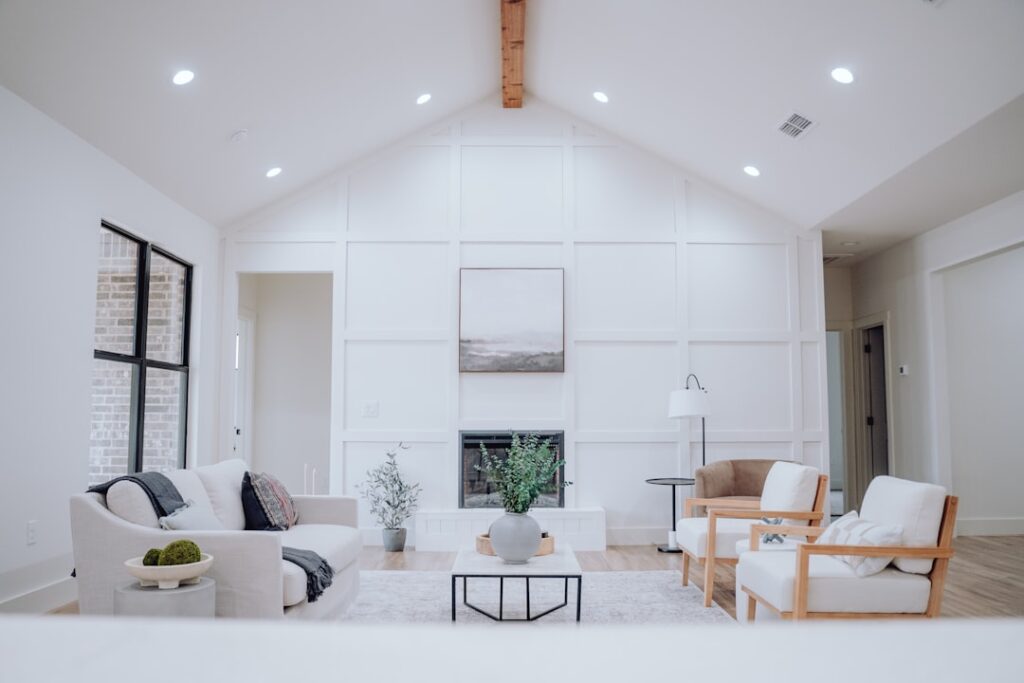
Builder white overhead is a habit, not a rule, and choosing a modern ceiling paint color is the fastest way to make a plain room look designed. I’ve rolled ceilings for twenty years, and the ones people remember are almost never bright white. The right modern ceiling paint color pulls a room together, hides ductwork shadows, and costs the same as the flat white you were going to slap up anyway.
Part of our Paint & Walls guide — explore the full guide →
- Why the Ceiling Deserves Better Than Flat White
- Soft Whites and Warm Off-Whites
- Moody Dark Ceilings for Drama
- Color-Drenched Rooms
- Sky and Pale Color Ceilings
- Choosing the Right Sheen Overhead
- What It Costs and How Much You Need
- Application Tips From the Truck
- Matching the Ceiling to Your Room
- Ceilings by Room
- The Bottom Line
Why the Ceiling Deserves Better Than Flat White
Designers call the ceiling the “fifth wall” for a reason. It’s roughly the same square footage as your biggest wall, and it reflects light down onto everything below. A dead-flat white ceiling reads as an afterthought, and in rooms with recessed cans it can look chalky and gray in the corners where the light falls off.
Color up there does real work. A warm tone softens harsh LED downlights. A deep shade lowers a too-tall ceiling and makes a big room feel like a den. And a color that echoes your wall, just lighter, makes an 8-foot ceiling feel taller because your eye stops registering where the wall ends.
Soft Whites and Warm Off-Whites
If you want modern without commitment, drop the stark white and go one notch warmer. These read clean but not clinical, and they’re forgiving on older plaster.
- Sherwin-Williams Alabaster (SW 7008) — LRV 82, a creamy soft white with the faintest warm undertone. It’s the most-used ceiling white I keep on the truck.
- Benjamin Moore White Dove (OC-17) — LRV 85, warm with a whisper of gray so it never goes yellow under LEDs.
- Sherwin-Williams Pure White (SW 7005) — LRV 84, a crisp neutral white for anyone who still wants “white” but not blue-white.
Pro move: paint the ceiling one shade lighter than the walls in the same color family. If your walls are Alabaster, thin the ceiling perception by keeping it Alabaster too, or step to a brighter white. The subtle blend erases the wall-to-ceiling line.
Moody Dark Ceilings for Drama
Dark ceilings are the trend that refuses to leave, and for good reason. In a dining room, powder room, or bedroom, a deep ceiling turns an ordinary box into something intimate. You need at least 8-foot ceilings to pull it off comfortably, but I’ve done 7.5-foot bedrooms in charcoal and clients loved the cave-like calm.
- Benjamin Moore Hale Navy (HC-154) — LRV 6, a classic deep blue that reads black in low light and navy in daylight.
- Sherwin-Williams Iron Ore (SW 7069) — LRV 6, a soft near-black with warm undertones. Gorgeous over white walls and brass fixtures.
- Benjamin Moore Kendall Charcoal (HC-166) — LRV 12, a smoky gray that’s dark enough to feel modern but not funeral-dark.
Two rules for dark ceilings. First, keep the trim and walls light so the ceiling reads as an intentional feature, not a mistake. Second, add light — a dark ceiling eats it. Plan for two or three lamps or a fixture with 800-plus lumens per bulb.
Color-Drenched Rooms
“Color drenching” means running one shade across walls, ceiling, and trim. It’s the most current look in paint right now, and it’s shockingly easy because you stop cutting in clean lines at the ceiling. Everything is one color, so brush overlap doesn’t matter.
Muted, dusty tones work best drenched. Try Sherwin-Williams Evergreen Fog (SW 9130), a gray-green with LRV 30, or Benjamin Moore Cushing Green (HC-125), a soft sage at LRV 27. A drenched room in a dusty blue like Benjamin Moore Van Deusen Blue (HC-156) feels enveloping without going full dark. Use the same color in different sheens if you want subtle contrast — matte on the ceiling, eggshell on the walls, satin on the trim.
Sky and Pale Color Ceilings
Not ready for drama? A barely-there color overhead adds warmth you feel more than see. This is where “haint blue” porch ceilings come from, and the idea translates indoors beautifully.
- Benjamin Moore Palladian Blue (HC-144) — LRV 61, a pale blue-green that makes a bathroom or bedroom feel like a spa.
- Sherwin-Williams Rainwashed (SW 6211) — LRV 61, a soft aqua-gray, calming over a white bathroom.
- Benjamin Moore Gray Owl (OC-52) — LRV 65, a light warm-gray that reads as “not quite white” and hides imperfections in older ceilings.
Choosing the Right Sheen Overhead
Sheen matters more on ceilings than anywhere else because raking light from windows and fixtures will expose every roller mark and drywall flaw a shiny finish reflects.
- Flat / matte — the default for 90% of ceilings. It hides taping seams, nail pops, and roller lap marks.
- Eggshell — only for a color-drenched room where you want the ceiling to catch a little light, and only if the drywall is smooth.
- Satin or semi-gloss — reserve for bathroom and kitchen ceilings where moisture and grease demand a scrubbable, mildew-resistant finish.
Never use a high-sheen paint to try to brighten a room. Gloss overhead just spotlights every imperfection and creates glare from your ceiling lights.
What It Costs and How Much You Need
A gallon of quality ceiling or wall paint covers about 350–400 square feet per coat. A typical 12-by-14-foot room has a 168-square-foot ceiling, so one gallon does two coats with paint to spare. Budget paint runs $25–$35 a gallon; better lines like Sherwin-Williams Emerald or Benjamin Moore Aura run $60–$90.
For dark ceilings, tint your primer gray and plan on two finish coats — deep bases need the extra coverage. A pint of accent color and a mini roller lets you sample a 2-by-2-foot patch first. Dry time is usually one hour to touch and two to four hours to recoat, but wait the full recoat window or you’ll pull the first coat right off.
Application Tips From the Truck
Roll ceilings with a 3/8-inch nap on smooth drywall or a 1/2-inch nap on light texture, and keep a wet edge — work in 4-by-4-foot sections and always roll toward the last stroke so laps blend. Cut in the perimeter with a 2.5-inch angled brush right before you roll each wall’s edge, not the whole room at once, so the cut line stays wet when the roller reaches it.
For a color-drenched room, spray if you can rent an airless — brushing trim, walls, and ceiling in one color by hand is a long day. And always box your paint: pour every gallon into one 5-gallon bucket and stir, so color stays consistent from the first wall to the last corner of the ceiling.
Matching the Ceiling to Your Room
The ceiling color that stuns in a photo can flop in your actual space, so match the shade to what the room is doing. Low ceilings under 8 feet? Stay light — a bright white or a pale tint keeps the room from feeling like it’s pressing down on you. Tall ceilings over 10 feet can take a dark color that visually lowers the space and makes a cavernous great room feel human-scaled.
Consider the walls, too. A dark ceiling over dark walls swallows the room; you want contrast so the eye reads the ceiling as intentional. Over white or pale walls, a charcoal or navy ceiling looks crisp and architectural. And factor in the light — a north-facing room with cool light makes a gray ceiling read icy, so warm it up, while a south-facing room floods with warm light that can push a beige ceiling toward yellow.
Ceilings by Room
- Bedroom — the best room for a moody ceiling. A deep charcoal or navy overhead makes the space feel like a cocoon and helps you wind down.
- Bathroom — a pale spa blue or soft aqua-gray in a satin or semi-gloss handles moisture and feels like a retreat.
- Dining room — go bold. A color-drenched dining room in dusty green or a deep blue ceiling turns dinner into an occasion.
- Kitchen — keep it lighter and scrubbable; a warm white in satin resists grease and bounces task light onto the counters.
- Home office — a drenched room in Evergreen Fog or a soft gray-blue reads focused and calm without going dark.
The Bottom Line
Picking a modern ceiling paint color is low-risk and high-reward. Start with a warm off-white if you’re cautious, drench the room in a dusty green or blue if you’re bold, or go moody charcoal in a space you want to feel cozy. Whatever you choose, keep the finish flat, add enough light, and sample before you commit — the fifth wall pays back the effort every time you walk into the room.