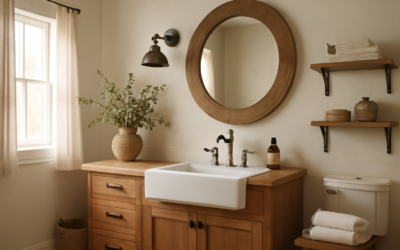
The line between a warm, collected modern farmhouse kitchen and a wall of mass-produced “Gather” signs is thinner than most people realize. Good modern farmhouse kitchen wall decor leans on texture, negative space, and a restrained palette rather than a pile of distressed word art. The current version of the style has quietly grown up, trading heavy shiplap-everything for cleaner walls, natural materials, and a few well-chosen pieces that actually mean something. Below are the ideas that read as designed rather than shopped straight off a big-box endcap.
Part of our Kitchen Remodeling guide — explore the full guide →
Start With the Palette and the Wall Itself
Before you hang a single thing, settle the backdrop. The modern farmhouse base is warm white or soft greige on the walls, with contrast coming from black hardware, natural wood, and matte black or aged brass fixtures. Paint colors like Benjamin Moore White Dove, Sherwin-Williams Alabaster, and Agreeable Gray anchor thousands of these kitchens for a reason: they read clean without going stark or cold.
If you want architectural texture, use it sparingly. A single shiplap accent wall behind open shelving, or beadboard on the lower half with a chair rail around 32 to 36 inches, gives you the farmhouse cue without wrapping the whole room. Vertical shiplap in particular feels more current than the horizontal boards that saturated the look a few years back.
Open Shelving Done Right
Open wood shelves are the signature farmhouse move, and they double as decor and storage. Use thick, chunky boards, ideally 1.5 to 2 inches, in white oak, walnut, or a matte-black steel bracket paired with reclaimed wood. Standard depth is 8 to 10 inches and standard spacing between shelves is 12 to 16 inches.
Style them with restraint. A short stack of white ironstone plates, a couple of wood cutting boards leaning at the back, one small trailing plant, and a piece of pottery is plenty. The trick is leaving roughly a third of each shelf empty. Cram them full and the eye has nowhere to rest, which is exactly what makes a farmhouse kitchen tip into cluttered.
Wall Decor Ideas Beyond the Word Sign
You can signal the style without a single “Eat” or “Farmhouse” sign. These pieces do the work with more sophistication.
- Vintage-look botanical or landscape prints in simple black or natural-wood frames, hung as a tidy grid of four or six.
- Antique or reproduction breadboards and cutting boards mounted directly on the wall in a staggered cluster.
- A large round jute or woven wall piece to add organic texture above a coffee station or banquette.
- Cast-iron or matte-black wall hooks holding linen aprons, market bags, or a few copper pans, which is decor that also earns its keep.
- A framed antique mirror to bounce light in a smaller kitchen and break up a run of solid wall.
- Shelf with a small collection of amber or clear apothecary bottles, kept to one color family.
Scale, Spacing, and Hanging Height
Most decor mistakes are really scale mistakes. Art hung over a table or counter should span about two-thirds the width of the surface below it. A lonely 12-inch frame floating over a 6-foot counter looks like an afterthought. When hanging a single piece, center it at roughly 57 to 60 inches from the floor to the middle of the frame, which is standard gallery eye level.
For a gallery wall, lay the arrangement out on the floor first and keep 2 to 3 inches between frames for a tight, modern grid. Group pieces so the overall shape is a clean rectangle or square rather than a scattered spray. Consistent frames in black or natural wood keep a mixed set of prints looking intentional.
Budget and Where to Spend
You can pull this off at almost any budget, but a few strategic splurges pay off. Real solid-wood shelves and brackets, roughly $40 to $120 per shelf, look dramatically better than thin veneered ones. Vintage cutting boards and pottery from estate sales or Facebook Marketplace often cost $5 to $25 each and carry more character than new reproductions.
Frames are where cheap shows fastest. Skip flimsy plastic and spend $15 to $40 on solid wood or metal frames with real glass. If you want one statement piece, an oversized framed print or a large woven fiber art in the $80 to $250 range anchors the whole room and lets everything around it be inexpensive.
Decorating the Awkward Spots
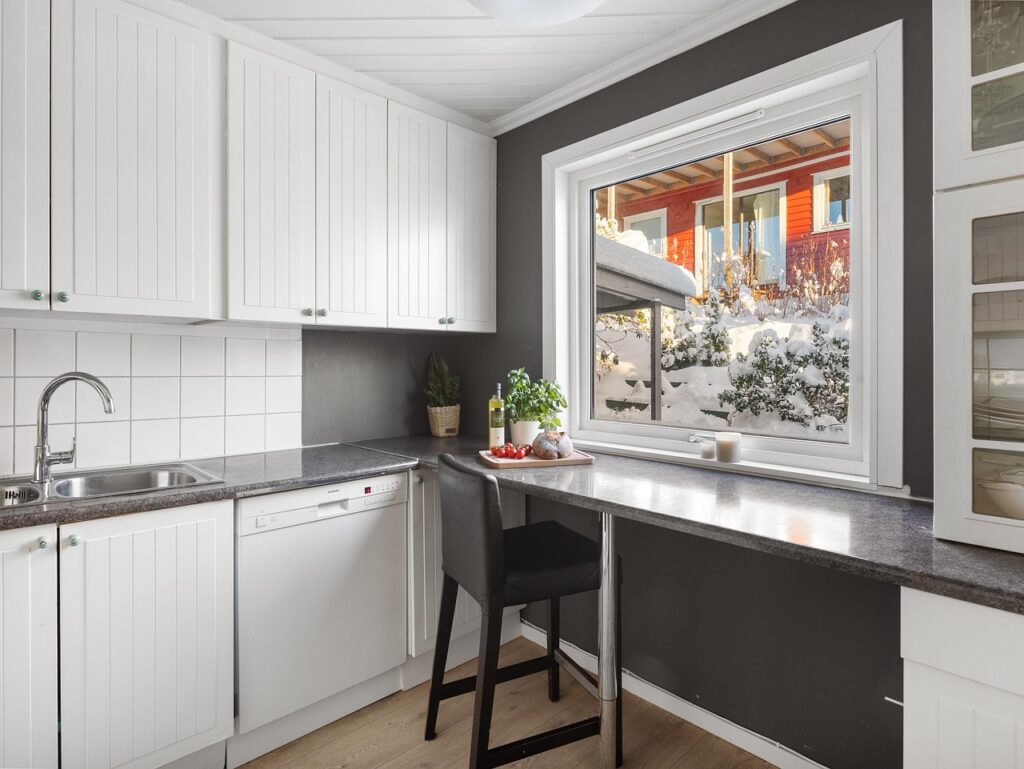
Every kitchen has walls that resist a straightforward gallery arrangement, and those are where a farmhouse scheme can shine. The narrow strip of wall between upper cabinets and countertop is prime real estate for a low shelf, a rail with S-hooks holding utensils and mugs, or a run of subway or handmade zellige tile that reads as both backsplash and decor. Above the sink window, a simple linen valance or a couple of trailing plants on the sill softens the hardest-working wall in the room.
The end of a cabinet run or a bit of wall beside the fridge suits a chalkboard, a vintage clock, or a wall-mounted wooden shelf for cookbooks. Over a doorway, a single reclaimed board or a slim sign can bridge the gap without crowding. The trick is treating these leftover surfaces as intentional opportunities rather than blank spots to ignore, one well-placed piece turns dead wall into character.
Mistakes That Cheapen the Look
A few habits pull a modern farmhouse kitchen straight back into cliche territory. Avoid covering every surface with mass-produced signs, especially anything with a rustic font and a phrase. Skip fake distressing that looks sandblasted rather than aged. Do not mix four or five metal finishes; pick one primary metal, usually black or aged brass, and let it repeat. And resist the urge to hang small art directly next to the range where grease and heat will coat it within a season.
The strongest farmhouse kitchens feel personal. A framed family recipe in a grandparent’s handwriting, a bowl brought back from a trip, or a plant you actually keep alive beats a dozen catalog pieces. Edit until every item on the wall is there because you want it, not because it fills a gap.
One more habit separates the polished kitchens from the cluttered ones: let the wall change with the seasons. Instead of hanging permanent holiday-specific decor, keep a neutral base of shelves and frames, then swap a single element, a small seasonal wreath, a bundle of eucalyptus, a bowl of citrus, as the year turns. It keeps the space feeling fresh and intentional without adding to the permanent pile, and it means you are decorating with a light, considered hand rather than accumulating more signs every December.
Frequently Asked Questions
What colors work best for modern farmhouse kitchen walls?
Warm whites and soft greiges dominate, such as White Dove, Alabaster, and Agreeable Gray. Contrast comes from black hardware, natural wood tones, and aged brass or matte black fixtures rather than bold wall colors.
How high should I hang kitchen wall art?
Center a single piece about 57 to 60 inches from the floor, standard gallery eye level. Art hung over a counter or table should measure roughly two-thirds the width of the surface beneath it to stay in proportion.
Is shiplap still in style for farmhouse kitchens?
Yes, but used sparingly. A single accent wall or vertical shiplap behind open shelving feels current. Wrapping an entire kitchen in horizontal shiplap now reads as dated, so treat it as one texture among several.
How do I decorate open shelves without them looking cluttered?
Use a light hand and leave about a third of each shelf empty. Group items in small collections of one color family, mix heights, and lean one or two boards at the back for depth. Fewer, larger pieces always beat many small ones.
Can I do modern farmhouse decor on a small budget?
Absolutely. Estate-sale cutting boards and pottery run $5 to $25, solid-wood shelves $40 to $120, and quality frames $15 to $40. Spend on one oversized statement piece and keep everything around it inexpensive and simple.