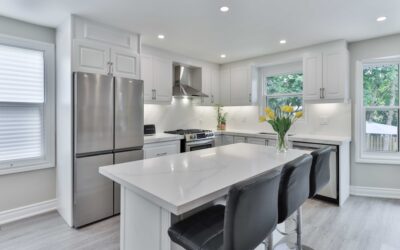
Walk into any showroom and the salesperson will tell you everything is “popular.” After two decades fabricating and installing countertops across Texas and Colorado, I can give you the real numbers. The most popular countertops in American kitchens right now are dominated by quartz, with granite holding strong in second and a quiet surge in butcher block and porcelain slabs. Here is what is moving off the floor, what the materials actually cost, and where each one fits.
Part of our Countertops guide — explore the full guide →
Quartz Sits at the Top
Engineered quartz from brands like Caesarstone, Silestone, and Cambria now accounts for roughly 45 to 50 percent of new countertop installs. The material is about 93 percent crushed natural quartz bound with resin and pigments. It does not need sealing, resists most stains, and gets fabricated to look like marble, concrete, or solid colors.
Expect to pay $55 to $95 per square foot installed for mid-tier slabs, and $100 to $140 for premium veined designer lines like Calacatta Gold or Statuario Maximus. The downside nobody mentions on the showroom floor: quartz cannot handle a 350-degree pot straight from the oven. The resin yellows or scorches. Always use a trivet.
Granite Is Still a Workhorse
Granite slipped from its 2010s dominance but still owns about 25 percent of new installs. Buyers who want a natural stone with real character keep coming back to it. Each slab is unique, and the price range is wider than any other material — entry-level Ubatuba or Santa Cecilia runs $40 to $60 per square foot installed, while exotic blue or red granites can hit $200 per square foot.
Granite handles heat better than quartz. You can set a hot pan on it without damage. The trade-off is annual sealing on most colors and the possibility of staining from oil if the seal wears thin. A simple water bead test every six months tells you when to reseal.
Butcher Block Is Having a Moment
Five years ago, butcher block was confined to islands and farmhouse kitchens. Now it shows up in coastal kitchens, modern designs, and rental flips. Maple, walnut, and acacia are the three species moving fastest. Pricing is the appeal — $30 to $70 per square foot installed puts it within reach of nearly any renovation budget.
The maintenance reality is what scares off some buyers. Oil the surface with food-grade mineral oil monthly for the first year, then quarterly after that. Water damage near the sink is the most common failure I see. If you go with butcher block around a sink cutout, seal the cut edge with marine epoxy before installation.
Porcelain Slabs Are the Quiet Riser
Large-format porcelain slabs — brands like Neolith, Dekton, and Laminam — barely existed in residential ten years ago. They now ship in 5-foot-by-10-foot sheets, just 12 millimeters thick, with realistic marble and concrete prints baked into the surface. Cost runs $80 to $150 per square foot installed.
Porcelain is the only countertop material that genuinely shrugs off heat, knives, and UV light. You can use it outdoors for grilling stations without fading. The hard part is fabrication — only specialty shops with bridge saws and waterjet cutters handle it well. Get three quotes before signing anything.
Solid Surface Holds the Mid-Market
Corian and Wilsonart’s HiMacs lines refuse to die. Solid surface countertops use acrylic and polyester resins to create seamless installs with integrated sinks and coved backsplashes. Price runs $45 to $85 per square foot installed.
The reason solid surface keeps a loyal customer base is repairability. Cigarette burn? Sand it out. Scratch from a knife? Buff with 600-grit sandpaper and the spot disappears. No other countertop material can be repaired in place this easily. Healthcare and commercial kitchens still specify it heavily for this reason.
Marble Stays a Status Material
Real marble — Carrara, Calacatta, Statuario — sits in about 5 percent of new installs. The price varies wildly. Basic honed Carrara might run $60 per square foot installed; a bookmatched Calacatta Borghini slab can hit $250 per square foot.
Be honest about your tolerance for patina. Marble etches when red wine, lemon juice, or vinegar sit on it for more than a few minutes. Some homeowners love that lived-in look. Others come back two years later wanting a full replacement. Honed finishes hide etching better than polished.
Concrete Continues for Custom Builds
Concrete countertops occupy a small niche — maybe 2 percent of installs — but the homeowners who go this route are passionate about it. Cast in place or in a fabrication shop, concrete runs $75 to $135 per square foot installed depending on integral pigments, embedded glass, and edge profiles.
Plan on resealing twice a year with a food-safe penetrating sealer. Hairline cracks are part of the look, not a defect, but some buyers cannot live with them. If you want a perfectly smooth, crack-free surface, choose quartz instead.
How to Pick Between the Top Options
Cut through the marketing by matching the material to how you actually use the kitchen.
- Heavy cooks who want low maintenance — quartz or porcelain
- Budget under $50 per square foot installed — laminate, butcher block, or entry-level granite
- Resale-focused renovations — mid-grade quartz in white or light gray sells fastest
- Designers chasing a specific veined look — Calacatta-pattern quartz or porcelain mimics real marble at half the cost and ten times the durability
- Off-grid or outdoor kitchens — porcelain or sealed concrete only; quartz and butcher block fail in UV
Get three written quotes that include fabrication, edge profile, sink cutout, and removal of the old countertop. Pricing varies up to 40 percent between fabricators in the same metro for the same slab.
What Is Falling Out of Favor
Tile countertops, once common in 1980s and 1990s kitchens, are nearly extinct in new builds. Grout lines stain and crack, and the maintenance is not worth it. Laminate sees occasional use in rentals and basement bars but rarely in primary kitchens. Soapstone has a devoted following but stays under 1 percent of installs because of price and softness.
The most popular countertops winning the market right now are the ones balancing looks, durability, and a maintenance schedule a busy homeowner can actually keep up with. Quartz remains the safest pick for most kitchens, but the right material for your home depends on cooking style, budget, and how much patina you can tolerate.