
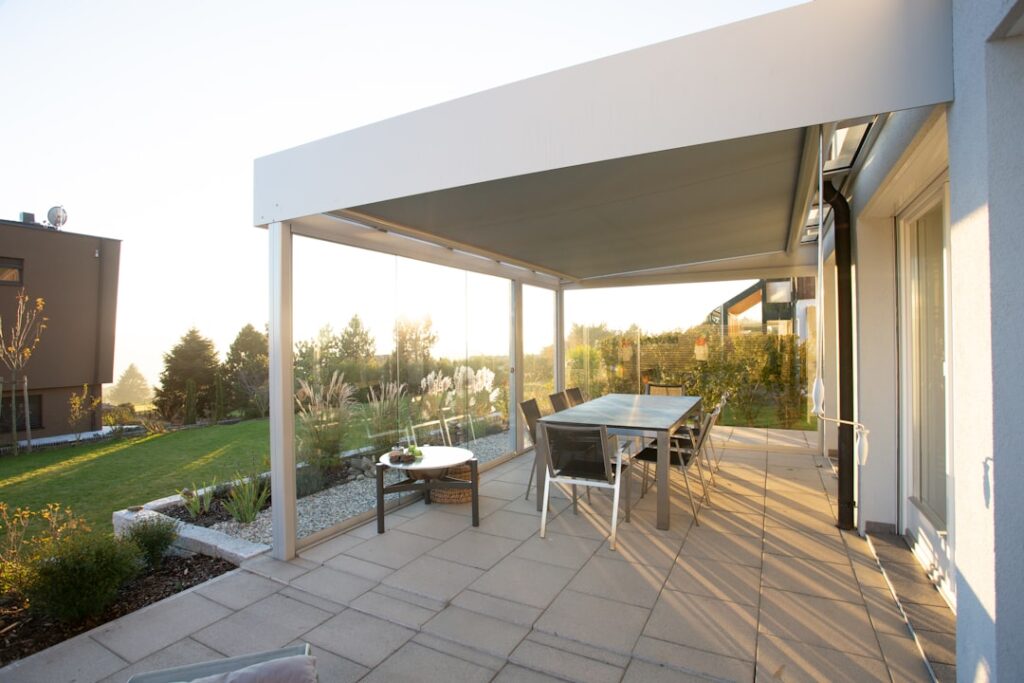
Push a button and a wall appears: mesh drops from a discreet header cassette, seals into side tracks, and a breezy open porch becomes a bug-proof, shaded, semi-private room — then vanishes again in fifteen seconds. Motorized patio screens are the fastest-growing category in outdoor living for a reason, but they are also a product where the price spread is enormous: the same 12-foot opening can cost $900 in DIY kit form or $5,500 from a premium dealer. This guide explains how track-guided retractable screens actually work, what wind ratings and zipper tracks mean, which motors matter, and what realistic installed costs look like per opening.
Part of our Decks & Outdoor guide — explore the full guide →
How Track-Guided Motorized Screens Work
The system has four parts. A cassette housing (typically a 5″ to 7″ aluminum box) mounts at the header and contains the roller tube. Inside the tube sits a tubular motor that raises and lowers the screen. The mesh’s vertical edges carry a welded plastic bead — the “zipper” — that runs captive inside vertical side tracks, and a weighted bottom bar keeps the fabric taut and seals against the floor. Because the zipper locks the fabric into the tracks, the screen cannot blow out of its channels the way old spline-edge screens did; the mesh becomes a tensioned membrane that flexes and recovers. That zipper-track detail is the single most important spec on the sheet — it is what separates true wind-rated systems from glorified roller shades, and it also eliminates the light-and-insect gaps at the edges.
Mesh Choices: Insect, Solar, and Vinyl
- Insect mesh (17/20 or 20/20 fiberglass or polyester): maximum airflow and visibility, the baseline choice for screened-porch duty. No-see-um-rated 20/30 weaves are available in coastal and lake markets.
- Solar mesh (Textilene-style PVC-coated polyester, openness factors of 1 to 10 percent): blocks 80 to 97 percent of solar heat gain and UV, cuts glare for outdoor TVs, and adds daytime privacy — from outside you see almost nothing; from inside you see through. A 5 percent openness fabric is the popular middle ground. Solar mesh doubles as insect screening in most weaves.
- Clear vinyl or hybrid panels: some systems offer PVC “window” bands for cold-season enclosure, effectively turning a porch into a three-season room at a fraction of glazing cost.
Wind Ratings and Real-World Limits
Reputable zipper-track systems publish wind resistance by span: small openings commonly rate to 60+ mph, while a 20-foot span may rate to 30 to 40 mph deployed. Read those numbers the way engineers intend — the screen survives that wind while deployed, but the correct operating practice is to retract screens in storms; the cassette protects the fabric completely when rolled up. Wider spans lower the rating because the mesh membrane deflects more; heavy bottom bars and intermediate posts recover some capacity. If your site sees regular 25+ mph afternoon winds, tell the dealer: they will spec heavier tracks, a larger bottom bar, or a wind-sensor retract automation (a $150–$300 Somfy Eolis add-on that retracts the screen automatically above a set threshold).
Motors: Why Somfy Dominates
Somfy tubular motors power the majority of premium screen systems (Phantom, Progressive Screens, many Screen Innovations builds), with Alpha, Dooya, and house-brand motors filling out the budget tier. The Somfy premium — roughly $200 to $400 per opening over generic motors — buys quieter operation, a 5-year motor warranty, robust obstacle detection, and the RTS/Zigbee ecosystem: handheld remotes, wall switches, wind sensors, timers, and hubs (TaHoma) that bridge to Alexa, Google Home, and Control4. Hardwired 110V motors are standard; battery and solar-powered motors exist for retrofit openings where fishing wire is impractical, at the cost of seasonal recharging. Whatever the brand, insist on a motor warranty of at least 5 years — the motor is the component that fails first, and replacement labor involves de-installing the roller tube.
Sizes and Spans
Single-motor screens run practically from about 4 feet up to 25 feet wide in premium lines (Screen Innovations and Progressive advertise spans to 25’+; most mainstream systems top out at 16 to 20 feet), with drops of 8 to 16 feet. Beyond a single unit’s limit, wide lanai openings take multiple screens with a slim structural post between — often the cheaper and more wind-worthy choice anyway. Cassettes can surface-mount to the header face, tuck under a beam, or — best of all — be recessed into new construction so only a slot shows. If you are building or re-roofing a porch now, rough in a recessed pocket and conduit for power even if screens come later; it is a $100 framing decision that saves an ugly surface cassette forever.
Installed Cost Per Opening
Professionally installed zipper-track motorized screens run $2,000 to $5,500 per opening depending on span, mesh, and motor package. Representative dealer numbers: a 10-foot-wide by 8-foot-tall opening with insect mesh and a Somfy motor lands around $2,200 to $3,200 installed; a 16-foot great-room opening in 5 percent solar mesh runs $3,500 to $5,000; oversized 20-foot-plus spans push past $6,000. A three-opening lanai package typically totals $7,500 to $14,000, with multi-unit discounts common. Electrical rough-in (an outlet or junction box at each cassette) adds $150 to $400 per opening if not existing. Premium dealer brands to shortlist: Phantom Screens, Screen Innovations (Motion line), Progressive Screens, MagnaTrack (notable for its magnet-based self-correcting track that resists jams), and Fenetex in hurricane country.
What Installation Day Involves
A dealer crew handles a three-opening lanai in one day. The sequence: verify the header can carry the cassette (a loaded 16-foot screen assembly weighs 80 to 120 lb, so hollow aluminum porch beams sometimes need a backer channel), mount the cassette level to within 1/8″ across the span, plumb and fasten the side tracks, connect power, then set the motor’s upper and lower limits with the programming remote. Limit-setting is the fussy part — the bottom bar must land with even compression on an out-of-level patio slab, which good installers handle with adjustable bottom-bar seals. Expect the crew to cycle each screen a dozen times and to walk you through obstacle-detection behavior before leaving. For DIY kits the same steps apply with two amplifications: check the opening’s diagonals (more than 3/8″ difference between them predicts zipper bind on tall drops) and never trim tracks with anything but a fine-tooth blade, because a burred track chews the zipper bead every cycle thereafter.
Living With Them: Maintenance and Longevity
Upkeep is minimal but real. Rinse mesh and tracks with a hose monthly in pollen season, wash annually with mild soap and a soft brush, and keep leaf litter out of the track bottoms — debris jams are the top service call. Never pressure-wash mesh, and never force a stalled screen; clear the obstruction and re-cycle. A silicone-free dry lubricant in the tracks once a year keeps travel quiet (petroleum sprays attract grit and void some warranties). Expect fabric life of 10 to 15 years, motors similar, and warranties in the premium tier of 10 years to limited-lifetime on components with 5 years on the Somfy motor. In freeze climates, retract screens for winter storage inside their cassettes — that is all the winterization the product needs, and it is precisely why the cassette design has outcompeted fixed screening in northern markets.
DIY Kits vs Dealer Install
Online-configured kits — Smart Screens USA, Screeneze-adjacent motorized offerings, Amazon and Alibaba-sourced systems — price a 12-foot motorized screen at $800 to $1,800, roughly a third of dealer cost. The honest trade-offs: you measure (and own mis-measures on a custom-cut product), openings must be reasonably plumb and square or the zipper binds, generic motors and remotes replace the Somfy ecosystem, warranties shrink to 1 to 3 years with no local service, and two people plus a long level are mandatory for the install day. Competent DIYers with a square, surface-mount opening and 110V power already present genuinely succeed with kits. Choose the dealer when spans exceed 14 feet, when openings are out of square (older porches usually are), when you want wind-sensor automation and smart-home integration, or when a 10-to-limited-lifetime screen warranty with local service matters. Either route, motorized patio screens are one of the rare upgrades that add usable square footage to a house without framing a wall — and the cost per gained “room” reflects exactly that.


