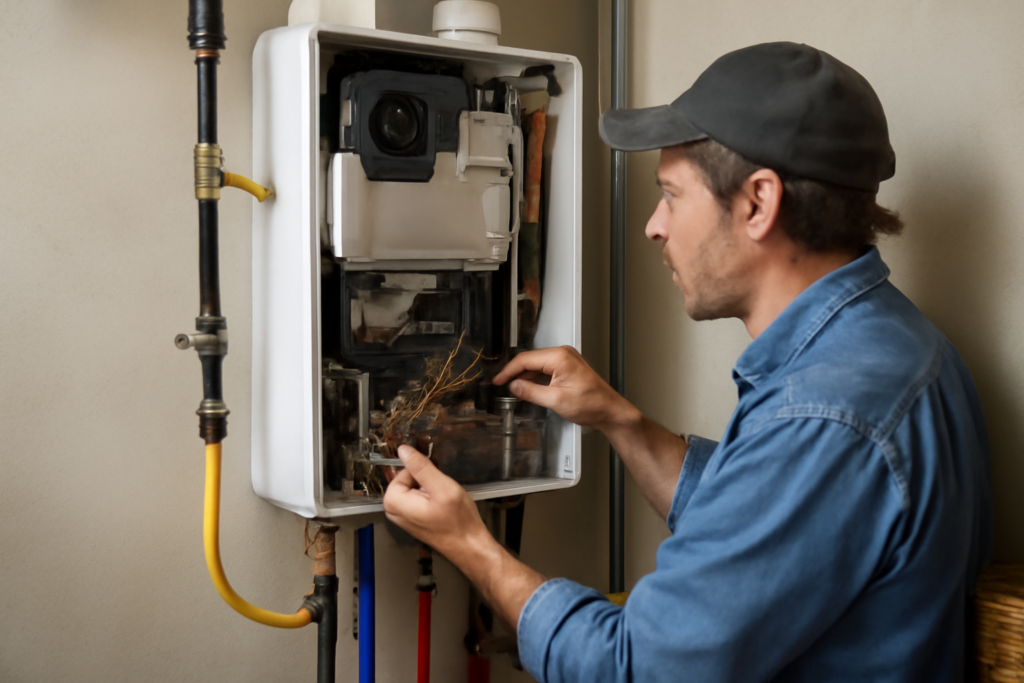
A Navien tankless unit can run for 20 years, but only if you keep the scale out of it. Skip the yearly service and mineral buildup slowly chokes the heat exchanger, driving up gas bills and eventually triggering error codes that shut off your hot water on the coldest morning of the year. Proper Navien tankless water heater maintenance is straightforward, takes about an hour once a year, and can be done with a few tools most homeowners already own. This guide walks through the full routine so you can protect the investment.
- Why Tankless Units Need Regular Service
- How Often to Service Your Navien
- Tools and Supplies You’ll Need
- Step-by-Step Descaling (Flushing)
- Cleaning the Inlet Water Filter
- Cleaning the Air Intake Filter
- Reading Common Error Codes
- Checking the Condensate Drain and Trap
- Testing the Pressure Relief Valve and Venting
- When to Call a Professional
- Keeping a Maintenance Log
Why Tankless Units Need Regular Service
Unlike a tank heater that stores water, a tankless unit fires only when you open a hot tap and heats water on demand through a compact heat exchanger. That exchanger has narrow passages, and hard-water minerals, mainly calcium and magnesium, plate onto them as scale. Even a thin layer forces the burner to work harder to reach your set temperature, which wastes gas and stresses components.
Left unchecked, scale restricts flow, causes temperature swings, and eventually produces a lockout code. Homes with hard water, generally above 7 grains per gallon, need service more often. A water softener dramatically slows scaling, but it doesn’t eliminate the need for periodic descaling.
How Often to Service Your Navien
Navien recommends flushing the system at least once a year. In hard-water regions, or if you notice reduced flow or fluctuating temperatures, bump that to every six to nine months. The other tasks, cleaning the inlet water filter and the air intake filter, should happen on the same annual visit so you handle everything at once.
Mark a recurring date on your calendar, ideally in fall before heavy winter use. A consistent schedule is the single biggest factor in how long the unit lasts.
Tools and Supplies You’ll Need
Gather your materials before you start so you’re not hunting mid-job. Most of this is inexpensive and reusable.
- A submersible pump (a small utility pump rated for the job)
- Two washing-machine-style hoses to connect to the service valves
- A 5-gallon bucket
- Three to four gallons of white vinegar, or a manufacturer-approved descaling solution
- A soft brush and a small screwdriver for the filters
- Shop towels
White vinegar is the safe, food-grade choice for descaling and works well for most homes. Commercial descalers act faster but cost more; either is fine.
Step-by-Step Descaling (Flushing)
Descaling circulates an acidic solution through the heat exchanger to dissolve mineral buildup. Nearly every Navien is installed with isolation valves that make this a closed-loop job.
1. Power Down and Shut the Valves
Turn off the unit at its switch and shut the gas supply. Close the hot and cold isolation valves so no household water enters the loop while you work. This step is non-negotiable; skipping it can scald you or flood the area.
2. Connect the Pump and Hoses
Attach one hose from the cold-side service port to the submersible pump sitting in the bucket, and run the second hose from the hot-side service port back into the same bucket. Open both service (purge) valves. Pour your vinegar or descaler into the bucket.
3. Circulate the Solution
Drop the pump in the bucket and run it for 45 to 60 minutes. The solution loops through the exchanger, dissolving scale as it goes. In very hard-water homes you may see the liquid darken as buildup breaks free.
4. Flush With Clean Water
Shut off the pump and drain the vinegar. Close the service valves, disconnect the hoses, and reopen the cold and hot isolation valves. Let fresh water run through a hot tap for five minutes to rinse any residual solution before returning the unit to service.
Cleaning the Inlet Water Filter
The cold-water inlet filter catches sediment before it reaches the exchanger, and it clogs over time. With the cold isolation valve closed, unscrew the filter cap, pull the screen, and rinse it under running water. Brush off stubborn debris, inspect for tears, and reseat it firmly. A clogged inlet filter is a common cause of low flow that owners mistake for a bigger problem.
Cleaning the Air Intake Filter
Navien condensing units draw combustion air through a filter that collects dust and lint, especially in garages and laundry rooms. Locate the filter near the air intake, remove it per your model’s manual, and vacuum or rinse it clean. A blocked intake starves the burner and can trigger ignition faults. Let it dry fully before reinstalling.
Reading Common Error Codes
Navien units display codes that point straight to the problem, which saves guesswork. A few you’re likely to see:
- E003: Ignition failure, often gas supply or intake related.
- E012: Flame loss during operation; check gas pressure and venting.
- E030 / E109: Exhaust or intake blockage; inspect vent piping and the air filter.
- E016: Overheating, frequently caused by heavy scale restricting flow.
Many of these clear after a proper flush and filter cleaning. If a code persists after maintenance, the issue may be gas pressure, venting, or a sensor, and that’s the point to call a licensed technician.
Checking the Condensate Drain and Trap
Navien condensing units pull extra heat out of the exhaust, and that process produces acidic condensate that drains away through a small line and trap. If that condensate path clogs with scale, sediment, or algae, the unit can throw a fault or leak water onto the floor. Once a year, inspect the condensate trap and line for buildup, and flush it with clean water to keep it flowing freely.
Because the condensate is mildly acidic, many installations include a neutralizer kit, a small cartridge of media that raises the pH before the water enters your drain. Check the neutralizer media during your annual service and replace it when it’s spent, since exhausted media stops protecting your plumbing. This step is easy to overlook but matters for both code compliance and the longevity of your drain lines.
Testing the Pressure Relief Valve and Venting
Every water heater has a temperature and pressure relief valve as a critical safety device, and it deserves a quick annual check. With a bucket positioned underneath, gently lift the valve’s test lever to confirm it discharges water and reseats without dripping afterward. A valve that weeps continuously or won’t reseat needs replacement; don’t ignore it, since this valve prevents dangerous pressure buildup.
While you’re at it, walk the venting. Navien condensing units use PVC or polypropylene vent piping, and you want to confirm every joint is intact, the exterior termination is clear of leaves, snow, and nests, and nothing is sagging or holding water. A blocked or compromised vent is a serious hazard and a common trigger for exhaust-related error codes. Clear venting keeps combustion safe and the unit running without nuisance faults.
When to Call a Professional
Annual flushing and filter cleaning are well within DIY range. Bring in a pro for anything involving the gas line, combustion adjustment, venting modifications, or a stubborn error code that survives a full service. Gas appliances leave no margin for guessing, so when in doubt, hire it out.
Keeping a Maintenance Log
Write down each service date, the descaler you used, how dirty the filters were, and any codes you cleared. Over a few years this log reveals whether your water is unusually hard and whether a softener would pay off. It also preserves your warranty; Navien can require proof of maintenance for certain claims.
Stay consistent and the payoff is real: efficient gas use, steady hot water, and a unit that reaches the far end of its service life. A disciplined approach to Navien tankless water heater maintenance turns an intimidating-looking appliance into one of the most reliable systems in your home, delivering endless hot water year after year with barely an hour of your time each fall.