The right office area rug does more than soften a hard floor. It defines your workspace, absorbs sound from clacking keyboards and conference calls, protects the surface underneath a rolling chair, and adds the kind of warmth that makes a home office feel like somewhere you actually want to spend eight hours. Choosing one, though, involves more decisions than most people expect.
An office area rug sits in a uniquely demanding spot: it lives under a wheeled chair, near foot traffic, and often in a room with mixed natural and artificial light. This guide walks you through sizing, materials, pile height, durability, and placement so the rug you buy still looks good two years from now.
Why an Office Rug Is Different From Any Other Rug
A living room rug mostly faces feet and the occasional spilled drink. An office rug faces a rolling chair that pivots, drags, and concentrates weight on four or five small casters hundreds of times a day. That single difference changes almost every buying criterion, from pile height to fiber choice.
Rolling chairs work best on low, dense surfaces. A plush shag may feel luxurious underfoot, but the casters sink in, the chair fights you when you push back from the desk, and the fibers crush permanently in the chair’s travel path. For most home offices, a flat-weave or low-pile rug is the smarter starting point. It rolls easily, shows wear slowly, and cleans without a struggle.
Getting the Size Right
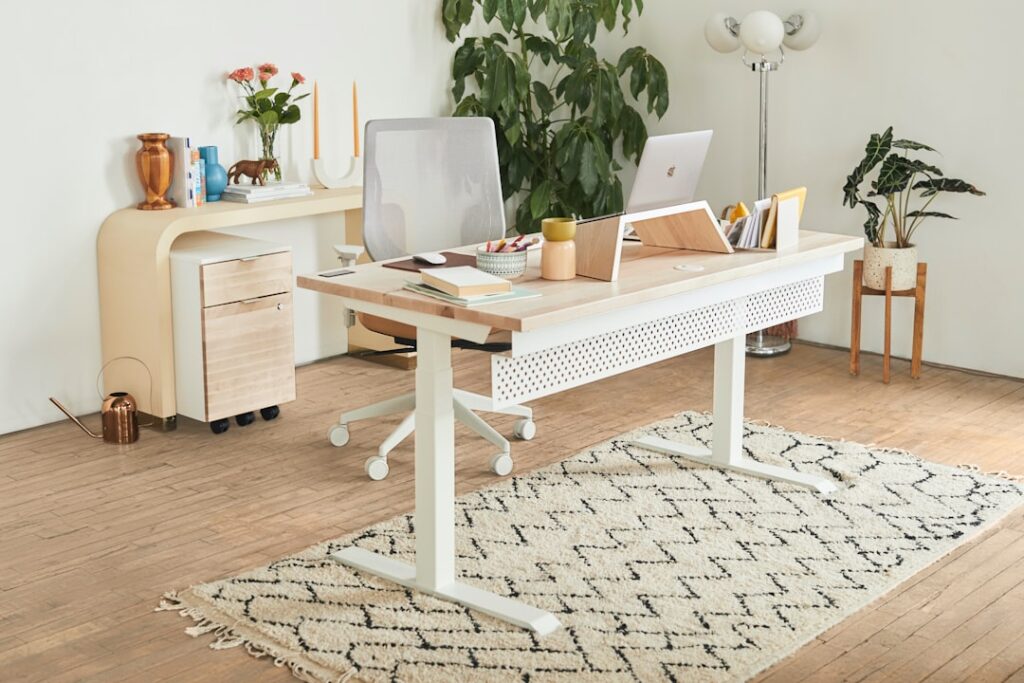
Sizing is where most people go wrong. The classic mistake is a small rug that floats under the desk while the chair rolls half-on and half-off, catching its edge every time you move. The fix is to think about the chair’s full range of motion, not just the desk’s footprint.
A useful rule: the rug should extend at least 24 to 36 inches behind the back edge of your desk so the chair stays on the rug even when you lean back or stand up. Here are common scenarios:
- Compact desk setup: a 5 by 7 foot rug suits a single desk against a wall.
- Standard home office: a 6 by 9 or 8 by 10 foot rug covers a desk plus the chair’s full roll zone.
- Large or executive layout: a 9 by 12 foot rug anchors a desk, side chair, and a small reading area.
Measure your floor and tape out the rug’s footprint before you buy. Painter’s tape on the floor for a day tells you more than any online dimension ever will.
The Best Materials for a Working Office
Material determines how the rug feels, how it wears, and how easily it cleans. For a workspace that sees daily chair traffic, durability beats softness.
- Wool: naturally resilient, stain-resistant, and long-lasting. It hides footprints and bounces back from compression better than most fibers. Expect a higher price, often $200 to $800 for common office sizes.
- Polypropylene (olefin): budget-friendly, fade-resistant, and easy to clean. A practical choice for offices, often $60 to $250.
- Nylon: the most durable synthetic, with good resilience under rolling loads. Mid-range pricing.
- Jute and sisal: attractive natural fibers, but they can be rough on casters and harder to clean. Better as a layered base than a sole work surface.
If you tend toward spills, a synthetic or a flat wool with a tight weave will forgive you most often.
Pile Height and Chair Compatibility
Pile height is the single most overlooked spec. Anything taller than about half an inch starts to fight a rolling chair. Flat-weave rugs, with essentially no pile, are the gold standard for chair travel; low-pile rugs in the quarter-inch range are a comfortable compromise that still rolls reasonably well.
If you love a thicker rug, you have two options. Place a clear chair mat over the rug in the immediate work zone, or accept that you will reposition the chair by lifting it rather than rolling. Many homeowners choose a low-pile rug under the desk and reserve plusher textures for reading corners away from the wheels.
Color, Pattern, and Keeping It Clean
Light, solid rugs photograph beautifully and brighten a small room, but they reveal every coffee ring and crumb. In a working office, a medium-tone color or a subtle pattern hides daily life far better. Patterns also disguise the wear path that inevitably forms where the chair travels.
Think about your light, too. North-facing rooms read cooler, so warm-toned rugs add balance; bright south-facing offices can handle cooler grays and blues without feeling stark. Whatever you choose, buy a fiber you can spot-clean, because office rugs collect coffee, ink, and the occasional toner smudge.
Rug Pads and Keeping It in Place
A quality rug pad is not optional in an office. It keeps the rug from sliding when you push off your desk, adds a thin cushion that protects the floor, and extends the rug’s life by reducing friction against the subfloor. For chair-traffic areas, choose a firm, low-profile felt-and-rubber pad rather than a thick foam one, which would defeat the purpose of a low pile.
Cut the pad an inch smaller than the rug on all sides so it stays hidden. On hard floors, confirm the pad’s backing is safe for your finish; some rubber compounds can discolor certain sealed wood or vinyl surfaces, so check the manufacturer’s guidance before laying it down.
Placement and Final Tips
Center the rug on your primary sightline, usually the view from the doorway, rather than perfectly centering it on the desk. Keep at least 8 to 12 inches of bare floor between the rug’s edge and the walls so the room reads intentional rather than wall-to-wall carpet.
Rotate the rug 180 degrees every few months to even out the wear from chair traffic and sunlight. Vacuum weekly with the beater bar off or on a low setting for flat-weaves, and address spills immediately by blotting, not rubbing. With the right size, a chair-friendly pile, and a good pad underneath, a well-chosen office area rug quietly does its job for years while making the room a more comfortable place to work.
One last consideration: budget for the rug pad and, if needed, a chair mat as part of the total cost rather than an afterthought. A $150 rug with a $40 pad outperforms a $250 rug sliding bare on a hard floor every single day you sit down to work.