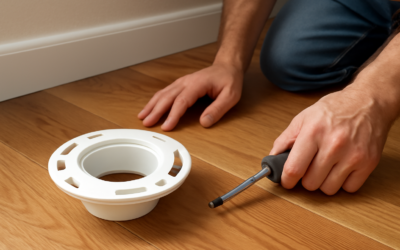
A new toilet that will not fit because the drain sits an inch or two off is a frustrating discovery, especially when the floor is already tiled. An offset toilet flange solves many of these problems by shifting the drain opening sideways or toward or away from the wall, without cutting into the subfloor or rerouting the pipe underneath. It is a small fitting that can save a full floor tear-out.
Part of our Bathroom Remodeling & Flooring guide — explore the full guide →
Offset flanges are not a cure-all, though. They work best when you need to move the opening about 1 to 2 inches, and they narrow the flow path slightly. Knowing when they fit, which material matches your drain, and where the code and flow limits sit will keep the fix from causing a slow or clog-prone toilet later.
- How an Offset Toilet Flange Works
- Problems an Offset Flange Can Fix
- PVC vs Cast Iron Offset Flanges
- 45-Degree Closet Flanges and Other Options
- Tools and Materials
- How to Install an Offset Toilet Flange
- Flow and Code Caveats
- Troubleshooting
- When to Call a Licensed Professional
- Frequently Asked Questions
We explain how offset flanges work, the common problems they fix, PVC and cast iron versions, 45-degree flanges, installation steps, and when a licensed plumber should take over.
How an Offset Toilet Flange Works
A standard closet flange is centered directly over the drain pipe. An offset closet flange has its ring and bolt slots shifted off center from the part that enters the pipe. Rotate the flange and the toilet outlet lands in a different spot, usually up to about 1.5 to 2 inches from where a standard flange would put it.
The shift can go in any direction. Turn the offset toward the back wall and the rough-in shrinks. Turn it away from the wall and the rough-in grows. Turn it sideways and the toilet moves left or right, which helps when a vanity, tub or side wall leaves too little clearance.
Because the opening is offset, the waste path has a small jog in it. That is why offset flanges are generally fine for a single toilet on a properly sloped drain, but they are not a substitute for correct drain design in a new bathroom.
Problems an Offset Flange Can Fix
- Wrong rough-in for the new toilet. Most toilets need a 12-inch rough-in measured from the finished wall to the center of the drain. Older homes may have 10-inch or 14-inch rough-ins, or an odd measurement like 13 inches. An offset can bring an 11 or 13-inch drain close enough to 12 inches.
- Thick wall finishes. New tile backer and tile on the wall behind the toilet can eat half an inch or more of rough-in.
- Side clearance too tight. Code typically wants at least 15 inches from the toilet centerline to a side wall or fixture. An offset can shift the bowl over to gain that space.
- A joist in the way. In remodels, the ideal drain location sometimes lands on a floor joist. An offset toilet drain lets you place the pipe beside the joist and still center the toilet where you want it.
Measure carefully before buying anything. Rough-in is taken from the finished wall surface, not the baseboard, to the center of the drain or the closet bolts.
PVC vs Cast Iron Offset Flanges
PVC and ABS Offset Flanges
A PVC offset closet flange glues inside or over plastic pipe, just like a standard flange. Most are designed for 4-inch pipe, often labeled as a 4 offset toilet flange or 4 offset closet flange, with an inside spigot that fits into 4-inch pipe or a hub that slips over 3-inch pipe. Use the cement that matches your pipe: PVC cement for PVC, ABS cement for ABS. A PVC offset toilet flange with a stainless steel ring adds strength for the toilet bolts and resists corrosion.
Cast Iron Offset Flanges
Cast iron drains in older homes need a flange made to seal against iron. Some cast iron offset flanges are set with lead and oakum, a job most homeowners leave to a plumber. Others are compression flanges with a rubber gasket that expands against the inside of the cast iron pipe. Compression models are much easier and are the usual DIY choice, provided the pipe is sound and not cracked or badly corroded.
45-Degree Closet Flanges and Other Options
A 45 degree closet flange connects to a 45-degree fitting instead of a 90-degree bend. It changes the angle of the drain under the floor, which can help route the pipe around obstacles in new construction. It is a design tool for building a drain, not a quick fix for a finished floor.
Other options for a mismatched rough-in include:
- Toilets built for other rough-ins. Many toilet models come in 10-inch and 14-inch rough-in versions. Buying the right toilet is often simpler than modifying the drain.
- Rear-outlet toilets. These connect to a drain in the wall instead of the floor, used in basements and some remodels.
- Moving the drain. When the floor is open, rerouting the pipe and installing a standard flange is the most permanent fix.
Tools and Materials
- Offset flange sized and rated for your pipe material
- Tape measure and marker
- Putty knife, rags and gloves
- Primer and solvent cement for plastic pipe
- Stainless screws or anchors to fasten the flange to the subfloor
- Stainless or brass closet bolts
- Wax ring or wax-free seal, ideally one with a funnel horn
- Oscillating tool or internal pipe cutter to remove an old flange
- Eye protection
How to Install an Offset Toilet Flange
- Turn off the water and remove the toilet. Close the supply valve, flush, sponge out remaining water, disconnect the supply line and lift the toilet off. Block the drain with a rag.
- Remove the old flange. Unscrew it from the floor. Glued plastic flanges usually need to be cut out from inside with an internal cutter or oscillating tool, taking care not to cut through the pipe wall.
- Measure the new position. Dry fit the offset flange and rotate it until the bolt slots land at the rough-in you need. Mark the orientation on the floor.
- Check for flow. Look down through the flange to see how much the opening overlaps the pipe. A large step or shelf inside the path can catch waste.
- Glue or tighten. For plastic pipe, prime and cement, then press in and rotate to your mark. For compression styles, tighten until snug and the flange does not move.
- Fasten to the floor. Drive corrosion-resistant screws through the ring into the subfloor, or use masonry anchors on concrete.
- Set the toilet. Install bolts, add the seal, lower the toilet straight down and tighten evenly. Reconnect water and test for leaks.
Flow and Code Caveats
The internal jog in an offset fitting reduces the effective opening. In a 4-inch drain, that is rarely a problem. In a 3-inch drain, it can narrow the path more than some inspectors like, so check before using one on 3-inch pipe. Most plumbing codes require the toilet drain to stay at a minimum of 3 inches, and using an offset should not reduce it below that.
Pay attention to how the wax ring sits. A thick ring squeezed into an offset opening can partially block it. Many plumbers prefer a wax-free seal or a wax ring with a plastic horn that guides waste into the pipe. If the toilet ever flushes slowly after an offset install, inspect the seal first.
Troubleshooting
The Toilet Rocks After Installation
The flange may sit higher than the floor or not be fully seated. Make sure it is flush with or slightly above the finished floor, and use plastic shims under the toilet base if the floor is uneven.
Leaks at the Base
Check that the flange is fastened firmly to the subfloor and that the seal was not disturbed when the toilet was set. A toilet lifted after setting needs a new wax ring.
Frequent Clogs
Look for a ledge where the offset meets the pipe, and confirm the drain has proper slope below. Repeated clogs may mean the offset is too aggressive for the drain size.
When to Call a Licensed Professional
Swapping a flange on sound plastic pipe is a manageable DIY project, but several situations call for a licensed plumber. Cast iron flanges set with lead and oakum, cracked or corroded pipe, rotted subfloor around the drain, and any relocation of the drain line all belong in professional hands. Moving a drain usually requires a permit and inspection, and a plumber can verify slope, venting and fixture clearances meet local code.
Costs vary with the work involved. The fitting itself is usually inexpensive, often in the range of ten to thirty dollars, while a plumber’s flange replacement usually runs a few hundred dollars. Expect more if a joist must be notched, the floor needs repair or the drain must be rerouted. An offset fitting is the low-cost route; moving the pipe is the high-cost but permanent one.
Frequently Asked Questions
How far can an offset flange move the drain?
Most models shift the opening about 1 to 2 inches in any direction you rotate them. That is enough to correct many rough-in and side clearance issues.
Can I use an offset flange on a 3-inch pipe?
Some models fit over 3-inch pipe, but the offset narrows the path. Many plumbers prefer to use offsets on 4-inch drains and check local code for 3-inch lines.
Do offset flanges cause clogs?
Not usually, when installed on a properly sloped drain with a seal that does not block the opening. Problems tend to come from overly thick wax rings or a poor fit.
Is an offset flange better than buying a different toilet?
If a toilet is available in your exact rough-in, buying that model is often simpler. An offset helps when the measurement is between standard sizes or you need side clearance.
Can an offset flange fit a cast iron drain?
Yes. Choose a compression offset flange made for cast iron, or have a plumber set a traditional lead and oakum flange.