Your patio takes a beating that no indoor floor ever will — UV rays, freeze-thaw cycles, rain, foot traffic, and the occasional dropped grill spatula. Choosing the right outdoor floor covering means balancing weather resistance, slip safety, looks, and budget, because a surface that fails outdoors is expensive to redo. Whether you are finishing a fresh concrete patio, refreshing a tired deck, or covering a balcony, the material you pick determines how the space looks and how long it lasts. Here is how the leading options actually stack up.
Part of our Windows & Doors guide — explore the full guide →
What Makes Outdoor Flooring Different
Outdoor surfaces face challenges indoor floors never see. Constant sun fades and degrades many materials, water demands proper drainage and rot resistance, and temperature swings cause expansion, contraction, and cracking. Safety matters more too, since wet surfaces turn slippery fast.
That means the best outdoor floor covering is rated for exterior use, handles your specific climate, and offers traction even when wet. A material that looks great in the showroom can crack, fade, or grow dangerously slick within a season if it is not built for the outdoors.
Once your patio flooring is in place, think about how you’ll use the space. A gazebo adds shade and structure, while a good outdoor furniture set turns it into a spot you’ll actually want to hang out in. A deck box is also worth considering if you need somewhere to stash cushions and outdoor gear.
We may earn a commission when you purchase through our links.
Concrete Pavers and Stone
Pavers are among the most popular and durable outdoor surfaces for good reason. Made from concrete, brick, or natural stone, they install over a compacted gravel and sand base and flex with the ground instead of cracking like a poured slab. If one cracks, you replace a single unit.
- Concrete pavers — versatile, affordable, and available in many shapes and colors
- Natural stone — flagstone, travertine, and slate offer high-end, timeless looks
- Brick pavers — classic, slip-resistant, and long lasting
Expect roughly $10 to $30 per square foot installed depending on material. Pavers excel at drainage, handle freeze-thaw well, and provide excellent traction.
Porcelain and Outdoor Tile
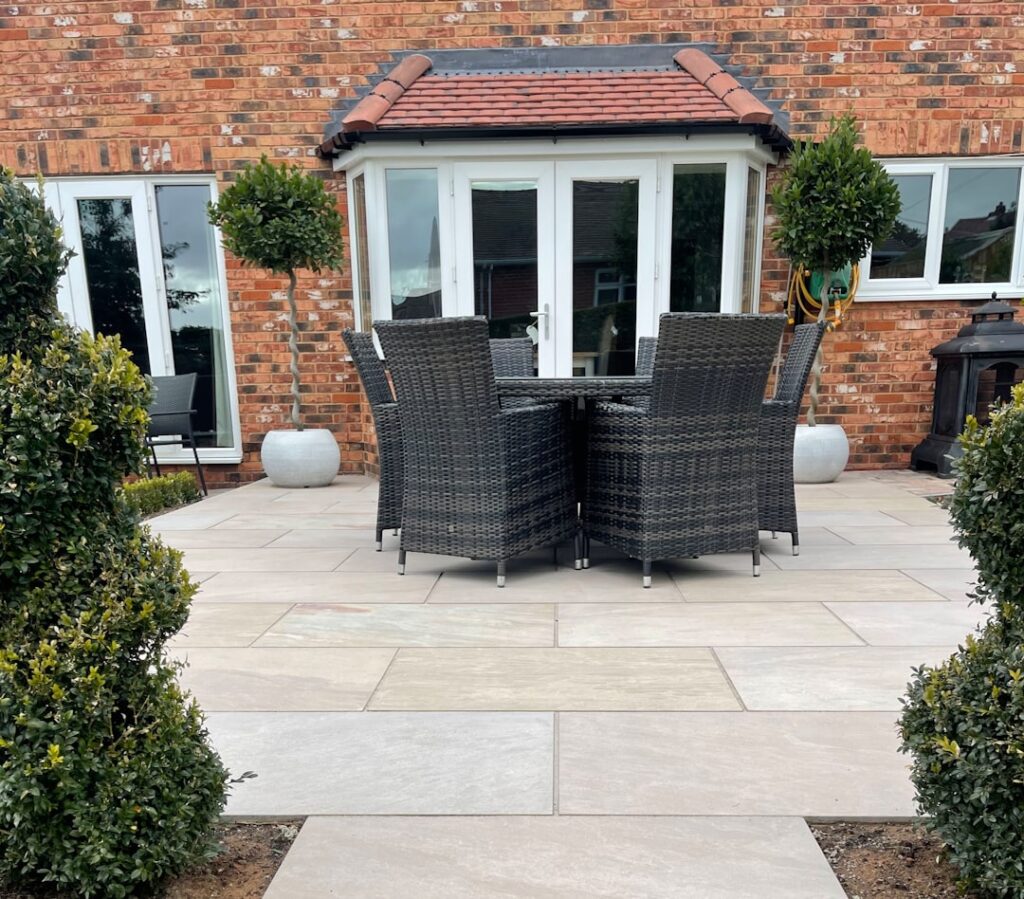
Outdoor-rated porcelain tile has surged in popularity because it delivers the clean look of indoor tile with serious durability. Thick 20mm porcelain pavers can be laid on sand, gravel, or pedestals, while standard porcelain tile gets mortared over a proper exterior substrate.
Porcelain absorbs almost no water, resists fading and stains, and comes in finishes that convincingly mimic wood, stone, or concrete. Crucially, choose a tile with a textured, slip-resistant surface rated for exterior use — glossy indoor tile becomes a hazard when wet. Installed costs typically run $15 to $35 per square foot.
Wood and Composite Decking
For raised patios, balconies, and anywhere you want warmth underfoot, decking is the go-to. Natural wood like cedar, redwood, and pressure-treated pine looks beautiful but demands regular sealing and staining to resist rot and gray weathering.
Composite decking — boards made from wood fiber and recycled plastic, from brands like Trex and TimberTech — costs more upfront but eliminates most maintenance. It will not splinter, rot, or need refinishing, and it resists fading. Wood runs $15 to $30 per square foot installed, while composite lands around $30 to $60. Decking tiles that snap together over an existing slab are a fast DIY option for balconies.
Outdoor Rugs and Soft Coverings
Sometimes you want comfort and color without a full renovation. Outdoor rugs made of polypropylene resist water, mold, and fading, and they roll out over any hard surface to define a seating area. They are an easy, low-cost way to soften a concrete patio.
For play areas and pool decks, interlocking foam or rubber tiles add cushioning and traction. Artificial turf is another soft option that brings a green look to balconies and rooftops without watering or mowing. These coverings are removable, making them ideal for renters or seasonal use.
Stamped and Coated Concrete
If you already have a concrete slab, you can transform it without tearing it out. Stamped concrete presses patterns into wet concrete to mimic stone or brick at a lower cost than the real thing. For existing slabs, a textured concrete overlay or epoxy coating adds color, traction, and protection.
These solutions cost roughly $8 to $20 per square foot and renew a dull patio quickly. The key is a slip-resistant sealer or texture additive, since smooth coated concrete gets slick in the rain. Resealing every few years keeps the finish protected from UV and moisture.
Installation and Prep Basics
Even the best material fails on a bad foundation, so the prep underneath matters as much as the surface on top. Drainage is the make-or-break factor outdoors — water that cannot escape causes heaving, staining, and slick growth. Plan a slight slope away from the house, about a quarter inch per foot, so rain runs off rather than pooling.
The base depends on the material. Pavers and loose-laid porcelain need a compacted gravel base topped with sand or screenings, typically 4 to 6 inches deep, to stay level through freeze-thaw cycles. Mortared tile and stone require a solid, properly cured concrete slab. Decking sits on a framed structure of posts, beams, and joists sized to the span.
- Slope the surface away from the house for drainage
- Compact the base in layers so pavers do not settle unevenly
- Use a membrane under mortared tile to absorb slab movement
- Seal porous materials like natural stone and concrete after install
Many of these surfaces are DIY-friendly for a handy homeowner — paver patios and interlocking deck tiles especially. Mortared tile and structural decking are better left to pros unless you have experience, since mistakes there are hard and expensive to fix.
Choosing the Right Outdoor Floor Covering
Start with your conditions. In freeze-thaw climates, prioritize pavers or 20mm porcelain that tolerate movement. For full sun, choose fade-resistant materials like porcelain and composite. On a balcony or over an existing slab, lean toward interlocking tiles, decking tiles, or an outdoor rug.
Weigh maintenance honestly: natural wood and stone need ongoing care, while porcelain, composite, and pavers are nearly hands-off. Match the look to your home’s style, confirm everything is exterior-rated and slip-resistant, and set a realistic budget. Chosen carefully, the right outdoor floor covering turns a bare slab into a durable, comfortable extension of your living space that lasts for years.
Prefer to explore on your own?
See how new flooring looks in your actual room in seconds — free, no signup.
Try the free Floor Studio →