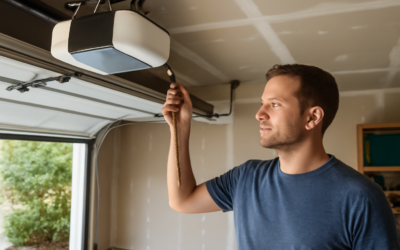
Roughly 70 percent of American homeowners now enter their house through the garage, which means the opener bolted to your ceiling gets more use than your front door ever will. An overhead door garage door opener is engineered to lift heavy sectional doors quietly and reliably, and the brand carries a long reputation because Overhead Door Corporation invented the upward-lifting garage door back in 1921. Choosing the right unit comes down to horsepower, drive type, and the smart features you actually plan to use. Get those three right and the opener will run for 15 years with almost no attention.
Part of our Garage Doors guide — explore the full guide →
What Sets Overhead Door Openers Apart
Overhead Door sells its openers under two consumer lines you will recognize: the Odyssey belt-drive series and the Destiny models sold at big-box stores. Both share the same DC motor platform used by LiftMaster, which is not a coincidence, since Overhead Door and Chamberlain sit under the same corporate umbrella. That relationship matters because it means parts, remotes, and safety sensors are often cross-compatible.
The practical benefit is a proven motor and a dealer network that can service the unit in most metro areas. If you want a professionally installed door and opener from a single manufacturer with matching warranties, an overhead door garage door opener keeps everything under one roof. Expect a professionally installed Odyssey 1000 to run between $500 and $750 including labor.
Warranty coverage is one reason buyers choose a name brand over a bargain unit. Overhead Door typically backs its consumer openers with a lifetime warranty on the motor, a shorter term on parts, and a limited warranty on the belt or chain and the electronics. Buying the door and opener from the same authorized dealer also means a single point of contact if anything goes wrong, rather than the finger-pointing that can happen when a third-party opener is bolted to another company’s door.
Matching Horsepower to Your Door
Horsepower ratings confuse buyers because a heavier door does not always need a bigger number. What you are really buying is lifting force and duty cycle. Here is a quick reference for the doors most homes have:
- 1/2 HP (or ½ HPc DC equivalent): single-car doors up to 9 feet wide, lightweight steel or aluminum
- 3/4 HP: double-wide 16-foot steel doors, insulated doors, and anything with glass inserts
- 1-1/4 HP: oversized carriage-house doors, solid wood doors, and doors taller than 8 feet
When in doubt, size up. A 3/4 HP motor lifting a light door barely works, so it lasts longer and runs quieter than a 1/2 HP unit straining at its limit. Overhead Door lists its DC motors in “HPc” (horsepower comparable) ratings, so a ½ HPc DC motor delivers lifting power similar to a traditional ½ HP AC motor while drawing less current.
Belt, Chain, or Screw Drive
Drive type is the single biggest factor in how loud your garage sounds at 6 a.m. Belt drive uses a reinforced rubber belt and is the quietest option, which is why it is standard on the Odyssey 1000. Chain drive costs less but sends a metallic rattle through any bedroom sharing a wall with the garage. Screw drive splits the difference and needs the least maintenance in dry climates.
If your garage sits below or beside living space, spend the extra $40 to $60 for belt drive. You will notice the difference every single day. For a detached garage where noise is irrelevant, a chain-drive Destiny model saves money without sacrificing lifting power.
Installation: What to Expect
A confident DIYer can install an opener in three to four hours with a helper. The rail assembly, motor mounting, and safety-sensor wiring are the fiddly parts. Follow this general sequence:
- Assemble the rail and trolley on the floor before lifting anything
- Mount the header bracket centered above the door, anchored into solid framing
- Hang the motor from the ceiling using the punched angle iron, keeping the rail level
- Attach the door arm to the top section with the door fully closed
- Install photo-eye sensors no higher than 6 inches off the floor
- Set the open and close force limits, then test the auto-reverse
The auto-reverse test is not optional. Lay a 2×4 flat under the door and run the cycle; a properly adjusted opener reverses the moment it touches the wood. Federal safety rules have required this since 1993, and a door that fails the test is genuinely dangerous around kids and pets.
Smart Features Worth Paying For
Newer Overhead Door units include integrated Wi-Fi so you can open, close, and monitor the door from your phone. This is genuinely useful for confirming you closed the door after leaving and for granting one-time access to a delivery driver. The companion app also logs every open and close event with a timestamp.
Battery backup is the other upgrade I recommend without hesitation. When the power fails during a storm, a backup battery still cycles the door 20 or more times, so you are never stuck manually hauling a 150-pound door in the dark. Units with backup typically add $60 to $90 to the price but pay for themselves the first time the grid goes down. In several states, battery backup on new residential openers is now required by law precisely because power outages during emergencies have trapped people in their garages.
Integrated LED lighting is a smaller but genuinely useful feature on newer units. Older openers had a single dim incandescent bulb, while current models flood the garage with bright LED panels that make the space usable for parking and work. If you buy a unit without it, at least fit the opener with LED bulbs rated as vibration-resistant and non-interfering, since cheap LEDs can throw radio noise that shortens your remote’s range.
Troubleshooting Common Problems
Most opener failures trace back to three culprits, and none require a service call. When the door reverses before it touches the floor, the close-force setting is too sensitive or the rollers are binding. Clean the tracks and back the force adjustment off slightly.
When the door will not close and the opener light blinks 10 times, the photo-eye sensors are misaligned or something is blocking the beam. Wipe the lenses and confirm both LEDs glow steady. If the remote works up close but not from the driveway, replace the 3-volt CR2032 battery before assuming the logic board failed.
Range problems that appear suddenly often trace to radio interference rather than the opener itself. LED shop lights, some smart bulbs, and nearby electronics can flood the opener’s frequency and cut your remote’s reach to a few feet. If your range dropped after you changed a bulb or added a device in the garage, swap that item out to test. Overhead Door units include an antenna wire hanging from the motor head; make sure it dangles freely and is not coiled or tucked up, since that short wire is what receives your remote’s signal.
Routine Maintenance That Extends Its Life
An opener works far harder than most homeowners realize, and a little seasonal care doubles its service life. Twice a year, wipe the rail and apply a light coat of white lithium grease to the trolley track, not the belt or chain itself. Listen for new rattles or grinding, which usually signal loose hardware or a dry gear.
Just as important is maintaining the door the opener lifts, because a poorly balanced door forces the motor to overwork. Once a year, pull the emergency release with the door closed and lift the door by hand; a properly balanced door should rise smoothly and stay put around waist height. If it slams down or is hard to lift, the springs need adjustment by a professional, since spring work under high tension is genuinely dangerous. A balanced door lets even a modest opener glide, while an unbalanced one burns out the motor and gears early.
When to Repair Versus Replace
A logic board, gear kit, or trolley is worth replacing on an opener under 10 years old. Beyond that, the math usually favors a new unit. Newer models pull less power, run quieter, meet current UL 325 safety standards, and include the rolling-code security that older fixed-code remotes lack. If your opener predates 1993 and has no photo eyes, replace it now regardless of whether it still runs.
A quality overhead door garage door opener is one of the few home upgrades that improves daily convenience, security, and safety at the same time. Match the horsepower to your door, choose belt drive if noise matters, and budget for battery backup. Do that and you will not think about your opener again for a very long time, which is exactly how a good one should behave.