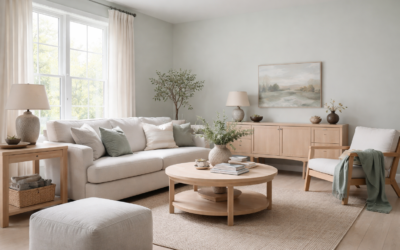
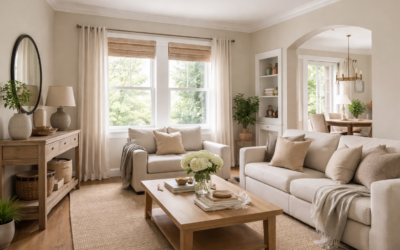
Plenty of homeowners pick Benjamin Moore Pale Oak expecting a creamy white and end up with walls that look softly gray, or even faintly blush, by late afternoon. That shift is the whole personality of the pale oak paint color. It is a light, warm greige from the brand’s Off-White Collection, code OC-20, and the manufacturer lists its light reflectance value (LRV) at 68.64. That puts it firmly in light-neutral territory: bright enough to open up a room, but with enough body to read as a color rather than a white.
Part of our Paint & Walls guide — explore the full guide →
The undertone is what decides whether you love it. Pale Oak mixes beige warmth with a gray cast, and in some light that gray can lean slightly pink or violet. In a sunny room it tends to look like a gentle warm off-white. In a dim, north-facing room it can look more like a light taupe gray.
- Pale Oak Paint Color Specs at a Glance
- Understanding the Undertone
- How Pale Oak Looks in Different Light
- Best Rooms for Pale Oak
- Trim, Ceiling and Accent Pairings
- Pale Oak Compared With Similar Greiges
- Pale Oak With Floors and Fixed Finishes
- Painting Tips and General Costs
- Frequently Asked Questions
Pale Oak Paint Color Specs at a Glance
Values come from the manufacturer’s color page. Screens and printed chips both distort paint, so treat any on-screen swatch as a rough guide only.
| Spec | Value | What it means |
|---|---|---|
| Name and code | Pale Oak, OC-20 | Quote the code at the counter so the right formula gets mixed |
| Collection | Off White Collection | Sits among the brand’s lighter, softer neutrals |
| LRV | 68.64 | Light, reflects most of the light in a room, but not a true white |
| Color family | Warm greige (gray-beige) | Balances warm and cool, so it suits mixed finishes |
| Undertone | Soft gray with a hint of pink or violet in some light | Can look blush near red brick or warm wood; grayer in cool light |
| Manufacturer pairings | Chantilly Lace OC-65, Gray Cardigan 1600, Dinner Party AF-300, Wrought Iron 2124-10 | A crisp white trim, a deeper greige, a rich red and a near-black accent |
| Similar color listed | Balboa Mist 1549 (LRV 65.53) | Slightly deeper, close in feel |
Sheen options depend on which product line you choose, not on the color itself. Most interior lines offer flat or matte, eggshell, pearl or satin, semi-gloss and gloss. Check the product’s current data sheet for exactly what is available.
Understanding the Undertone
Greige colors sit between beige and gray, and the way a specific greige behaves comes down to the pigments behind it. Pale Oak carries enough warmth to avoid looking cold, but it has a grayer, cooler edge than a straight beige. That combination is why people describe it so differently. Hold the swatch beside a pure white, and the warmth shows up. Hold it beside a yellow beige, and the gray and faint violet show up.
A good habit is to compare swatches against a large sheet of plain white printer paper. Pale Oak will look noticeably darker and warmer than the paper, which helps you judge how much color it really has. Then hold it against your floors, cabinets and countertops, since those fixed finishes are what it has to live with.
How Pale Oak Looks in Different Light
- North-facing rooms: Cool, indirect light pulls out the gray. Expect a soft greige that can look a little flat on overcast days.
- South-facing rooms: Warm sun brings out the beige side, and the color can read close to a warm off-white for much of the day.
- East-facing rooms: Bright and warm in the morning, grayer in the afternoon.
- West-facing rooms: Neutral through the morning, then warm and glowing near sunset, when any blush undertone is easiest to see.
- Artificial light: Warm white bulbs around 2700K make it cozier and beige. Cooler bulbs around 4000K and higher make it grayer.
Because of these swings, a sample is not optional. Peel and stick paint sample swatches are the easiest way to compare: put two or three on each wall, check them morning, midday and night for a few days, and move them around the room. They avoid patchy painted test squares and make it easy to compare Pale Oak against its neighbors.
Best Rooms for Pale Oak
Living rooms and open plans
Its light LRV keeps large spaces bright, and the greige base works with both warm wood floors and cooler gray furniture. It is a good whole-house neutral when you want one color to flow through hallways and connected rooms.
Bedrooms
The softness reads as calm, especially with linen, warm wood and brass. In a dark bedroom it will look deeper, so pair it with warm bulbs if you want it to feel cozy.
Kitchens and baths
Pale Oak suits white or cream cabinetry and pairs well with marble-look counters that have soft gray veining. Against strongly yellow granite or orange-toned oak, the gray undertone can look a little dull, so test it next to the countertop first. In bathrooms, use a scrubbable finish such as eggshell, satin or semi-gloss.
Cabinets and exteriors
Some people use it on kitchen cabinets for a soft, not-quite-white look. Outdoors, bright sun washes light colors out, so it may look closer to an off-white on siding than it does on the chip.
Trim, Ceiling and Accent Pairings
The manufacturer suggests a crisp white trim (Chantilly Lace), a deeper greige (Gray Cardigan), a deep red (Dinner Party) and a near-black (Wrought Iron) as companions. These show the range: Pale Oak behaves like a neutral backdrop for both soft and bold choices.
- Trim and doors: A clean white in semi-gloss gives crisp contrast. A softer, warmer white keeps the look low-contrast and gentle.
- Ceilings: Use a flat white, or tint the ceiling with a lighter version of Pale Oak for a cocooned look.
- Accent walls and cabinetry: Deeper greiges, muted greens, navy and charcoal all work. Black window frames and hardware add definition.
- Floors and fabrics: Medium oak, walnut, warm white oak and natural fibers suit it. Cool gray luxury vinyl planks also pair well because of the gray in the paint.
Pale Oak Compared With Similar Greiges
| Color | Code | LRV | How it compares |
|---|---|---|---|
| Pale Oak | OC-20 | 68.64 | Light warm greige with a soft gray and faint blush cast |
| Classic Gray | OC-23 | 73.67 | Lighter, closer to an off-white with a soft gray cast |
| Balboa Mist | 1549 | 65.53 | Slightly deeper, similar warm-gray balance |
| Edgecomb Gray | HC-173 | 63.09 | Deeper, more beige-leaning greige |
Side by side on a wall, the pale oak paint color sits in the middle of this group for lightness. If Pale Oak feels a little too pink in your light, test a greige with a more beige or green-leaning base. If it feels too dark, a lighter neighbor such as Classic Gray keeps the same mood with more brightness.
Pale Oak With Floors and Fixed Finishes
Because the color sits between warm and cool, it gets along with most flooring, but the undertone can shift depending on what is underfoot. Honey or orange-toned oak floors bounce warm light onto the walls and can make the faint blush more noticeable. Gray-washed wood and cool gray vinyl planks pull out the gray side and make the walls look more neutral. White oak, natural walnut and mid-tone brown tile tend to be the easiest matches. Brushed nickel, matte black and warm brass hardware all work, so you rarely have to change fixtures to suit it.
Painting Tips and General Costs
- Repair and sand patches, then spot-prime with a primer suited to the surface.
- Prime fully over dark colors, raw drywall or stains. A gray-tinted or white primer helps a light greige cover evenly.
- Cut in edges first, then roll in sections while the edge is still wet to avoid lap marks.
- Apply two finish coats, waiting the label’s recoat time in between.
- Use the same batch, or box several cans together, so the color stays consistent from wall to wall.
Premium interior paint generally costs in the range of a few dozen to around a hundred dollars per gallon, depending on the line. One gallon covers roughly 350 to 400 square feet per coat. Professional painters typically charge somewhere around $2 to $6 per square foot of wall for a standard room, more for high ceilings and detailed trim. Call a pro for stairwells, tall walls, or if older trim may contain lead paint; in homes built before 1978, test before sanding.
Frequently Asked Questions
What is the LRV of Pale Oak?
The manufacturer lists Pale Oak OC-20 at an LRV of 68.64, which makes it a light neutral rather than a true white.
Is Pale Oak warm or cool?
It is a warm greige, but its gray side gives it a cooler edge than a beige. In cool or dim light it reads grayer; in warm light it reads closer to an off-white.
Does Pale Oak look pink?
In some rooms it can show a faint pink or violet undertone, especially near warm woods, red brick, or in late-afternoon light. Sample it on several walls before committing.
What white trim goes with the pale oak paint color?
The manufacturer pairs it with Chantilly Lace for a crisp contrast. A softer, warmer white works if you want lower contrast.
Is Pale Oak too dark for a small room?
Usually not. Its LRV is high enough to keep a small room bright, though in a dim, north-facing space it will look more gray than on the chip.