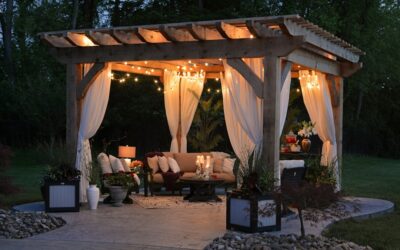
The patio you build this year has to survive a hundred freeze-thaw cycles, two summer parties a month, and a Weber Genesis that occasionally drips grease in the same spot. Pick the wrong surface and you are pulling weeds out of joints every spring, sealing cracks every fall, or watching a flagstone shift two inches off level after the first hard winter. Patio surfaces commonly available in the US break down into six main categories — poured concrete, concrete pavers, natural stone, clay brick, gravel, and composite decking over a slab — each with distinct tradeoffs in price, lifespan, and weekend labor required.
Part of our Decks & Outdoor guide — explore the full guide →
Poured Concrete
Concrete remains the workhorse of American patios because of cost and durability. A 4-inch slab with #4 rebar on a compacted gravel base runs $8 to $15 per square foot installed, depending on regional labor rates and finish complexity. A standard 12-by-20 foot patio lands around $1,900 to $3,600.
Stamped concrete that mimics flagstone or slate adds $5 to $10 per square foot. Integral color, sealer, and saw-cut joints push high-end stamped projects to $25 per square foot. Concrete lasts 30 to 50 years if the subgrade is properly compacted to 95 percent Proctor density and control joints are cut at 8 to 10 foot spacing per ACI 332 residential standards. The downside is cracking — every concrete slab cracks eventually, and patching is visible.
Concrete Pavers
Concrete pavers (Belgard, Techo-Bloc, Unilock, Pavestone) sell for $2 to $7 per square foot for the units alone and $13 to $25 per square foot installed. They handle ground movement better than monolithic concrete because each unit floats independently on a compacted sand bed. ICPI (Interlocking Concrete Pavement Institute) installation specs call for 4 to 6 inches of compacted ASTM No. 57 stone, then 1 inch of bedding sand, then the pavers.
- Pavestone Holland (Home Depot): $0.50 per piece, basic rectangular paver, around $5 per square foot installed.
- Belgard Mega-Arbel: $4 to $5 per square foot for the units, large-format slab look.
- Techo-Bloc Blu 60: $5 to $7 per square foot for the units, premium finish.
- Unilock Beacon Hill Flagstone: $5 to $8 per square foot, mixed-size random pattern.
Sweep polymeric sand (Alliance Gator Maxx Bond, $35 per 50-pound bag at Lowe’s) into the joints to lock the pavers and prevent weed growth. Re-sweep every 5 to 7 years as the binder degrades.
Natural Stone (Flagstone, Bluestone, Travertine)
Natural stone delivers a high-end look at $15 to $30 per square foot installed. Pennsylvania bluestone, Tennessee crab orchard flagstone, and Mexican travertine each have distinct color palettes and price points.
- Pennsylvania bluestone (thermal finish): $8 to $14 per square foot for material, $20 to $28 installed.
- Irregular flagstone: $4 to $8 per square foot for material, $15 to $22 installed.
- Travertine pavers: $4 to $8 per square foot at Floor & Decor, $14 to $20 installed.
- Limestone tile: $6 to $12 per square foot for material, $18 to $25 installed.
Set flagstone on a 1-inch mortar bed over a 4-inch reinforced concrete slab for permanence, or dry-lay on compacted stone dust for a more rustic look. Sealing with a penetrating sealer like Miracle 511 Impregnator ($35 per pint) prevents staining from leaves, wine, and grilling grease.
Clay Brick
Brick pavers run $8 to $15 per square foot installed. Pine Hall Brick, Belden Brick, and Glen-Gery all make residential paver lines specifically rated under ASTM C902 for ground contact. Standard sizes are 4 x 8 inches and 8 x 8 inches.
Brick patios last 50 to 100 years with minimal maintenance when installed on a proper base. The classic herringbone pattern locks the units against rotation and handles patio furniture traffic better than running bond. Resand the joints every 5 years and the surface looks new indefinitely.
Gravel
The cheapest patio option at $1 to $3 per square foot installed. Pea gravel, crushed granite, and decomposed granite (DG) work well in mild climates and informal yards.
Pin steel edging like Col-Met or aluminum landscape edging ($1 to $3 per linear foot at Lowe’s) to keep gravel from migrating into adjacent grass. Lay woven geotextile fabric (Mirafi 140N, $50 per 4×100-foot roll) underneath to prevent soil mixing. The downside is comfort under bare feet and chairs that wobble on uneven stones. A bistro set with thin chair legs sinks unevenly. Best paired with crushed angular stone rather than rounded river pea gravel.
Composite Decking Over a Slab
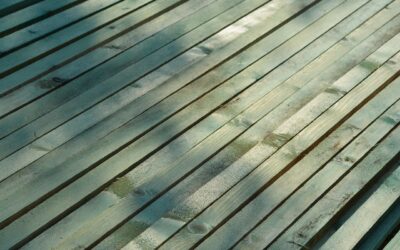
Trex, TimberTech, and Fiberon make composite deck boards specifically for ground-level installation over a sleeper system on concrete. Material runs $5 to $10 per square foot, with installed cost around $25 to $40 per square foot.
The advantage over a wood deck is no annual staining or sealing, and a 25-year structural warranty from most manufacturers. The disadvantage is heat retention — composite boards in full sun hit 145 degrees Fahrenheit on a July afternoon in Phoenix, hot enough to burn bare feet. Choose lighter colors to mitigate.
Permits, Codes, and Drainage
Most US jurisdictions exempt patios under 200 square feet from permits, but check local rules. Any patio with a fire pit, gas line, or electrical outlet requires permits. The 2021 International Residential Code mandates patio drainage of at least 1/4 inch per foot slope away from the foundation. Failure to slope causes water intrusion into basements within five years.
For retaining walls over 4 feet tall adjacent to a patio, you need an engineer-stamped design and a permit in nearly every jurisdiction. The patio itself can usually be built without an engineer.
Maintenance by Material
Different patio surfaces demand different upkeep:
- Concrete: Reseal every 3 to 5 years with a silane-siloxane sealer ($30 per gallon).
- Pavers: Re-sweep polymeric sand every 5 to 7 years.
- Natural stone: Reseal with penetrating sealer every 2 to 3 years.
- Brick: Resand joints every 5 years.
- Gravel: Add 1 cubic yard per 100 square feet every 2 to 3 years.
- Composite: Wash twice a year with a soft-bristle brush and Trex-recommended cleaner.
Picking the Right Surface for Your Yard
For a tight budget under $2,000 on a 200-square-foot patio, pour concrete or use Pavestone Holland from Home Depot. For mid-range projects at $3,000 to $5,000, large-format concrete pavers like Belgard Mega-Arbel deliver a high-end look without natural stone pricing. For a forever patio at $5,000 and up, Pennsylvania bluestone on mortar over a slab looks better at 30 years old than it did the day it was installed. Match the surface to the climate, the use, and the maintenance time you have.