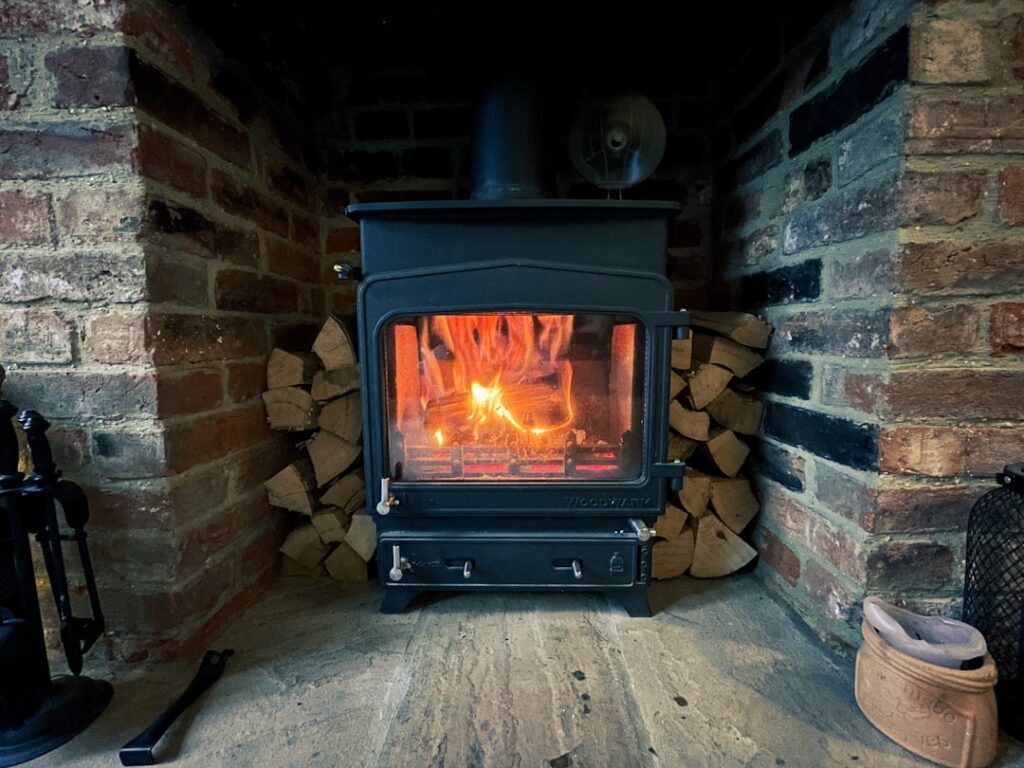
A pellet stove insert for fireplace upgrades an old open hearth into a thermostatically controlled, high-efficiency heater that burns compressed wood pellets instead of cordwood. You load a hopper, set a temperature, and the insert feeds pellets automatically and pushes steady warmth into the room, no constant tending, no hauling logs. This guide covers how they work, efficiency, sizing, venting, cost, and the safety that any solid-fuel appliance requires.
For homeowners who want the low cost and self-reliance of wood heat but not the labor and mess, a pellet insert is often the sweet spot.
How a Pellet Insert Works
A pellet insert is a self-contained appliance that slides into your existing fireplace opening. Pellets, small cylinders of compressed sawdust, load into a hopper that holds roughly 40 to 80 pounds, about a day or two of burning. An electric auger meters pellets into a burn pot at a rate the control board sets, a combustion fan feeds precise air for a hot, clean burn, and a convection blower moves heated air into the room.
Because everything is metered and fan-driven, a pellet insert burns far more completely than a wood fire and holds a set temperature like a furnace. The tradeoff is that it needs electricity to run the augers, fans and controls, so a power outage stops it unless you add a battery backup.
Efficiency and Operating Cost
Pellet inserts are efficient, typically 70 to 83 percent, and burn cleanly enough to meet EPA emissions standards, usually well under 2.0 grams of particulate per hour. That is a world apart from the 10 to 15 percent efficiency of an open fireplace.
On cost, a 40-pound bag of pellets runs $6 to $9, and a ton (50 bags) runs $300 to $450. In moderate weather a home burns roughly one bag a day; in deep cold, two or more. That works out to a few dollars a day, often cheaper than electric or propane heat and competitive with natural gas, depending on local prices. Buying pellets by the ton before winter is the way to keep the cost down.
Sizing to Your Space
Pellet inserts are rated in BTU output and in the square footage they heat. Match the unit to the area you want to warm.
- Small (up to ~35,000 BTU): Heats about 800 to 1,500 square feet, good for a single level or a tight home.
- Medium (35,000 to 45,000 BTU): Heats roughly 1,500 to 2,200 square feet, the common choice.
- Large (45,000 BTU and up): Heats 2,200 to 3,000+ square feet in open or cold-climate homes.
As with any heater, don’t oversize. A too-large insert forced to idle low burns dirtier and wastes pellets. Also measure your fireplace opening, height, width and depth, because the insert must fit inside it with room for the surround panel that seals the face.
Venting Requirements
This is the step that makes it a professional job. A pellet insert does not vent like an open fireplace. It requires a dedicated pellet vent pipe, typically 3-inch or 4-inch, run up through your existing chimney as a liner to the top. The insert’s exhaust is fan-forced and lower-temperature than a wood fire, so it needs this sized, sealed vent to carry combustion gases safely outside and maintain proper draft.
The existing chimney must be inspected and swept before installation, and the pellet vent liner must run the full height and terminate with an approved cap. Cutting corners on venting risks exhaust and carbon monoxide entering the home, so this is not the place to improvise.
Installation and Cost
Installed cost for a pellet stove insert for fireplace generally runs $3,500 to $6,000. The breakdown:
- The insert itself: $2,000 to $4,500 for a quality EPA-certified unit.
- Pellet vent liner and cap: $400 to $1,200.
- Professional installation and electrical: $500 to $1,200.
- Chimney inspection, sweeping and any repair: $200 to $800.
The insert also needs a nearby 120-volt outlet for its controls and fans. Because of the venting, clearances, weight and electrical connection, hire a certified installer and pull the required permit. A battery backup or small inverter, $100 to $300, is a smart add so the stove keeps running during a power outage.
Safety and Maintenance
Pellet inserts are among the safer solid-fuel appliances because combustion is contained and fan-controlled, but they still burn fuel and produce exhaust:
- Install carbon monoxide and smoke detectors on every level and near bedrooms, and test them monthly. This is essential with any combustion appliance.
- Respect clearances to combustibles around the insert face and on the hearth extension per the manual.
- Clean it regularly. Empty and scrape the burn pot every few days, vacuum the ash weekly with an ash vacuum, and wipe the glass. A dirty burn pot causes poor combustion and eventual shutdowns.
- Have the vent and chimney swept annually by a professional, who also inspects the gaskets, auger, and fans.
- Burn quality pellets rated low-ash and store them dry. Damp or low-grade pellets clog the auger and foul the burn pot.
- Dispose of ash in a covered metal container kept outside, since embers can smolder for hours.
Is a Pellet Insert Right for You?
A pellet stove insert makes sense if you want efficient, thermostat-controlled, low-labor heat, have an existing fireplace to convert, and can buy pellets locally at a good price. It rewards you with clean, steady warmth, easy operation, and lower fuel bills, in exchange for a nearby outlet, routine cleaning, and dependence on electricity unless you add a backup. Buy an EPA-certified unit, size it to your space, insist on a proper pellet vent liner and professional installation, and stay on top of the cleaning. Done right, it is one of the most convenient ways to heat a home with wood.
Pellet Insert vs. Wood Insert
Both convert a fireplace to real heat, but they suit different owners. A pellet insert gives you thermostat control, automatic feeding, and clean, consistent burns with far less labor, no splitting, stacking, or tending, but it needs electricity and buys fuel in bags. A wood insert runs without power, burns cordwood you can cut or source cheaply, and delivers the classic crackle and radiant heat, at the cost of hauling wood, loading by hand, and cleaning more ash. If you value convenience and steady temperatures and don’t mind a plug and pellet purchases, go pellet; if you want outage-proof heat and have access to affordable wood, go wood. Neither is wrong, they’re different trade-offs.
Buying and Storing Quality Pellets
Fuel quality makes or breaks a pellet insert. Look for premium-grade pellets with low ash content (under 1 percent) and low moisture; cheap, high-ash pellets clog the burn pot and force frequent cleaning. Hardwood and softwood pellets both work, with softwood often burning a touch hotter. Buy by the ton, 50 bags, before winter for the best price, around $300 to $450, and store the bags in a dry garage or shed off the concrete, because pellets swell and crumble if they absorb moisture, jamming the auger.
Planning for Power Outages
The one real weakness of any pellet appliance is its dependence on electricity to run the augers, fans and controls. In a power outage, a standard pellet insert shuts down, exactly when you may need heat most. The fix is a battery backup or a small inverter and marine battery, $100 to $300, sized to run the insert for several hours, or a portable generator. If reliable outage heat is a priority, factor this into your decision or lean toward a wood insert instead.
Handle those pieces, quality pellets, dry storage, and a power backup, on top of a properly vented, professionally installed pellet stove insert for fireplace, and you get efficient, low-effort, thermostat-controlled warmth that turns an old fireplace into one of the most convenient heat sources in the house.