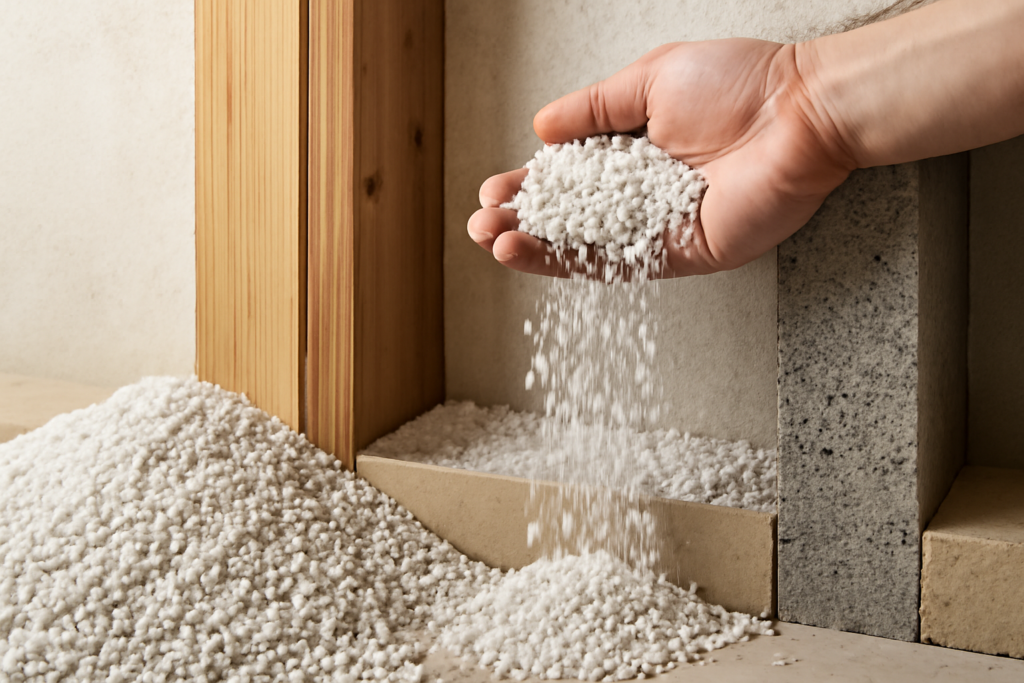
Heat a certain volcanic glass to about 1,600°F and it pops like popcorn, expanding up to 20 times its volume into featherweight white pellets full of sealed air cells. That popped rock is perlite, and as perlite insulation it has been poured into concrete block cores, chimney chases, and masonry cavity walls for the better part of a century. It will not burn at any temperature a house fire can produce, insects cannot eat it, and it never settles into uselessness the way some loose fills do. It is also heavier and pricier per R than fiberglass or cellulose, which confines it to jobs where its fireproof, pourable, mineral nature is exactly what is needed. Here is where perlite genuinely wins, what it costs, and how to use it right.
What Perlite Is and How It Insulates
Perlite starts as an amorphous volcanic glass containing 2 to 5 percent trapped water. Crushed ore fed through a furnace softens, and the water flashes to steam, inflating each particle into a cellular white bead — the same material gardeners know from potting mix, though insulation grades are coarser and often treated with silicone for water repellency. The finished product weighs just 2 to 11 pounds per cubic foot and insulates the way all good insulation does: millions of tiny air pockets that shut down convection and slow conduction.
The working numbers: expanded perlite loose fill delivers roughly R-2.5 to R-3.7 per inch depending on density and grade, with typical masonry-fill grades near R-3. It is completely noncombustible with a melting point around 2,300°F, chemically inert with an essentially neutral pH, rot-proof, vermin-proof, and dimensionally stable — poured perlite in a confined cavity does not settle appreciably because the particles interlock. Under ASTM C549 (the perlite loose-fill standard), water-repellent treated grades are specified for masonry so incidental cavity moisture drains rather than soaks.
The Core Use: Filling Concrete Block and Cavity Walls
Perlite’s signature job is being poured into the hollow cores of concrete masonry units. An 8-inch CMU wall is a thermal sieve — bare, it rates around R-2 total — and core-filling with perlite roughly doubles to triples the wall’s R-value while adding meaningful sound deadening and, per Perlite Institute testing, improving the wall’s fire rating. The pour itself is almost comically simple: dump bags into the open cores from the top of the wall, rod or tap the wall lightly, top up. Perlite’s free-flowing beads self-compact into mortar snots and web gaps that foam inserts miss. Figure one 4-cubic-foot bag fills the cores of roughly 8 to 10 standard 8-inch blocks; a 100-sq-ft wall of 8-inch block takes about 15 to 18 cubic feet.
The same pourability serves cavity brick walls (the 2-inch air gap in older double-wythe masonry), glass block panels, and clay tile walls. One caution inherited from a century of masonry: any future wall penetration — a dryer vent, an AC lineset — releases a stream of beads, so photograph and note filled walls for whoever cuts into them next.
Chimneys, High-Heat, and Below-Grade Uses
Because it is a fireproof mineral, perlite goes places organic and plastic insulations legally cannot. Chimney relining is the big one: when a stainless flue liner is inserted into an old masonry chimney, the annular space around the liner gets filled either with a perlite-vermiculite-cement slurry or a pour of loose perlite mix, insulating the flue to improve draft and keep condensates above dew point. Pre-mixed products (ChamberTech, Thermix-style liner insulation mixes) are perlite-based. Cryogenic and industrial tanks use perlite for the same tolerance of extremes. Under-slab and rooftop applications use perlite concrete — perlite as the aggregate in a lightweight insulating concrete of R-1 to R-1.5 per inch, common on older flat roofs as tapered fill. And in horticulture-adjacent home uses, bags of perlite backfill planters and green-roof media where weight is the enemy.
One place perlite has largely ceded ground: open attics. It works, but at 5-plus times the cost per R of blown cellulose or fiberglass and several times the weight on the drywall below, nobody chooses it there anymore except above boilers, flues, and other heat sources where a noncombustible fill is mandatory.
What Perlite Insulation Costs
Perlite sells by the bag, typically 4 cubic feet:
- Standard masonry-fill grade (4 cu ft bag): $18 to $35
- Silicone-treated insulation grade: $25 to $45 per bag
- Bulk pallet pricing (30 to 36 bags): often 20 to 30 percent under single-bag rates through masonry suppliers
Translated to wall area, core-filling 8-inch block runs roughly $0.60 to $1.20 per square foot in material — cheap as masonry upgrades go, and the labor is shovel-and-funnel simple. Compare alternatives for the same job: foam injection into block runs $1.50 to $3.50 per sq ft installed, delivers a higher R, and air-seals better, while vermiculite (perlite’s historical rival) is now mostly avoided because pre-1990 vermiculite from the Libby, Montana mine carried asbestos contamination — modern vermiculite is clean, but perlite never had the problem and inherited the market. If you encounter old gray-gold vermiculite fill in an attic, treat it as presumed asbestos-containing and call an abatement pro rather than disturbing it; that warning does not apply to perlite, which is snow-white and asbestos-free by nature.
Working With Perlite: Practical Tips
The material’s quirks are manageable with a little technique. It is dusty — nuisance dust, not fiberglass itch or asbestos hazard, but wear an N95 and safety glasses and pour on calm days, because the fines are light enough to drift on any breeze. Pour through a funnel, grain scoop, or cut-down jug into block cores, and lightly tap the wall rather than aggressively rodding, which can bridge and jam the flow. Keep bags dry before use; wet perlite pours badly and temporarily loses R until it dries. In any wall that sees bulk water, specify the silicone-treated grade and make sure weep paths stay open — perlite drains well, but the wall still needs its normal moisture management. And confine it: perlite is a fill for closed cavities, not an exposed blanket, since open-poured beads migrate with airflow and foot traffic.
Perlite vs. the Other Loose Fills
Seen alongside its competitors, perlite’s niche sharpens. Against vermiculite, the historical head-to-head, perlite wins on every modern axis: similar R-value (vermiculite runs R-2.1 to R-2.4 per inch, slightly lower), no asbestos legacy, better water behavior when treated, and wider availability, which is why vermiculite survives mainly in horticulture and a few high-temperature niches. Against blown cellulose (R-3.2 to R-3.8 per inch, roughly $0.30 to $0.45 per sq ft installed at attic depths), perlite loses badly on price and air-sealing but wins wherever fire, moisture, or pests rule — cellulose is treated paper, and no treatment makes paper mineral. Against blown fiberglass, the story is the same trade at a smaller margin. And against foam injection for block walls, perlite gives up R-value and air-sealing but counters with permanence, zero cure chemistry, easy future coring, and roughly half the installed cost.
A quick decision table for the pour-in-place question: block cores in a habitable buildout where every R matters — foam injection. Block cores in a garage, barn, or budget project — perlite. Chimney liner annulus — perlite-based mix, full stop, since it is one of the few materials listed for the job. Attic floor — cellulose or fiberglass, with perlite only in the strip around flues and heat-producing penetrations where clearance rules apply. Planters, green roofs, and lightweight fills — perlite by weight alone. Matching the mineral to those jobs uses its strengths and nobody’s wallet gets hurt chasing R-value where cheaper fibers already own the market.
Should You Use It?
Choose perlite when the job description reads “pourable, fireproof, mineral, permanent”: CMU cores in a garage or basement buildout, the gap around a chimney liner, glass block, planters, high-heat surrounds, and historic masonry where reversible, inert materials are the conservation-friendly answer. Skip it where plastic foams or fibrous blankets do the job for less — attics, stud walls, rim joists. Within its lane, it is about the most trouble-free insulation there is: a bag of popped volcanic rock has no fire rating to lose, no off-gassing to finish, no food value to pests, and no lifespan worth measuring against the building it sits in. Pour it once and it outlasts the mortgage, the roof, and probably the block wall around it.