Family photo albums are irreplaceable, yet most of them sit in attics, basements, or garages — exactly the worst places for them. The best photo album storage ideas balance two goals: keeping albums accessible enough to enjoy and protected enough to survive for decades. The biggest threats to photographs are humidity, heat, light, and acidic materials, so smart storage starts with controlling those four enemies. Here’s how to store albums so your memories last.
- Use Acid-Free, Archival Materials
- Control the Climate
- Keep Albums Out of Light
- Store Albums Properly on the Shelf
- Smart Shelving and Furniture Solutions
- Label and Organize for the Future
- Digitize as a Backup
- Choosing the Right Storage Containers
- Organizing a Large Collection
- Protecting Against Disasters
- Handle Older Photos With Care
Use Acid-Free, Archival Materials
Acid is the silent killer of old photos. Cheap albums, cardboard boxes, and paper can contain acids and lignin that slowly yellow, fade, and degrade prints over time. Whenever possible, transfer photos into acid-free, archival-quality albums and store them in acid-free boxes. Look for products labeled “archival safe,” “acid-free,” and “lignin-free.” Photo-safe plastic sleeves should be made of polypropylene, polyester (Mylar), or polyethylene — never PVC, which off-gasses and damages prints. These materials cost a little more but are the foundation of real preservation.
Control the Climate
Where you store albums matters more than how. Photographs do best in cool, dry, stable conditions, roughly room temperature with moderate humidity. The classic mistakes are attics (too hot), basements (too damp), and garages (both, plus pests). Heat accelerates chemical breakdown, and humidity invites mold and causes photos to stick together. Aim for an interior closet, a spare bedroom, or another climate-controlled living space rather than an unconditioned area. Avoid spots near heating vents, radiators, and exterior walls that swing with the weather.
Keep Albums Out of Light
Light, especially direct sunlight and UV, fades photographs permanently. Store albums closed and away from windows. If you display certain photos, use copies rather than originals and frame them with UV-protective glass. For the bulk of your collection, dark, enclosed storage — a closed cabinet, drawer, or archival box — is ideal. The less light albums see day to day, the longer their colors hold.
Store Albums Properly on the Shelf
How you position albums affects their longevity too:
- Stand albums upright like books on a shelf, supported snugly so they don’t lean and warp.
- Lay large or fragile albums flat, stacked no more than a few high so the bottom ones aren’t crushed.
- Avoid overcrowding, which makes it tempting to yank albums out and damages covers and pages.
- Keep them off the floor, where flooding, dust, and pests are bigger risks.
Smart Shelving and Furniture Solutions
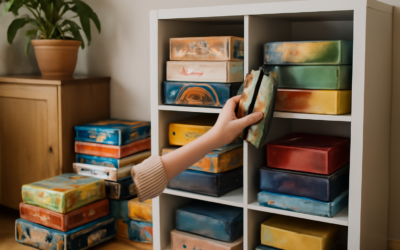
Practical storage doesn’t have to be ugly. A closed bookcase or cabinet protects albums from light and dust while keeping them accessible. Built-in shelving in a hallway or office turns a collection into a feature. Archival photo boxes in coordinated colors stack neatly on shelves and label easily by year or family branch. Media cabinets, ottomans with storage, and under-bed boxes all work well for albums you want nearby but out of sight — just confirm the location stays climate-stable.
Label and Organize for the Future
Preservation includes knowing what you have. Label boxes and album spines clearly by date, event, or family member so you and future generations can find specific memories without pulling everything apart. Use a pencil or photo-safe marker for any notes near photos, never a regular ballpoint or marker that can bleed. Creating a simple index or inventory of your collection is invaluable, especially as it grows.
Digitize as a Backup
Even the best physical storage can’t survive every disaster — fire, flood, or theft. Scanning your albums creates a backup that protects the memories themselves even if the originals are lost. Store digital copies in at least two places, such as an external drive and a cloud service, following the principle of keeping multiple copies in multiple locations. Digitizing also lets you share photos with relatives without handling the fragile originals.
Choosing the Right Storage Containers
Not all boxes and bins are created equal for photos. Plain cardboard boxes are acidic and short-lived, so skip them for long-term storage. Look instead for archival photo boxes made from acid-free, lignin-free board, ideally with a buffered or unbuffered designation suited to your materials. Metal storage boxes with a baked-enamel finish are another stable option that resists pests and moisture. Plastic bins can work if they’re made of safe polypropylene or polyethylene and stored somewhere climate-stable — but avoid cheap PVC containers, and never seal photos in airtight plastic in a humid space, where trapped moisture causes mold. Whatever you choose, keep it sized so albums and prints fit without bending.
Organizing a Large Collection
Big collections become unusable without a system. Sort chronologically by year or by life chapter — childhoods, weddings, trips — whichever way your family naturally remembers events. Dedicate one box or shelf section per category and label clearly so anyone can find a specific memory. Tackle the project in manageable sessions rather than trying to sort decades in one weekend; burnout leads to half-finished piles. As you go, weed out duplicates, blurry shots, and meaningless images so you’re preserving the photos that actually matter, not every frame ever printed. A leaner, well-labeled collection is far easier to store and far more likely to be enjoyed.
Protecting Against Disasters
Even careful storage can’t fully account for floods, fires, and burst pipes, so build in a little resilience. Keep albums off basement floors and out of areas prone to leaks or flooding. Store the most precious, irreplaceable photos in a higher location and, ideally, keep digital scans somewhere off-site. Some families keep a small selection of their most important originals in a fireproof, waterproof safe or a safe-deposit box. The combination of smart physical placement and an off-site digital backup means that even a worst-case event won’t erase your family’s visual history. It’s the single best insurance against losing memories that truly can’t be replaced.
Handle Older Photos With Care
When sorting or moving vintage prints, handle them by the edges with clean, dry hands to avoid transferring oils. Remove photos from old “magnetic” or self-adhesive albums, which are notorious for acidic, sticky pages that yellow and ruin prints over time — gently transfer them to archival sleeves instead. If photos are stuck or deteriorating badly, consider consulting a photo conservator before attempting risky removal.
Good photo album storage comes down to protecting against acid, heat, humidity, and light, then keeping everything organized and backed up. Move albums out of the attic and garage into a cool, dry, dark living space, switch to acid-free archival materials, store them upright or flat without crowding, and digitize for safekeeping. Do that, and the memories in those albums will still be sharp and vivid generations from now.