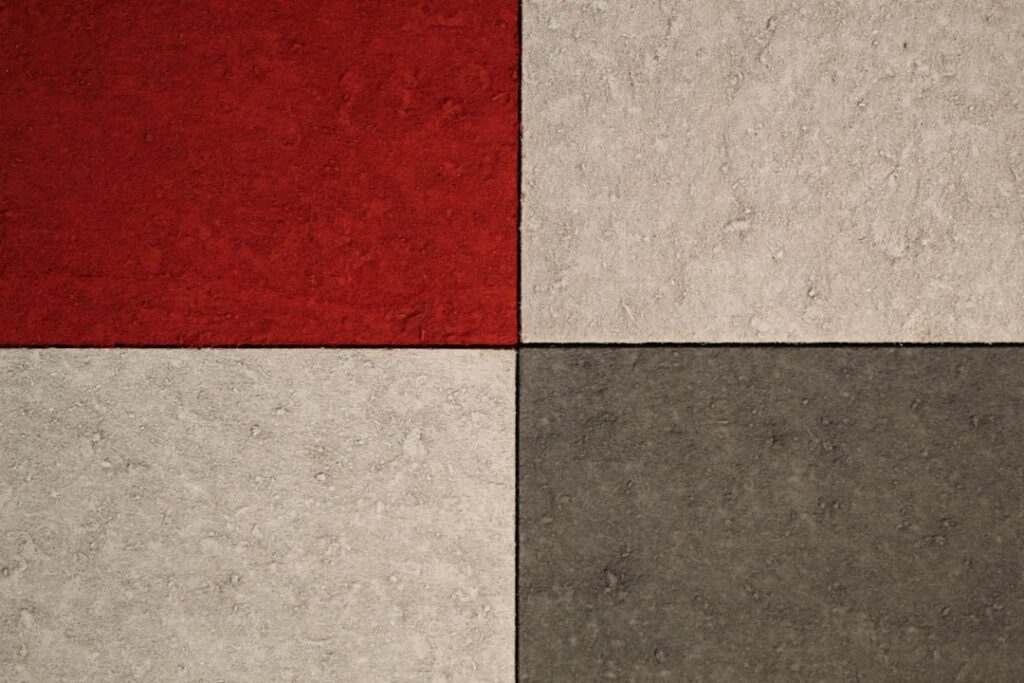
Hard floors, bare walls, and big windows look great in a modern home, but they turn many rooms into echo chambers. Polyester acoustic panels are one of the simplest fixes: lightweight felt boards made from PET fiber, often with recycled content, that soak up the reflections bouncing around a room. They cut easily, hold their shape, carry no loose fibers, and come in dozens of colors. What they do not do is soundproof a wall, and that distinction matters before you spend a dollar.
This guide explains how the material works, how thickness affects performance, what the ratings on the spec sheet mean, how many panels a room typically needs, and how to install them cleanly. It sticks to flat wall and ceiling panels; specialty shapes and free-standing dividers are topics of their own.
What Polyester Acoustic Panels Are Made Of
Polyester acoustic panels are made from polyethylene terephthalate, the same PET polymer used in drink bottles. The fibers are thermally bonded into a dense, felt-like board, usually without glue or binders. Many manufacturers advertise a significant share of post-consumer recycled content, though the percentage varies by product.
The result is a material with a few practical advantages over traditional fiberglass or mineral wool panels:
- No itchy fibers: PET felt can be handled bare-handed and cut without a respirator, although a dust mask is still sensible when sanding edges.
- No fabric wrap needed: The face is the finished surface, available in solid colors, heather tones, and printed patterns.
- Moisture tolerance: Polyester does not absorb water the way paper-based or natural-fiber boards do and resists mold growth when kept clean.
- Lightweight: A 2×4-foot panel at 12 mm thick typically weighs only a few pounds, which makes adhesive mounting practical.
Common thicknesses run from about 9 mm (roughly 3/8 inch) up to 24 mm (about 1 inch), with thicker boards and layered or baffle products available for commercial jobs.
How Sound Absorption Actually Works
When sound hits a hard surface like drywall, glass, or tile, most of the energy bounces back into the room. That reflected sound is what you hear as echo, reverberation, and the “loud restaurant” effect. Porous materials like PET felt let sound waves enter the fibers, where friction turns a portion of that energy into a tiny amount of heat. Less sound comes back out.
Absorption is not the same as blocking. Blocking sound from traveling into the next room requires mass, air-tight construction, and decoupling, such as extra layers of drywall, resilient channels, or insulated stud cavities. A 12 mm felt panel adds almost no mass. It will make a home office sound less boomy on video calls, but it will not keep a teenager’s drum practice out of your bedroom.
Why frequency matters
Thin porous panels are most effective at mid and high frequencies, the range of speech, clattering dishes, and footsteps on hard floors. Low frequencies such as bass notes and HVAC rumble have long wavelengths that pass through thin material with little loss. That is why a thin felt panel can make conversation sound much clearer while the bass in a home theater still booms.
NRC Ratings and Thickness
The number you will see most on spec sheets is the Noise Reduction Coefficient (NRC), an average of how much sound the material absorbs at 250, 500, 1,000, and 2,000 Hz, tested under ASTM C423. An NRC of 0 means total reflection; 1.0 means essentially total absorption across those frequencies.
For polyester acoustic panels, NRC depends heavily on thickness and mounting. General patterns you can expect:
| Thickness | Typical Use | General NRC Range |
|---|---|---|
| 9 mm (about 3/8 in) | Decorative, light echo control | Low to moderate |
| 12 mm (about 1/2 in) | Offices, bedrooms, living rooms | Moderate |
| 24 mm (about 1 in) | Home theaters, studios, open plans | Moderate to high |
| Panel spaced off wall | Better low-mid absorption | Higher than same panel flush |
Always compare published test results for the exact product and mounting type, since manufacturers test differently. Pay attention to the mounting designation in the report. “Type A” mounting means the panel was tested flat against a hard surface. Results for panels mounted with an air gap behind them, such as “E-400” (about 16 inches of air space, typical of a ceiling), are usually much higher and not directly comparable to wall mounting.
The air-gap trick
Mounting a panel on standoffs or furring strips with a 1 to 2 inch air space behind it extends its absorption into lower frequencies. You get more performance from the same panel without buying thicker material, which is useful behind a TV wall or at first-reflection points in a media room.
Fire Safety Ratings
Anything mounted over a large area of a wall or ceiling should have a known fire rating. For interior finishes in the US, the common test is ASTM E84 (also known as UL 723), which measures flame spread and smoke development. Many polyester acoustic panels are marketed as Class A, the best classification under that test, which is typically required for finishes in commercial corridors, schools, and many public spaces.
Class A does not mean the panel cannot burn; PET will melt and can burn in a fire. It means the tested product met specific limits for flame spread and smoke. Ask for the actual test report rather than relying on a sales listing, especially if you are outfitting a rental unit, a home business open to clients, or a basement bedroom. Keep panels away from heat sources such as wood stoves, space heaters, halogen lamps, and recessed light trims, and never cover smoke alarms, sprinklers, or electrical panels.
How Many Panels Do You Need?
For most homes, the goal is not a dead studio sound but a room that feels calm and where speech is easy to understand. A practical rule of thumb is to cover roughly 15 to 30 percent of the total wall area for a noticeable improvement in a typical living room or office. Rooms with lots of hard surfaces, such as open kitchens with tile floors and stone counters, or rooms with tall ceilings, may need more.
- Measure wall area: perimeter times ceiling height, minus large windows and doors.
- Pick a coverage target: about 15 percent for mild echo, 25 to 30 percent for a lively room or recording space.
- Divide by panel size: a 2×4-foot panel covers 8 sq ft.
For example, a 12×14-foot home office with 8-foot ceilings has about 416 sq ft of wall area. Subtract a window and door, say 40 sq ft, leaving 376 sq ft. Twenty percent coverage is about 75 sq ft, or roughly nine or ten 2×4 panels. Start with half that number, live with it for a week, and add more if the room still rings.
Where to Place Panels for the Best Results
Placement often matters more than quantity. A few locations do most of the work:
- First reflection points: the spots on side walls where sound from speakers or your voice bounces directly to your ears. Have a helper slide a mirror along the wall while you sit in your listening or desk position; wherever you see the speaker or your own mouth in the mirror is a reflection point.
- Behind your desk or camera: the wall you face during video calls reflects straight back into the microphone.
- Parallel walls: two bare walls facing each other create “flutter echo,” a fast zinging sound when you clap. Treat at least one of them.
- Ceilings: in rooms with tile, concrete, or hard LVP floors, a few ceiling panels over the seating area can make a big difference.
Staggering panels at varied heights looks more deliberate than a straight line, and color-matched panels can nearly disappear against a painted wall.
Installation Methods
Because polyester acoustic panels are light, installation is usually a one-afternoon job. Choose the method based on whether you rent, how permanent you want the panels to be, and whether you want an air gap.
Adhesive
Construction adhesive or a spray adhesive rated for felt works on painted drywall. It is secure but will damage the paint and paper face when removed. Test adhesive on a scrap first, since some solvent-based products can stain lighter felt.
Removable strips and velcro
Heavy-duty hook-and-loop strips or removable mounting strips suit renters and smaller panels. Use more strips than you think you need, especially on textured walls.
Impaling clips and Z-clips
Impaling clips screw to the wall and have small spikes that grip the back of the panel, allowing removal later. Z-clips or French cleats on a thin backing board create a small air gap and make it easy to lift panels off.
Cutting and finishing
A sharp utility knife and a metal straightedge cut PET felt cleanly; change blades often. For decorative shapes, some homeowners use a jigsaw with a fine blade. Store and cut panels flat so they do not warp.
Costs, Cleaning, and Care
Pricing depends on thickness, printing, and brand, but typical ranges are:
- 9-12 mm panels: roughly $2 to $6 per sq ft.
- 24 mm panels: roughly $5 to $12 per sq ft.
- Printed, grooved, or pre-shaped panels: higher, often $10 to $25 per sq ft.
- Professional installation: commonly $2 to $6 per sq ft of panel area, more for ceilings or complex layouts.
Maintenance is simple. Vacuum panels with a soft brush attachment every few months. Spot-clean stains with a damp cloth and mild soap, blotting rather than scrubbing so you do not fuzz the surface. Avoid painting felt panels; paint seals the pores and reduces absorption significantly.
Frequently Asked Questions
Do polyester acoustic panels block sound from neighbors?
No. They absorb reflections inside a room but add very little mass. Blocking sound between rooms requires construction changes such as added drywall layers, sealed gaps, and insulated or decoupled walls.
Are PET felt panels safe to use in a bedroom or nursery?
Generally yes. They shed no loose fibers like fiberglass. Look for low-VOC certifications and a documented fire rating, and keep panels away from heat sources.
Which thickness should I buy for a home office?
Twelve millimeter panels are a common, budget-friendly choice for speech clarity. Choose 24 mm or mount thinner panels with an air gap if the room has hard floors and high ceilings.
Can I cut polyester acoustic panels at home?
Yes. A sharp utility knife and straightedge handle straight cuts, and a fine-tooth jigsaw works for curves. Change blades often for clean edges.
Will acoustic panels help with bass in a home theater?
Thin panels do little for bass. Thick panels, panels with an air gap, or dedicated bass traps in room corners are needed for meaningful low-frequency control.