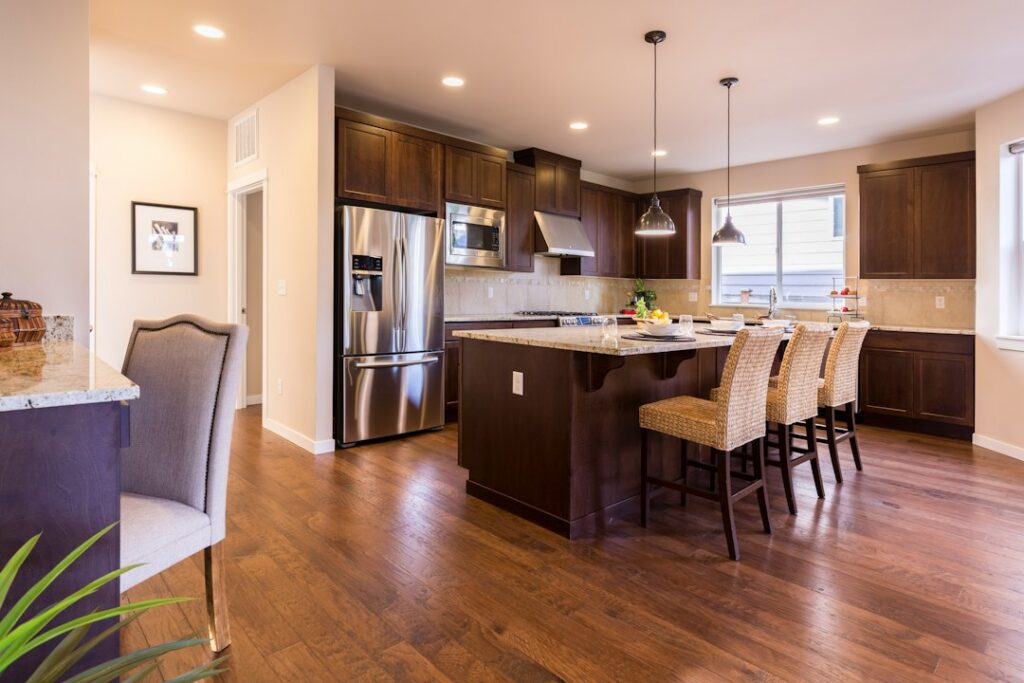
Hard floors, big windows, and open floor plans look great, but they turn many modern homes into echo chambers. Acoustic wood panels, the slatted wall panels you have probably seen in design magazines, are one of the few fixes that make a room sound better and look better at the same time. The catch is that they are often sold with exaggerated claims, and a lot of homeowners buy them expecting soundproofing when what they actually get is echo control. Here is what these panels really do, how to choose them, and how to install them so they perform.
- What Are Acoustic Wood Panels?
- Sound Absorption vs. Soundproofing: Know the Difference
- How Well Do They Actually Work? Understanding NRC
- Choosing Materials and Finishes
- How Many Panels Do You Need?
- Acoustic Wood Panels Cost
- How to Install Acoustic Wood Panels
- Care, Humidity, and Placement Tips
- Frequently Asked Questions
What Are Acoustic Wood Panels?
Most acoustic wood panels sold for homes are slat panels: narrow strips of wood or wood-veneered MDF, usually about 1/2 inch thick and 1-1/8 inches wide, glued to a backing of dense felt. The felt is typically recycled polyester (PET) about 3/8 inch thick, and the slats are spaced roughly 1/2 inch apart so sound can pass between them into the felt. A standard panel measures about 94.5 by 23.6 inches (roughly 8 feet by 2 feet), which lines up neatly with an 8-foot ceiling.
There are other styles too. Perforated and micro-perforated wood panels have a pattern of small holes drilled through a solid face, with mineral wool behind. Grooved panels have routed channels. Wood-wool panels are made from shredded wood bound with cement. For most living rooms, offices, and media rooms, though, the slat-on-felt panel is the product people mean, and it is the one this guide focuses on.
Sound Absorption vs. Soundproofing: Know the Difference
This is the part marketing tends to blur. Absorption reduces the echo and reverberation inside a room. Soundproofing stops sound from traveling between rooms. Wood slat panels are absorbers. They make your living room less boomy, make voices clearer on video calls, and tame the harsh ring you hear when you clap your hands in an empty room. They will not stop you from hearing a neighbor’s TV or keep a drum kit from bothering the family upstairs.
Blocking sound transmission requires mass, air-tight construction, and decoupling: things like double layers of 5/8-inch drywall, damping compound, resilient channels, and sealed gaps. If your real goal is keeping sound in or out, put your money there first. Slat panels can be installed on top of a soundproofed wall as the finish layer, and that combination works well in home theaters.
How Well Do They Actually Work? Understanding NRC
Absorption is measured with the Noise Reduction Coefficient (NRC), a number from 0 to 1 that averages how much sound a material absorbs across speech frequencies. Painted drywall sits around 0.05. A thick carpet with pad might reach 0.3 to 0.4. Here is where slat panels typically land:
| Mounting Method | Typical NRC | Best For |
|---|---|---|
| Screwed flat to drywall | 0.40–0.55 | Living rooms, bedrooms, offices |
| On 1–2 in battens with air gap | 0.60–0.75 | Open-plan spaces, dining rooms |
| On battens with mineral wool behind | 0.80–0.90 | Home theaters, music rooms, podcasts |
Two things stand out. First, the felt backing does most of the work in the mid and high frequencies, which is where voices and the sharp slap of echo live. Second, adding an air gap and insulation behind the panel dramatically improves low-frequency performance. Bass is hard to absorb with thin materials, so if a room booms, space the panels off the wall.
Choosing Materials and Finishes
Real-wood veneer over MDF is the most common construction because it is stable, affordable, and looks like solid wood from a normal viewing distance. Solid-wood slats cost more and can move slightly with humidity. Laminate or melamine-faced slats are the budget option and resist scuffs well in playrooms and hallways.
- Oak (natural, white, or smoked): the most popular finish; pairs well with light hardwood and LVP floors.
- Walnut: warm, dark, and dramatic; great for a single accent wall behind a TV.
- Black or charcoal: reads modern and makes a wall recede, useful in media rooms.
- Felt color: black felt is standard and hides shadows; gray felt looks softer behind light slats.
If you are matching floors, bring a sample board home and look at it at night under your actual lights. Oak veneer on panels often has a clear lacquer that shifts slightly more yellow than a matte waterborne floor finish. Fire rating matters, too: look for panels tested to ASTM E84 with a Class A or Class B flame spread rating, particularly for basements and rooms with wood stoves or fireplaces.
How Many Panels Do You Need?
You do not need to cover every wall. A practical rule is to treat 15 to 25 percent of the total wall area in an echoey living space, and 25 to 40 percent in a home theater, office used for calls, or music room. For a 14 by 16 foot living room with 8-foot ceilings, total wall area is about 480 square feet, so 15 to 25 percent means 72 to 120 square feet, or roughly five to eight standard panels at about 15.5 square feet each.
Placement matters as much as quantity. Sound bounces between parallel hard surfaces, so put panels on at least one of each pair of facing walls. First-reflection points, the spots on side walls halfway between you and your speakers, are high-value locations in a media room. In a home office, the wall behind your monitor and the wall behind your chair do the most for call clarity. A panel above a hard-floored dining table also knocks down the clatter of conversation surprisingly well, and some people mount panels on the ceiling for that reason.
Acoustic Wood Panels Cost
Pricing is refreshingly straightforward. For standard 94.5 by 23.6 inch panels, expect roughly:
- Laminate-faced slats: $55 to $90 per panel.
- Real-wood veneer over MDF: $80 to $150 per panel.
- Solid hardwood or custom panels: $180 to $400 or more per panel.
- Battens, mineral wool, and screws: about $1 to $2 per square foot extra if you space them off the wall.
- Professional installation: $40 to $100 per panel, or a flat $300 to $800 for a typical accent wall, more if outlets must be cut around.
An 8-panel accent wall in veneer typically lands between $800 and $1,600 all-in as a DIY project, which is less than many people pay for a single piece of furniture. Custom architectural panels with engineered acoustic backers can run $25 to $60 per square foot installed.
How to Install Acoustic Wood Panels
This is a very approachable DIY project. You need a stud finder, level, drill-driver, a circular saw or track saw with a fine-tooth blade, and black-headed screws (usually included) about 1-1/4 to 1-5/8 inches long.
- Plan the layout. Mark studs and decide where panel edges fall. Start from a visible corner or center the run on a focal point like a TV or bed.
- Install battens if spacing off the wall. Screw 1×2 or 2×2 furring strips horizontally into studs every 16 to 24 inches. Friction-fit mineral wool, such as 1.5-inch or 2-inch acoustic batts, between them.
- Check plumb. Set the first panel with a level. Walls and floors are rarely perfect, and an out-of-plumb first panel will make every slat after it look crooked.
- Screw through the felt. Drive screws through the felt in the gaps between slats, about every 12 inches and into studs or battens. The black screw heads disappear in the black felt.
- Join panels. Many panels have one extra-wide felt edge or an overhanging slat so the next panel interlocks and the slat spacing stays consistent.
- Cut to fit. Cut with the good face up on a track saw, or face down on a circular saw, and use painter’s tape on the cut line to reduce veneer chipping. Cut between slats through the felt with a utility knife when you only need to drop a slat.
For outlets and switches, turn off the breaker, remove the cover, add a box extender so the device sits flush with the new panel face, and cut a clean opening with an oscillating tool. If you need an outlet moved or added for a wall-mounted TV, have a licensed electrician handle the wiring.
Care, Humidity, and Placement Tips
Dust panels with a soft brush vacuum attachment every month or two; the felt collects dust between slats. Wipe the wood with a barely damp microfiber cloth only. Keep panels out of full bathrooms and away from shower steam, since MDF cores swell with repeated moisture. In basements, run a dehumidifier to keep relative humidity between 35 and 55 percent, the same range that protects hardwood floors. Finally, do not mount panels directly above a fireplace opening or around a wood stove without confirming the manufacturer’s clearance to combustibles; wood and felt are combustible materials, and fire code clearances always win over aesthetics.
Frequently Asked Questions
Do acoustic wood panels block noise from neighbors?
No. They absorb echo and reverberation inside a room but add very little mass, so they do not meaningfully block sound traveling through walls. Soundproofing requires added mass, sealed gaps, and decoupled construction.
Can you install acoustic wood panels on the ceiling?
Yes, and ceilings are an excellent location in open-plan rooms. Screw into joists or furring strips with more fasteners than a wall install, and use a helper or panel lift since the panels are awkward overhead.
Are wood slat panels better than foam panels?
Foam can absorb slightly more high-frequency sound per dollar, but slat panels look like finished millwork, are more durable, and add some diffusion from the slats. For living spaces, most homeowners prefer the wood look.
Do acoustic wood panels work without insulation behind them?
They still work, with an NRC around 0.4 to 0.55 when mounted flat. Adding an air gap and mineral wool behind the panels raises absorption, especially at lower frequencies.