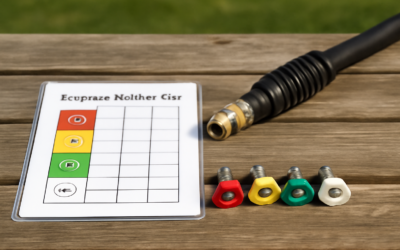
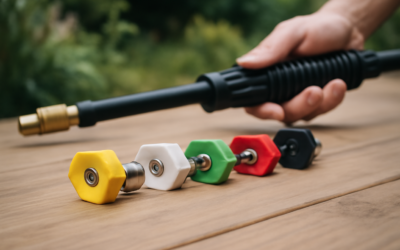
The fastest way to gouge your siding, strip paint you meant to keep, or etch permanent lines into a wood deck is to grab the wrong tip. A pressure washer nozzle chart is the cheat sheet that prevents all of it — five color-coded nozzles, each throwing water at a different spray angle, and each suited to a specific job. Learn the colors and you’ll clean faster, safer, and without the “cleaning stripes” that scream amateur. This guide lays out the full chart, what each tip is for, and the mistakes that turn a $200 washer into a demolition tool.
How Nozzles Change Everything
The engine and pump set your maximum pressure and flow, but the nozzle decides how that energy hits the surface. A narrow spray angle concentrates the same water into a smaller area, multiplying the impact force. A wide angle spreads it out, gentler but covering more surface. Change nothing but the tip and you can go from stripping concrete to rinsing a car — that’s how much the nozzle matters.
Most pressure washers use a quick-connect system, so nozzles pop on and off a 1/4-inch coupler in seconds. Always release the trigger and engage the safety before swapping tips.
The Color Chart, Tip by Tip
Five standard colors cover almost every job. Memorize this and you’re set:
- Red — 0 degrees (pinpoint jet): A single concentrated stream with maximum force. Extremely aggressive. Use only for spot-blasting caked mud, rust, or tar from concrete and metal — never on wood, siding, or your car. It will cut skin, so treat it with respect.
- Yellow — 15 degrees (chiseling spray): A narrow fan for heavy-duty stripping — peeling paint, prepping surfaces before painting, and cleaning deep grime from concrete and masonry.
- Green — 25 degrees (cleaning spray): The everyday workhorse. Good for driveways, sidewalks, patios, decks (with care), outdoor furniture, and general washing. If you use one tip for most jobs, it’s this one.
- White — 40 degrees (washing spray): A wide, gentle fan for delicate surfaces — vinyl siding, windows, cars, boats, and painted wood. Broad coverage with low risk of damage.
- Black — 65 degrees (soaping nozzle): The lowest pressure of all. Its wide angle drops the velocity enough to draw detergent from the soap tank and apply it as a foam. Use it to lay down cleaner, then rinse with green or white.
Matching the Tip to the Job
Here’s the quick decision guide for common tasks:
- Washing a car or truck — black to soap, white (40°) to rinse. Never anything narrower.
- Vinyl or aluminum siding — white (40°), from a safe distance and angled slightly downward.
- Wood deck — green (25°) or white (40°), held 12+ inches back to avoid furring the grain.
- Concrete driveway — green (25°) for general cleaning, yellow (15°) for stubborn oil stains.
- Paint prep and stripping — yellow (15°).
- Blasting rust, tar, or hardened debris off metal or concrete — red (0°), sparingly.
When in doubt, start with the widest safe tip and a longer distance, then step down only if the job demands it. You can always get more aggressive; you can’t un-gouge a deck board.
The Distance Rule
Nozzle angle is only half the equation — distance is the other half. The closer the tip, the more concentrated the impact. A green tip held two inches away can do as much damage as a yellow tip held a foot back. Start every job with the wand 2 to 3 feet from the surface, then move closer gradually until the cleaning is effective. On siding and wood, keep 12 to 18 inches minimum and watch for any surface disruption.
Turbo and Adjustable Nozzles
Two extras are worth knowing beyond the color set:
- Turbo (rotary) nozzle: Spins a 0-degree jet in a circular cone, combining the power of red with the coverage of a wider fan. It’s the fastest way to clean concrete and strip stubborn grime, cutting cleaning time roughly in half. Aggressive, so keep it off delicate surfaces.
- Adjustable / variable nozzle: A single tip you twist to change the spray angle, so you don’t have to swap physical nozzles. Convenient for casual users, though dedicated color tips generally hit harder and cleaner.
Safety You Can’t Skip
These machines are more dangerous than they look. A red 0-degree tip can lacerate skin and cause serious injury, and the injection of water under the skin is a medical emergency. Always:
- Wear closed-toe shoes and eye protection.
- Never point the wand at people, pets, or yourself.
- Engage the trigger safety lock before swapping tips.
- Keep both hands on the wand — the recoil on narrow tips is real.
- Never use a red tip on any surface you can’t afford to damage.
How PSI and GPM Interact With Nozzles
The chart tells you the angle, but two other numbers decide how a tip actually performs on your machine. PSI (pounds per square inch) is the pressure — the punch — while GPM (gallons per minute) is the flow — the rinsing volume. Multiply them for a rough “cleaning units” figure that predicts real-world power. A 2,000 PSI machine at 1.5 GPM and a 1,500 PSI machine at 2.0 GPM can clean similarly despite different pressure ratings, because flow carries dirt away.
Nozzles are sized to a specific pressure-and-flow range, which is why using a mismatched aftermarket tip can hurt performance. A tip’s orifice size is calibrated so your pump reaches its rated PSI; too large an orifice drops the pressure, too small can overload the pump and pop the thermal relief valve. When you buy replacement nozzles, match them to your machine’s PSI and GPM rating rather than grabbing a generic set. Most quick-connect tips are stamped with a size number for exactly this reason.
Storing and Maintaining Your Nozzles
Those little tips are easy to lose and easy to clog, and either problem sidelines the whole machine. Keep them on the onboard holder or in a labeled small container so a $6 nozzle doesn’t vanish into the grass. When a tip sprays unevenly, throws a split stream, or the pressure suddenly drops, the orifice is almost always clogged with grit or mineral scale.
- Turn off the machine and relieve pressure by squeezing the trigger.
- Remove the nozzle and back-flush it with water from the clean side.
- Use the thin cleaning wire that ships with most washers to gently poke debris out of the orifice — never a drill bit or nail, which enlarge the hole and ruin the spray pattern.
- Rinse, reinstall, and test on a wide tip before returning to work.
Store nozzles somewhere they won’t freeze with water inside, and they’ll last the life of the machine.
Nozzle Sizing and Machine Ratings
The number stamped on a quick-connect tip — often something like 2.5, 3.0, or 4.0 — is the orifice size, and it must be matched to your machine’s flow. A common rule sizes the tip so that at your rated GPM the pump reaches its rated PSI. As a rough guide, a 2,000 PSI unit at 1.6 GPM wants a size-3.0 orifice, while a 3,300 PSI unit at 2.5 GPM wants roughly a size-4.0. Buy a five-pack matched to your washer rather than a generic set, and you’ll keep the pressure honest without straining the pump.
Electric pressure washers, typically 1,300 to 2,000 PSI at around 1.2 to 1.5 GPM, use the same five colors but with smaller orifices to hit those numbers. Never move nozzles between a 1,700 PSI electric and a 3,000 PSI gas machine expecting the same result — the flow mismatch either kills the pressure or spikes it. If a new tip drops your pressure noticeably, the orifice is too large for your GPM; step down one size.
Print It, Tape It, Use It
The whole system is easy once it clicks: red and yellow strip and blast, green is the daily driver, white handles delicate surfaces, and black lays down soap. Keep this pressure washer nozzle chart handy in the garage until the colors are second nature. Match the tip and distance to the surface, start wide and back off, and you’ll clean everything from your car to your concrete without a single regret etched into the finish.