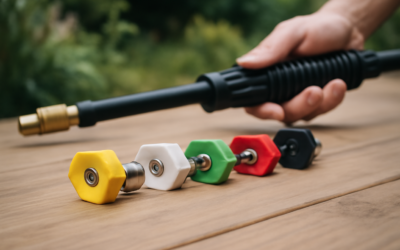
The single most expensive mistake with a pressure washer is grabbing the wrong nozzle and etching your wood siding, stripping paint, or carving lines into concrete in seconds. A pressure washer tip chart exists precisely to prevent that, matching each color-coded nozzle to a spray angle and the surfaces it is safe to use on. Learning the pressure washer tip chart takes five minutes and will save you from ruining a deck, a car finish, or worse, injuring yourself with a too-narrow tip at close range.
I keep this chart memorized after years of pressure washing, and it is the difference between a clean job and a costly repair. Here is every nozzle explained, with the right tip for each task.
How Nozzle Tips Work
A pressure washer tip does one job: it shapes the water stream into a fan of a specific angle. A narrow angle concentrates all the machine’s force into a tiny area, delivering maximum cutting power but covering very little surface. A wide angle spreads that same force over a broad fan, gentler on the surface but faster to cover ground.
The tips are universal and color-coded across brands, so a green tip means the same thing on a Ryobi as on a Simpson. Most quick-connect tips snap into the wand’s socket. The rule to remember: the smaller the degree number, the narrower and more powerful the spray, and the more dangerous it is to skin, wood, and paint.
The Five Standard Nozzle Colors
Here is the core chart every homeowner should know:
- Red (0 degrees): a single concentrated jet. Extremely powerful and easily damages surfaces. Almost never needed; reserved for removing caked mud from equipment or stubborn stains from concrete at a distance. Never point at people, and keep it off wood, siding, and vehicles.
- Yellow (15 degrees): intense cleaning for tough jobs, stripping paint, prepping surfaces, cleaning heavy grime from concrete and masonry.
- Green (25 degrees): the everyday workhorse. General cleaning of concrete, brick, driveways, decks (with care), patio furniture, and dirty siding.
- White (40 degrees): a gentle, wide fan for delicate surfaces, washing cars, windows, vinyl siding, and stucco.
- Black (65 degrees, soap tip): the low-pressure nozzle. Its wide bore drops pressure so the machine draws detergent, used for applying soap before rinsing.
A sixth tip, the turbo or rotary nozzle, spins a 0-degree jet in a cone, combining red-tip power with 25-degree coverage. It strips heavy grime from concrete fast, but treat it with the same caution as the red tip.
Matching Tips to Common Tasks
Here is how the chart translates to real jobs around the house:
- Washing a car or truck: white (40) or the soap tip for suds; never red or yellow, which strip clear coat.
- Vinyl or aluminum siding: white (40), holding the wand 3-4 feet back.
- Wood deck or fence: green (25) or white (40), keeping the tip 12 inches or more away to avoid furring the wood.
- Concrete driveway or sidewalk: green (25) for general grime, yellow (15) or a turbo nozzle for stubborn stains.
- Brick and masonry: green (25), testing an inconspicuous spot first.
- Patio furniture: white (40).
- Removing paint or heavy prep: yellow (15).
- Applying detergent: black soap tip only.
When unsure, always start with the widest safe tip and a greater distance, then step down to a narrower angle only if needed. You can always add power; you cannot un-etch a surface.
Distance Matters as Much as the Tip
The tip is only half the equation. The distance between the nozzle and the surface dramatically changes the force delivered. A green tip held 2 inches away can gouge wood, while the same tip at 3 feet is safe. This is why “test at a distance and move closer” is the golden rule.
Start every job with the wand about 3 to 4 feet from the surface, then slowly close the gap until you see effective cleaning without damage. Keep the spray moving in smooth, overlapping passes, and hold the wand at a slight angle to the surface rather than straight on, which helps lift dirt and prevents digging in one spot.
PSI, GPM, and Your Machine
The same tip behaves differently on different machines because your washer’s pressure and flow set the ceiling. A 1,800 PSI electric homeowner unit is far more forgiving than a 3,500 PSI gas machine, where even a green tip demands respect. On high-PSI machines, favor wider tips and greater distance for anything delicate.
Always match the tips to your machine’s rating; using a tip sized for a lower-flow machine on a high-flow one raises pressure dangerously. Most tips are stamped with a size number (like 2.5 or 3.0) that corresponds to your machine’s GPM. When replacing lost tips, buy the size that matches your washer’s flow rate.
Safety Rules You Cannot Skip
Pressure washer injuries are serious; a 0-degree jet can cut skin and inject debris under it. Follow these rules every time:
- Never point any tip at a person or pet, especially the red or turbo tip.
- Wear closed shoes and eye protection; debris flies back at high speed.
- Engage the trigger lock when changing tips, and release pressure first.
- Keep both hands on the wand; the narrow tips produce real recoil.
- Test in a hidden area before committing to a whole surface.
Adjustable and Specialty Nozzles
Beyond the standard five colors, a few specialty nozzles are worth knowing. Adjustable nozzles let you twist a collar to change the spray angle on the fly, convenient because you carry one tip instead of five, though dedicated fixed tips generally deliver more consistent pressure. Some homeowner machines ship with a single variable nozzle that covers everything from a pencil jet to a wide fan.
The turbo or rotary nozzle deserves special mention: it spins a 0-degree jet in a small circle, combining the raw cutting power of the red tip with the coverage of a 25-degree fan. It strips heavy dirt, moss, and stains from concrete and masonry dramatically faster than a standard tip, but it hits with red-tip force, so keep it off wood, siding, vehicles, and anything delicate. A foam cannon is another useful add-on, a wide-mouth soap nozzle that produces thick clinging suds for car washing, dwelling on the surface to lift dirt before you rinse with a white tip.
Caring for Your Nozzles
Nozzles are small and easy to lose, but they also clog and wear, which quietly ruins performance. Mineral deposits and debris build up in the tiny orifice over time, causing an uneven spray or reduced pressure. Clean a clogged tip with the included cleaning needle or a thin wire, working it gently through the orifice from the front, and flush with water. Never enlarge the hole, which permanently drops the pressure.
Store tips in the holder on the machine or a small parts box so they do not get lost, and keep a spare set on hand since they are cheap and easy to misplace. Inspect the quick-connect O-rings periodically and replace them if they crack or leak. A worn tip, one whose orifice has eroded larger with use, delivers noticeably weaker cleaning and should be replaced. Match any replacement to your machine’s GPM-based tip size, stamped on the tip, so the pressure stays correct. A clean, correctly sized set of tips is what keeps a pressure washer cleaning at full strength year after year.
Keep the Chart Handy
Memorize the pressure washer tip chart and you will clean faster, better, and without the expensive damage that comes from grabbing the wrong nozzle. The pattern is simple: red is the most powerful and most dangerous, and each color up to white gets wider and gentler, with black for soap. Green (25) and white (40) handle the vast majority of homeowner jobs, so if you only remember two tips, remember those.
Start wide and far, step down only as needed, and respect the red and turbo tips. Do that, and your pressure washer becomes a safe, versatile cleaning tool for driveways, decks, siding, and vehicles alike, rather than a device that carves permanent lessons into your property. Tape a printed chart inside your garage, and never guess again.