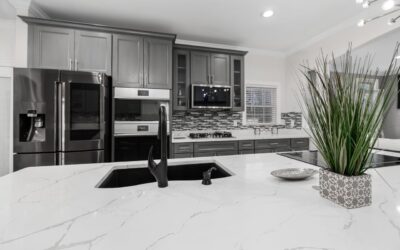
The quartz countertops vs granite debate is the single most common question we hear from homeowners planning a kitchen renovation. Both are premium countertop materials that last decades, look stunning, and add real value to your home. But they are fundamentally different products with distinct strengths and weaknesses.
Part of our Countertops guide — explore the full guide →
After installing both materials for over 30 years, we can tell you there is no universal winner. The right choice depends on your priorities, budget, lifestyle, and design preferences. This guide gives you an honest, side-by-side comparison so you can make a confident decision.
What Makes Them Different
Before diving into the comparison, it helps to understand what each material actually is.
Granite is 100% natural stone quarried from the earth. Each slab is unique, formed over millions of years under intense heat and pressure. It is cut from massive blocks, polished (or honed or leathered), and fabricated to fit your kitchen.
Quartz countertops are engineered stone. They contain roughly 90-94% ground natural quartz crystals bound together with 6-10% polymer resins and pigments. Major brands include Caesarstone, Cambria, Silestone, and MSI. The manufacturing process allows for consistent color and pattern control.
This fundamental difference, natural vs engineered, drives nearly every distinction in the quartz countertops vs granite comparison. Granite offers natural uniqueness but with natural variability. Quartz offers consistency and customization but is a manufactured product.
Durability Comparison
Both materials are extremely durable, but they handle wear differently.
Granite durability: Granite rates 6-7 on the Mohs hardness scale, making it one of the hardest natural surfaces available. It resists scratches well and can last 50+ years with proper care. However, granite can chip or crack if hit with a sharp impact on an edge or corner. Because it is a natural material, some slabs contain hidden fissures that may develop into cracks over time, though this is uncommon with quality material.
Quartz durability: Quartz also rates around 7 on the Mohs scale since the primary component is natural quartz crystal. The resin binders add a degree of flexibility that makes quartz slightly more resistant to impact and chipping than granite. Quartz is less likely to crack from impact but can be damaged by excessive force.
Stain resistance: This is where quartz pulls ahead clearly. Quartz is non-porous, meaning liquids cannot penetrate the surface. Granite is porous and requires periodic sealing to maintain stain resistance. An unsealed or poorly sealed granite countertop can absorb wine, oil, and coffee, leaving permanent stains.
Winner: Quartz edges out granite on overall durability, primarily due to its non-porous nature and slightly better impact resistance.
Cost Comparison
Cost is often the deciding factor in the quartz countertops vs granite decision. Here is how they compare.
Granite cost range: $40-200 per square foot installed, with most homeowners spending $50-100 per square foot. Basic granite colors (Uba Tuba, Giallo Ornamental) start around $40-60 installed, mid-range options run $60-100, and exotic slabs (Blue Bahia, Van Gogh) can exceed $200.
Quartz cost range: $50-150 per square foot installed, with most homeowners spending $65-110 per square foot. Entry-level quartz starts around $50-65 installed, mid-range options run $70-100, and premium brands like Cambria can reach $150.
For a typical kitchen with 40 square feet of countertop space, granite runs $2,000-8,000 total while quartz runs $2,600-6,000 total. Granite has a wider price range because natural stone varies enormously in rarity and quality.
Hidden costs to consider: Granite requires periodic sealing ($15-50 per application, once or twice yearly). Quartz has no ongoing maintenance costs. Over a 20-year period, granite’s sealing costs add $300-1,000 to its total cost of ownership.
Winner: Tie. Budget granite is cheaper than budget quartz, but mid-range options are similarly priced. When you factor in maintenance costs, they are essentially equal over time.
Maintenance Requirements
Maintenance is one of the biggest practical differences between these two materials.
Granite maintenance: Requires sealing every 6-12 months with a quality penetrating sealer. Daily cleaning with stone-specific cleaner or mild soap and water. Acidic substances (lemon juice, vinegar, tomato sauce) should be wiped up quickly as they can etch the surface. Stains that penetrate unsealed granite may require poultice treatment to remove.
Quartz maintenance: No sealing ever required. Daily cleaning with dish soap and water or any non-abrasive cleaner. Far more forgiving of spills that sit for extended periods. The only maintenance concern is avoiding harsh chemicals (bleach, oven cleaner) that can damage the resin binders.
For busy families, quartz’s low-maintenance nature is a significant practical advantage. You never have to think about resealing, and spills that sit overnight are far less likely to cause permanent damage.
Winner: Quartz wins decisively on maintenance. It is genuinely a set-it-and-forget-it surface.
Appearance and Design Options
Both materials offer stunning visual options, but their design strengths differ significantly.
Granite appearance: Every slab is one-of-a-kind. The natural patterns, veining, and color variations mean no two granite kitchens look the same. This uniqueness is a major selling point for homeowners who value natural beauty. However, it also means you need to hand-select your exact slab at the stone yard, and what you see on a sample chip may differ substantially from the full slab.
Quartz appearance: Modern quartz manufacturing can replicate the look of marble, concrete, granite, and other natural stones with remarkable accuracy. Patterns are consistent from slab to slab, so what you see in the showroom is exactly what you get installed. Quartz also comes in colors and patterns that do not exist in nature, expanding your design options.
Edge profiles: Both materials accept the full range of edge profiles including eased, beveled, bullnose, ogee, and waterfall. Neither has an advantage here.
Finish options: Granite offers polished, honed, and leathered finishes. Quartz primarily comes in polished and matte finishes, though textured options are becoming more common.
Winner: This depends entirely on your priorities. Granite wins for one-of-a-kind natural beauty. Quartz wins for consistency, color range, and the ability to match specific design visions.
Heat and Scratch Resistance
How each material handles the daily demands of a working kitchen matters greatly.
Heat resistance: Granite is the clear winner here. It can handle hot pots and pans placed directly on its surface without damage. Granite formed under extreme geological heat and can withstand temperatures well above anything your kitchen produces. Quartz, because of its resin content, can be damaged by sustained heat above 300 degrees Fahrenheit. Hot pans can cause discoloration, clouding, or even cracking of the resin. Always use trivets with quartz.
Scratch resistance: Both materials resist scratches well in normal use. Granite can be scratched by materials harder than it (like diamond or some ceramics) but not by steel knives. Quartz has similar scratch resistance. In practical terms, you should use cutting boards with both materials, more to protect your knives than the countertops.
UV resistance: Granite is completely UV stable and will not fade or discolor from sunlight exposure. Some quartz colors, particularly darker ones, can fade or yellow when exposed to prolonged direct sunlight. This makes granite the better choice for outdoor kitchens and countertops near large windows.
Winner: Granite wins on heat and UV resistance. For kitchens where hot pots frequently hit the counter, this advantage is significant.
Resale Value Impact
Both quartz and granite are considered premium countertop materials that add value to your home.
Granite’s resale impact: Granite has been the gold standard for kitchen countertops for decades. Real estate agents consistently list granite countertops as a selling point. Most buyers view granite as a premium upgrade, and it can help recover 60-80% of its installation cost at resale.
Quartz’s resale impact: Quartz has achieved equal standing with granite in most markets and may even be preferred by younger buyers. Its association with modern, low-maintenance living appeals to the growing segment of buyers who prioritize convenience. Quartz also recovers approximately 60-80% of its cost at resale.
In luxury markets, the choice between quartz and granite rarely affects the sale price. Both signal quality and thoughtful renovation. The only scenario where one significantly outperforms the other is when the overall kitchen design clearly calls for one material. A farmhouse kitchen with granite just feels right, while a sleek modern kitchen may benefit more from quartz.
Winner: Tie. Both materials add comparable value to your home.
Which Is Best for Your Situation
Based on our experience installing both materials in thousands of kitchens, here are our recommendations for specific situations.
Choose quartz if: You want minimal maintenance, you have a busy family kitchen, you prefer consistent patterns, you want a wide range of color options, or you plan to use your countertops heavily without worrying about sealing and staining.
Choose granite if: You want a completely unique, natural surface, heat resistance is a priority (you frequently place hot cookware on counters), you have an outdoor kitchen, your kitchen gets heavy direct sunlight, or you prefer the depth and character of natural stone.
Choose granite on a budget if: You want premium stone at the lowest possible price. Entry-level granite is more affordable than entry-level quartz, and many budget-friendly granites are genuinely beautiful.
Choose quartz for rental properties: Its low-maintenance nature means tenants are less likely to damage it, and you never have to worry about resealing between tenants.
Frequently Asked Questions
Is quartz cheaper than granite?
Not necessarily. Budget granite is cheaper than budget quartz, but mid-range options are similarly priced at $65-100 per square foot installed. When you add granite’s ongoing sealing costs over 20 years, the lifetime cost is roughly equivalent for comparable quality levels.
Which is more durable, quartz or granite?
Both are extremely durable and last decades. Quartz has a slight edge in stain and impact resistance due to its non-porous, resin-bound composition. Granite has a significant advantage in heat resistance. For overall daily kitchen use, quartz is marginally more durable.
Can you tell the difference between quartz and granite?
Usually yes, if you look closely. Granite has a depth and randomness in its patterns that is difficult to replicate perfectly. Quartz patterns tend to be more uniform, though high-end quartz brands are getting remarkably close to natural stone appearance. The tactile feel also differs slightly, with granite feeling cooler and more varied in texture.
Do home buyers prefer quartz or granite?
Market research shows roughly equal preference between the two in 2026. Younger buyers tend to lean toward quartz for its low maintenance and modern aesthetic. Older buyers often prefer granite for its natural beauty and established reputation. Both are viewed as premium upgrades by real estate professionals.
Can I mix quartz and granite in the same kitchen?
Absolutely. A popular approach is using granite for the main countertops (especially around the stove for heat resistance) and quartz for the island or bar area. Mixing materials can create visual interest while optimizing each surface for its specific use.