Walk into almost any newly remodeled kitchen today and there’s a good chance you’re looking at quartz stone countertops, and for good reason. Unlike granite or marble pulled straight from the earth, quartz countertops are engineered, blending roughly 90 to 95 percent ground natural quartz with resins and pigments to create a surface that’s nonporous, consistent, and remarkably tough. That manufacturing process gives you the look of natural stone without most of its headaches. Here’s everything you need to know before you commit.
Part of our Countertops guide — explore the full guide →
This guide covers what quartz actually is, its real strengths and weaknesses, what it costs installed, how to care for it, and how it stacks up against granite.
What Quartz Stone Countertops Actually Are
Quartz countertops are engineered stone, not solid slabs cut from a quarry. Manufacturers grind natural quartz crystals, one of the hardest minerals on earth, and bind them with polymer resins and color pigments under heat and pressure. The result is a dense, uniform slab. Because the color and pattern are designed rather than mined, you get predictable looks and the ability to mimic marble veining, concrete, or solid colors with consistency that natural stone can’t promise. Well-known brands include Caesarstone, Silestone, Cambria, and others, though the underlying technology is similar across the category.
The Big Advantages
Quartz has become the default premium countertop for a handful of compelling reasons.
- Nonporous surface: The resin seals the stone completely, so it never needs sealing and won’t absorb wine, oil, or bacteria.
- Stain resistance: Spills wipe away without soaking in, a major edge over granite and marble.
- Durability: Extremely hard and resistant to chips and scratches under normal kitchen use.
- Consistent appearance: What you see in the showroom is what arrives in your kitchen, with no surprise variation.
- Low maintenance: Soap and water keep it looking new for years.
The Drawbacks to Know
No surface is perfect, and quartz has real limitations worth understanding before you buy.
- Heat sensitivity: The resin can scorch or discolor under a hot pan. Always use trivets and hot pads; never set cookware straight from the burner onto quartz.
- UV fading: Most quartz isn’t rated for outdoor or sun-drenched installs and can fade over time, so it’s an indoor product.
- Price: It sits in the premium tier, comparable to or above mid-grade granite.
- Visible seams: On large islands, seams can show, though a good fabricator minimizes them.
What Quartz Countertops Cost
Quartz is a premium material, and the installed price reflects that. Expect a typical range of roughly $50 to $120 per square foot installed, depending on the brand, the slab’s color and pattern, edge profiles, and your local labor rates. Designer patterns that mimic high-end marble sit at the top of that range, while simpler solid colors land lower. A few cost factors to keep in mind: complex layouts with lots of cutouts cost more, premium edge profiles add up, and removing and disposing of old countertops is often a separate line item. Always get measured quotes rather than relying on per-square-foot estimates alone.
Caring for Quartz Stone Countertops
This is where quartz rewards you daily. Routine care is nearly effortless:
- Wipe with mild soap and warm water or a gentle pH-neutral cleaner.
- Wipe up spills when convenient, no rush since nothing soaks in.
- Use a cutting board to protect your knives and avoid dulling the surface.
- Always use trivets and hot pads under anything hot.
- Avoid abrasive scrubbers and harsh chemicals like bleach, oven cleaner, and strong solvents, which can dull the finish.
For dried-on messes, a plastic scraper and a little elbow grease handle it without scratching. If a stubborn film builds up from hard water or cooking residue, a dedicated quartz cleaner or a 50-50 mix of water and isopropyl alcohol cuts it without harming the surface. Avoid leaving acidic spills like lemon juice or vinegar sitting for long periods, since prolonged exposure can dull the finish on some quartz over time. With this minimal routine, the surface keeps its factory shine for the life of the kitchen.
Quartz vs. Granite
The most common comparison is quartz against granite, and each wins in different areas. Granite is a 100 percent natural stone with one-of-a-kind veining and excellent heat resistance, but it’s porous and needs periodic sealing to resist stains and bacteria. Quartz is engineered, nonporous, more consistent in appearance, and never needs sealing, but it’s more heat-sensitive and not suited to direct sun. If you want a maintenance-free, predictable surface, quartz usually wins. If you prize natural uniqueness and want a surface that shrugs off hot pans, granite has the edge. Pricing for the two overlaps heavily.
Edges, Finishes, and Design Options
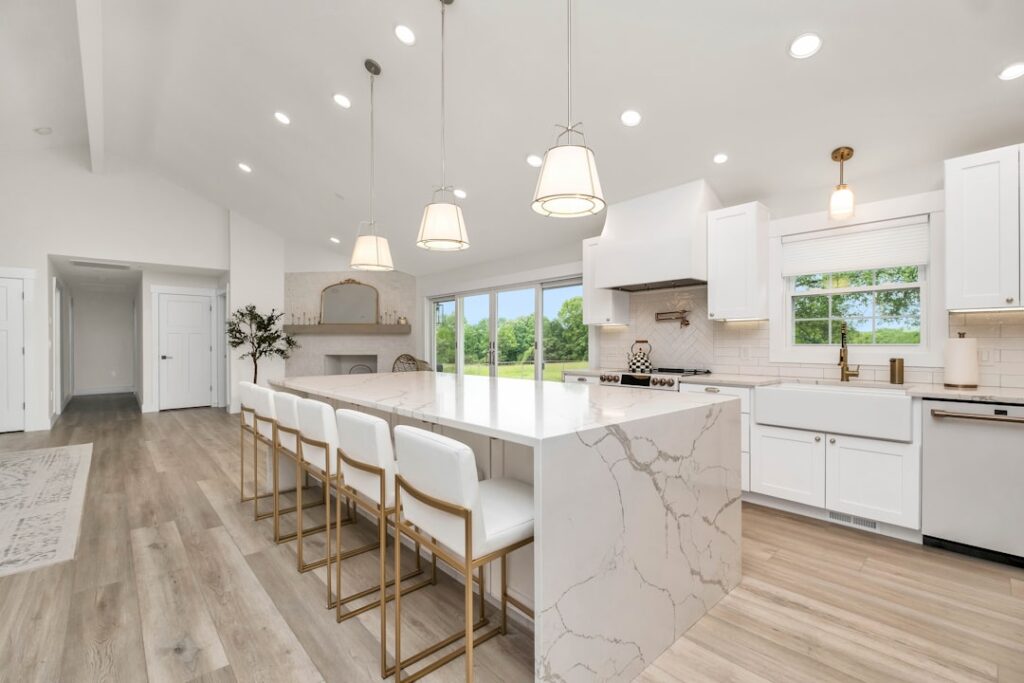
Part of quartz’s appeal is how customizable the finished look is, and these choices affect both style and price. Edge profiles range from a simple eased or pencil edge, the most affordable and the cleanest modern look, up to beveled, bullnose, ogee, and mitered waterfall edges that wrap the stone down the side of an island for a dramatic, thick appearance. Surface finishes vary too: a standard polished finish gives the bright, reflective look most people picture, while honed (matte) and textured finishes deliver a softer, more contemporary feel that also hides fingerprints better. Pattern selection is where quartz really flexes, from clean solid colors to convincing marble-look veining that runs consistently across the slab. When you’re picking a slab, view a full-size sample rather than a small chip, since large-scale veining reads very differently across a whole countertop. Spend a little time on these details, because they shape the kitchen’s character as much as the material itself does.
Is Quartz Right for Your Kitchen?
For most homeowners who want a beautiful, durable countertop that demands almost no upkeep, quartz is an easy recommendation. It resists stains and bacteria, never needs sealing, and offers an enormous range of designed looks. Just respect its two real weaknesses, heat and UV, by using trivets and keeping it indoors. Choose a reputable fabricator, get firm installed quotes, and your quartz stone countertops will deliver years of low-maintenance good looks in the busiest room of your home.