Walk the insulation aisle asking for a 2×6 wall batt and you will find three contenders — R19, R21, and R23 — and only one of them fully uses the cavity. R23 insulation is, for practical purposes, the Rockwool (mineral wool) batt made for 2×6 framing: 5.5 inches thick, dimensionally exact, and delivering the highest R-value you can get from a batt in that wall. Once crews try r23 insulation and see how it friction-fits and cuts, most of them stop speccing fiberglass for above-grade walls entirely. Here is where R23 fits in code, how it stacks against the alternatives, and what it costs.
What Exactly Is an R23 Batt?
The dominant product is Rockwool Comfortbatt R23: stone wool spun from molten basalt and slag, sized 5.5 x 15.25 inches (16-inch on-center framing) or 5.5 x 23 inches (24-inch OC), in bags of 8 to 12 batts covering roughly 30 to 40 sq ft. The spec sheet numbers that matter:
- R-value: R23 at 5.5-inch thickness — about R4.2 per inch
- Density: roughly 2.5 lb per cubic foot, versus about 0.5 to 0.7 for standard fiberglass batts
- Fire: non-combustible, melting point around 2,150°F; it doubles as a fire-resistive material
- Sound: NRC-boosting density makes a noticeable STC improvement in exterior walls over low-density fiberglass
- Water: hydrophobic — it sheds bulk water and does not slump when damp, and it is unfriendly territory for mold and rodents
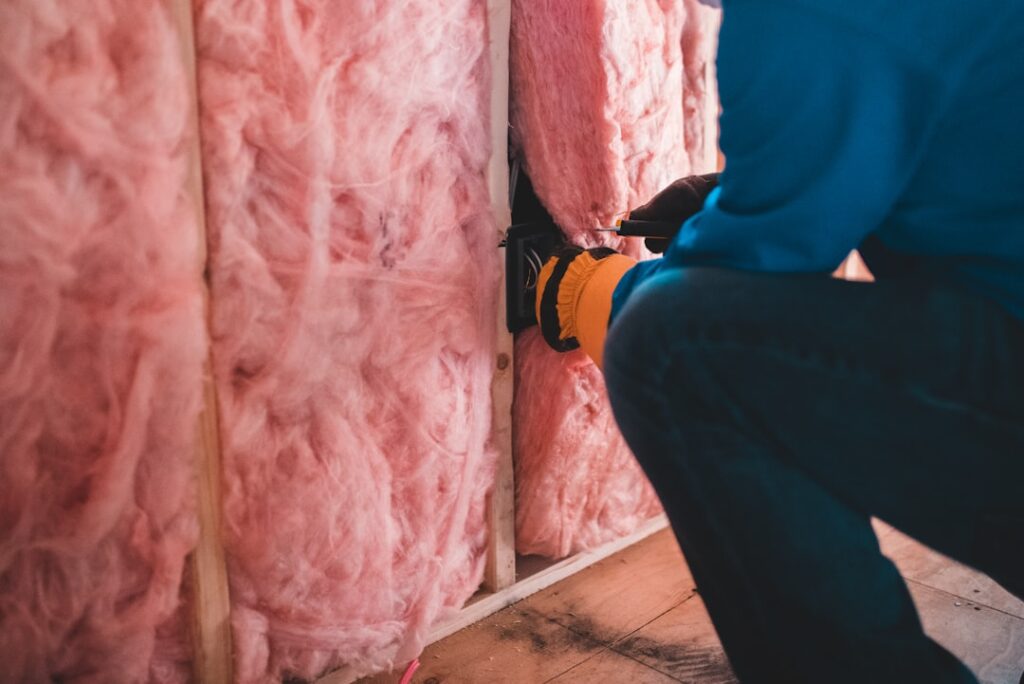
Because stone wool is semi-rigid, batts friction-fit and stand in the cavity without stapling, and you cut them with a serrated bread knife to a clean edge — which is exactly why real-world installed quality (RESNET Grade I fills) is easier to achieve than with floppy fiberglass.
R23 vs R19 vs R21 in a 2×6 Wall
All three are marketed for 2×6 walls; they are not equivalent.
- R19 fiberglass: manufactured 6.25 inches thick and rated at that loft. Compress it into a 5.5-inch cavity — which every 2×6 wall does — and it performs at about R18. It is the cheapest option and the weakest.
- R21 fiberglass: a high-density batt made at 5.5 inches, so it delivers its full R21 in the cavity. Firmer than R19, floppier than stone wool.
- R23 stone wool: full R23 at 5.5 inches, plus the fire, sound, and moisture behavior above.
The delta sounds small — R23 versus an effective R18 is about 25% more cavity resistance — but whole-wall performance also hinges on install quality, and this is where the semi-rigid batt quietly wins: gaps and compressions that knock a sloppy fiberglass job down a full letter grade are hard to produce with stone wool. If you are paying a crew by the wall, the material that installs correctly by default is worth real money.
Where R23 Fits the Energy Code
Under the 2021 IECC, prescriptive wood-frame wall requirements read as “20 or 13&5” and up, meaning R20 cavity alone, or R13 cavity plus R5 continuous exterior foam, with colder zones stepping to R20+5 or R13+10. Practical translation by climate zone:
- Zones 1-2 (Gulf South, Florida): R13 in 2×4 walls still passes; R23 is beyond requirement — nice, not necessary
- Zones 3-5 (mid-South through lower Midwest): R20 cavity minimum makes R23 in a 2×6 a clean prescriptive pass with margin
- Zones 6-8 (northern tier): R20+R5ci or R13+R10ci — an R23 batt plus 1 inch of exterior polyiso or graphite EPS is a common compliant assembly
Many states still enforce 2015 or 2018 IECC, where straight R20 or R21 cavity satisfies zones 3 through 8, so R23 passes everywhere a 2×6 wall is prescriptively allowed. It is also a favorite for Energy Star and performance-path builds because the honest installed R-value narrows the gap between design and blower-door reality.
Beyond Walls: Other Places R23 Earns Its Keep
The 5.5-inch format maps to more than exterior walls. In floors over garages and crawl spaces framed with 2×6 (older homes), R23 friction-fits between joists and stays put without rods or netting — its rigidity is a genuine advantage overhead. In basement walls furred with 2×6, stone wool’s moisture indifference makes it a safer cavity fill than fiberglass against interior-side dampness (still pair with proper foundation moisture control). And in interior 2×6 plumbing or media walls, an R23 batt is overkill thermally but superb acoustically; most people drop to Rockwool Safe’n’Sound there, but leftover Comfortbatt does the job. What R23 is not for: 2×4 walls (it will not compress in usefully) and attic flats, where blown insulation to R49-R60 is cheaper per R.
Cost and Coverage Math
Street pricing moves, but current big-box ballparks: R23 Comfortbatt runs about $1.50 to $2.10 per sq ft; R21 high-density fiberglass about $1.10 to $1.50; R19 fiberglass $0.70 to $1.00. On a 2,000 sq ft two-story with roughly 1,800 net sq ft of exterior wall cavity, that is approximately $2,700 to $3,800 in R23 material versus $1,300 to $1,800 for R19 — a $1,400 to $2,000 upgrade for measurably better thermal, fire, and sound performance for the life of the house. Professional batt installation adds $0.60 to $1.20 per sq ft in labor either way. One bag of 16-inch OC R23 covers about 34.5 sq ft; divide net wall area by 34 and round up, then add a bag for the cuts around openings.
Installing R23 Right
Stone wool installs fast, but the details still decide the blower-door number:
- Air-seal first: caulk plates, foam penetrations, and gasket boxes. Batts are not air barriers; R23 over leaks is lipstick.
- Cut batts 1/4 inch oversize with a serrated knife against a board straightedge for a compression fit.
- Split batts around wiring — slice the batt’s thickness so half passes behind the cable and half in front, rather than compressing the full batt over it.
- Cut tight collars around boxes and pipes; a 1-inch void around an outlet box is a thermal chimney.
- Check for proud batts before drywall — stone wool should sit flush, not bulge past the studs.
- In climate zones 5 and colder (and per local code), add the interior vapor retarder: kraft facing does not exist on Comfortbatt, so use a smart membrane (MemBrain, Intello) or certainteed-style poly where required.
Wear long sleeves and an N95 — stone wool itch is milder than old-school fiberglass but real.
R23 in Retrofits and Deep-Energy Upgrades
New construction gets the easy install; retrofits are where the judgment calls live. Gut-renovation of a 2×6 house is the ideal R23 moment — walls open, wiring visible, air-sealing accessible — and the incremental cost over reusing old fiberglass is trivial against the drywall and paint you are already buying. Trickier is the 2×4 house: an R23 batt physically cannot go in a 3.5-inch cavity, and the retrofit answer there is R15 mineral wool in the cavity plus exterior continuous insulation at re-siding time. For additions, matching matters less than people think — an R23 addition wall on an R13 original house is fine; heat loss is per-assembly, not averaged. One more retrofit niche: rim joists and knee walls. Leftover R23 batts, cut snug and paired with an air barrier, upgrade the two most neglected assemblies in older homes for the cost of a weekend. If you are chasing a deep-energy target (Pretty Good House or Passive House-adjacent numbers), treat R23 as the cavity layer of a wall system — the modeling only pencils when it sits behind meticulous air-sealing (aim for 2 ACH50 or better) and at least R5 to R10 of thermal-bridge-killing exterior foam or wood-fiber board.
Bottom Line: Who Should Buy R23
Choose R23 when you are framing or gutting 2×6 exterior walls and want the best batt-based assembly without exterior foam; when fire performance matters (wildland-urban interface, attached garages, zero-lot-line walls); or when street noise is part of the complaint list. Choose R21 fiberglass when budget rules and your installer is meticulous. Choose R19 only when it is going somewhere it can actually loft to 6.25 inches — which a 2×6 wall is not. And in zones 6 and up, remember the code math likely wants continuous exterior insulation regardless of which batt you pick; an R23 cavity plus R5 of exterior foam is one of the best-value cold-climate walls you can build today.