Step onto a cold porcelain floor at 6 a.m. in January and you understand why radiant flooring has quietly taken over new-build bathrooms across the country. Instead of blasting hot air that rises to the ceiling, radiant systems warm the floor, the furniture, and ultimately the air from the ground up. Room temperatures drop 2-4°F below what forced-air requires for the same comfort, which is why serious builders include radiant in spec on nearly every premium project now.
How Radiant Systems Actually Work
Radiant heat uses either hot water (hydronic) or electric resistance cable to warm a slab or underlayment. The floor surface typically runs 80-85°F — warm, not hot — and transfers heat directly to anything in contact with it. This dodges the drafts, dust kickup, and temperature stratification problems of forced-air HVAC.
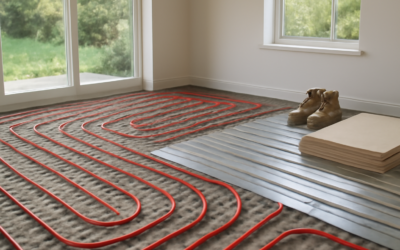
Hydronic systems rely on a boiler, manifold, and flexible PEX tubing looped through the slab or under the subfloor. Electric systems use a thin mat or cable embedded in thinset or self-leveler below the finish floor. Each has a clear use case.
Electric Radiant
Electric radiant is the easier retrofit. Mats from Warmup, SunTouch, Schluter Ditra-Heat, and Nuheat install in a single day for a bathroom. Expect $10-$16 per sq ft for the mat and thermostat, plus $6-$10 per sq ft of labor. Electric runs hotter per watt than hydronic but costs more to operate — sensible for bathrooms, mudrooms, and kitchens where you want a warm floor on demand, not whole-house heating.
Installation tip: always use a floor sensor paired with an air sensor thermostat, not just ambient air. The floor temp is what you actually want regulated, and a dual-sensor Nuheat or Warmup 4iE thermostat prevents overheating delicate finishes.
Hydronic Radiant
Hydronic runs more efficient at whole-house scale because water carries 3,500 times more heat per volume than air. A modulating-condensing boiler paired with zoned manifolds and 1/2-inch PEX heats a typical 2,500 sq ft home for 20-35% less than a conventional forced-air system over a full heating season.
Installed pricing lands at $8-$15 per sq ft for embedded slab systems in new construction and $12-$22 per sq ft for under-floor retrofits using aluminum heat-transfer plates. Boiler and manifold hardware add $4,000-$9,000 upfront. Payback relative to a heat-pump air system typically runs 8-12 years in cold climates, faster if you were going to install a boiler anyway.
Finish Floors That Work
Not every floor belongs over radiant heat:
- Porcelain and ceramic tile — ideal, conducts heat well, no movement issues
- Engineered hardwood — approved by most manufacturers up to 80°F floor temperature
- LVP and SPC — compatible if rated by the manufacturer, watch max surface temp
- Polished concrete — pairs naturally with embedded hydronic
- Solid hardwood — risky, can cup and gap; most manufacturers void warranties
- Thick carpet with heavy pad — insulates heat away, defeats the system
Always confirm the floor’s R-value plus pad stays under about R-2.0 for efficient heat transfer.
Pros of Radiant Flooring
- Comfortable even heat with no drafts or air circulation
- Silent operation — no blower noise
- No dust or allergens blown around the room
- Frees wall space that would house vents and returns
- 20-30% energy savings at equivalent comfort for hydronic systems
- Works perfectly with high-efficiency condensing boilers and solar thermal
Cons and Trade-offs
- Higher upfront cost than conventional HVAC
- Slow to warm up — 2-4 hour lag means you run on setbacks, not on/off
- Repairs in embedded systems are invasive — access requires cutting the slab
- Not ideal sole heat in high-ceiling rooms or spaces with lots of glass that lose heat fast
- Adds floor height (1/4 to 1-1/2 inches) which may require door trimming
Cost Summary
For a 2,500 sq ft home:
- Full hydronic radiant (new build): $28,000-$52,000 installed
- Electric radiant in two bathrooms plus kitchen (500 sq ft): $8,500-$15,000
- Retrofit hydronic under-floor plate system: $38,000-$65,000
Budget 10-15% contingency for unknowns — plumbing route changes, subfloor reinforcement, and electrical service upgrades often surface mid-project.
Common Install Mistakes
Three failures I see repeatedly: underlayment with too much insulation between the heating element and the finish floor (wastes watts), thermostat sensor probes installed in the wrong zone, and failure to do a hydrostatic pressure test on hydronic loops before the slab pour. A leak discovered after the slab cures costs tens of thousands to chase.
Controls and Zoning
Modern radiant systems divide into zones by room function. Bedrooms run cooler (65°F); bathrooms run warmer (74°F); great rooms take the middle. Smart thermostats from Ecobee and Warmup 4iE handle multi-zone scheduling and geofencing. Build in at least one zone per level and per functional area; more zones equal more comfort at a modest added cost.
Maintenance Expectations
Electric radiant mats are nearly zero-maintenance once installed — no moving parts, no fluid to refill. The thermostat is the only component likely to need replacement in 15-20 years. Hydronic systems require annual boiler service, pressure checks, and glycol or inhibitor top-offs every 5-7 years. Budget $200-$400 per year for professional hydronic maintenance to preserve warranty coverage.
Is It the Right Call?
For bathrooms, kitchens, and mudrooms, radiant flooring is close to a no-brainer if you’re renovating down to the subfloor — the comfort upgrade is dramatic and the payback on electric mats is short. For whole-house hydronic, the math favors new builds and high-end remodels in cold climates where the comfort and efficiency compound over decades. Run the numbers against your own fuel cost, and get two or three bids with specific manufacturer product listed.
Prefer to explore on your own?
See how new flooring looks in your actual room in seconds — free, no signup.
Try the free Floor Studio →