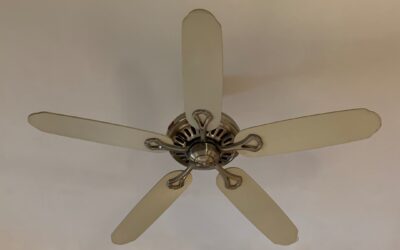
Standard ceiling fans hang down 12 inches or more from the ceiling, which is fine in a room with 9-foot ceilings but a genuine hazard in a bedroom with an 8-foot ceiling. That is where a recessed ceiling fan earns its place. By mounting the motor housing partially inside the ceiling and keeping the blades tight to the surface, these fans deliver real airflow without eating into headroom or dominating the room visually. If you have low ceilings, a sloped roofline, or simply want a cleaner look, this is the fan style to understand.
What Makes a Fan “Recessed”
The term recessed gets used a couple of ways, so it helps to be precise. In the strictest sense, a recessed ceiling fan has its motor housing set up into the ceiling cavity, so the blades sit nearly flush with the finished ceiling. More commonly, retailers use “recessed,” “flush mount,” “hugger,” and “low-profile” almost interchangeably to describe any fan that mounts directly to the ceiling with no downrod.
The practical result is the same: the fan sits high and tight, typically putting the blades just 7 to 10 inches below the ceiling instead of the 12 to 18 inches of a downrod-mounted fan. That difference is exactly what makes them safe and comfortable under low ceilings.
Why Choose a Recessed Fan
These fans solve specific problems, and knowing them helps you decide if one is right for your room:
- Low ceilings: code and common sense call for at least 7 feet of clearance from floor to blades. On an 8-foot ceiling, only a flush or recessed fan reliably meets that.
- Clean, modern aesthetics: without a dangling downrod, the fan reads as part of the ceiling rather than a fixture hanging in the room.
- Small rooms: in a compact bedroom, office, or laundry room, a hugging fan feels less bulky and intrusive.
- Safety: keeping blades high reduces the risk for tall people, loft beds, and raised platforms.
The Airflow Tradeoff
Here is the honest engineering reality: mounting a fan tight to the ceiling reduces its efficiency compared with a downrod fan. Air needs space above the blades to circulate freely, and a flush-mounted fan restricts that intake. As a result, recessed and hugger fans typically move somewhat less air, measured in cubic feet per minute (CFM), than the same fan on a downrod.
You can offset this. Look for a fan with a strong CFM rating — good hugger fans still deliver 4,000 to 6,000 CFM. Choose a model with an efficient DC motor, which produces more airflow per watt. And size the blade span correctly for the room, since a properly sized fan compensates for the mounting penalty. The tradeoff is real but manageable for most bedrooms and living spaces.
Sizing a Recessed Ceiling Fan
Match blade span to room size for the best air movement:
- Up to 75 sq ft (bathroom, small office): 29 to 36 inch blades
- 76 to 144 sq ft (bedroom, kitchen): 36 to 44 inch blades
- 145 to 225 sq ft (living room, master bedroom): 44 to 54 inch blades
- Over 225 sq ft (great room): 54 inch or larger, or two fans
Also confirm the fan is rated for your ceiling clearance and, if it is going in a bathroom, sunroom, or covered porch, that it carries a damp or wet location rating.
Installation Basics
Installing a flush-mount fan is a manageable DIY job for anyone comfortable with basic wiring, but it demands the right electrical box. A fan must hang from a UL-listed fan-rated ceiling box that supports at least 35 pounds and mounts to a joist or a rated brace bar. Never hang a fan from a standard light-fixture box — it can pull loose.
The general sequence:
- Turn off power at the breaker and confirm it is dead with a voltage tester.
- Remove the old fixture and verify the box is fan-rated; replace it if not.
- Mount the fan’s ceiling bracket to the box.
- Connect wiring: black to black (line), white to white (neutral), and green or bare to ground; blue is the light kit if present.
- Attach the motor housing tight to the bracket, install the blades, then the light kit and glass.
- Restore power and test all speeds and the reverse switch.
Because recessed fans put the motor close to the ceiling, make sure any wire connections tuck neatly into the box without strain.
Features Worth Paying For
Modern low-profile fans pack in features that improve comfort and efficiency. A reversible motor lets you run blades clockwise in winter to push warm air down, cutting heating costs. Integrated LED light kits eliminate the need for a separate ceiling light in the room. Remote controls or smart-home compatibility add convenience, and dimmable, color-adjustable LEDs let you tune the light from warm to bright. For bedrooms, look for a fan rated quiet — a good DC-motor hugger runs nearly silent.
Is a Recessed Fan Right for You
Choose a recessed ceiling fan when headroom is limited, when you want an uncluttered ceiling, or when a downrod fan would simply hang too low to be safe. Accept the modest airflow tradeoff by buying a well-rated, correctly sized model with an efficient motor. For rooms with tall ceilings, a downrod fan will always move more air and is the better pick. But for the millions of homes with 8-foot ceilings, a quality low-profile fan is the smart, safe way to stay comfortable year-round.
Maintenance and Troubleshooting
Recessed and low-profile fans collect dust on the blades just like any other, and because they sit so close to the ceiling that grime is easy to miss until it starts flinging streaks onto the paint. Wipe the blades every couple of months with a microfiber cloth or an old pillowcase slipped over each blade — the pillowcase trick catches the dust instead of dropping it on the floor. A balanced, clean blade set runs quieter and lasts longer.
Wobble is the most common complaint, and it is almost always fixable. First confirm the mounting bracket is tight against the box and the box itself is a fan-rated support. Then run the balancing kit that ships with most fans: clip the weight to each blade in turn to find the heavy one, then stick the adhesive weight in place. A persistent hum usually traces to a cheap wall dimmer feeding a non-dimmable motor — swap in the manufacturer’s control or a compatible fan switch and the noise disappears.
Frequently Asked Questions
Do recessed fans move as much air as standard fans?
Not quite. Sitting closer to the ceiling gives the blades less room to draw air, so a flush-mount typically moves somewhat less air than a downrod fan of the same diameter. Choosing a model with a strong CFM rating narrows the gap considerably.
What ceiling height needs a recessed fan?
Code calls for at least 7 feet from floor to blades. Any ceiling under about 8 feet is a candidate for a flush-mount or hugger fan, which keeps the blades safely up while still clearing tall people and doors.
Can I put a recessed fan on a sloped ceiling?
Yes, but you need a sloped-ceiling adapter, and many true flush-mount fans are not rated for steep angles. Check the maximum slope the model allows before buying, or plan on a short downrod with an angled canopy instead.
Do they come with lights?
Many do, with an integrated LED panel that keeps the whole fixture slim. If ceiling clearance is your reason for going recessed, a light-integrated model saves you from hanging a separate fixture nearby.
Are recessed fans harder to install than standard fans?
Not really. A flush-mount fan actually skips the downrod assembly, so there is one less step, and the process is otherwise the same: a fan-rated ceiling box, the mounting bracket, the wiring, and the canopy. The one thing to watch is that the fan-rated box is anchored to a joist or a listed brace, because the whole fixture hangs on it. If you are replacing an existing light with a fan, confirm the old box is fan-rated first, since a standard light box is not built to carry the weight and vibration of a spinning motor.