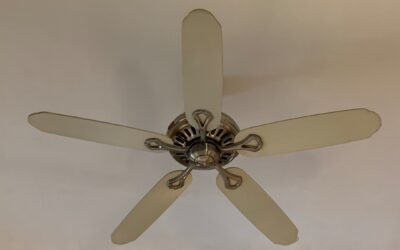
If your ceiling sits at eight feet or lower, a standard downrod fan can leave dangerously little headroom and looks bulky besides. An ultra low profile ceiling fan, also called a hugger or flush-mount fan, bolts the motor housing tight against the ceiling so the blades hang just a few inches down, preserving clearance while still moving real air. This guide covers how these fans work, the clearance math that keeps them code-compliant, and how to pick one that cools without feeling like a compromise.
What Counts as Ultra Low Profile
A conventional ceiling fan hangs from a downrod that drops the blades 12 inches or more below the ceiling. A low-profile or hugger fan eliminates the downrod, mounting the motor flush so the blades sit roughly 6 to 8 inches from the ceiling. The “ultra” tier pushes that even tighter, with some models placing the blades just 5 to 7 inches down and total housing depth under 8 inches. That difference is the whole point: on an 8-foot ceiling, every inch of blade clearance matters.
Building codes require at least 7 feet of clearance from the floor to the blades and a minimum of 18 inches from the blade tips to any wall or obstruction. A hugger fan is what makes those numbers work in a room where a downrod fan would put the blades below head height.
When You Actually Need One
Reach for an ultra low profile fan when your ceiling is 8 feet or shorter, which is common in older homes, bedrooms, hallways, laundry rooms, closets, and finished basements. They are also the right call for rooms where tall people or lofted beds bring heads close to the ceiling. If your ceiling is 9 feet or higher, a standard downrod fan is usually the better performer because it hangs the blades down into the optimal 8-to-9-foot sweet spot for air circulation.
The Airflow Trade-Off
Here is the honest catch: hugger fans generally move less air than downrod fans of the same size. Mounting the blades close to the ceiling restricts the air the fan can draw from above, so the motor has less room to work. Manufacturers rate airflow in CFM (cubic feet per minute), and a good low-profile fan should deliver at least 4,000 to 5,000 CFM, with strong models reaching 6,000 or more. Always check the CFM number rather than assuming a fan performs well; two similar-looking huggers can differ by 2,000 CFM.
To claw back some performance, look for a fan with a slightly steeper blade pitch (12 to 14 degrees) and a robust DC or high-quality AC motor. DC motors are especially worth it here because they push more air per watt and run quieter, which matters in the small, low-ceilinged bedrooms where these fans usually live.
Sizing the Blade Span to the Room
Blade span should match room size for effective cooling. Use these rough guidelines:
- Up to 75 sq ft (bathrooms, closets): 29 to 36 inch span.
- 76 to 175 sq ft (bedrooms, kitchens): 42 to 48 inch span.
- 176 to 350 sq ft (living rooms, master bedrooms): 52 to 56 inch span.
- Over 350 sq ft: 60 inch or larger, or consider two fans.
Also respect the 18-inch wall clearance rule when choosing span, so the blades never clip trim, cabinets, or a sloped ceiling edge.
Lighting and Control Features
Most ultra low profile fans include integrated LED light kits, which keep the whole fixture compact and add just an inch or two to the depth. Look for adjustable color temperature (2700K warm to 5000K cool) so you can tune the light to the room. Because these fans mount high and tight, a remote control or wall control is nearly essential; reaching a pull chain on a flush fan is awkward. Smart models add app and voice control, scheduling, and reverse-season switching from your phone.
Speaking of seasons, confirm the fan has a reversible motor. Running it clockwise on low in winter pushes warm air trapped at the ceiling back down into the room, a genuine benefit in the low-ceiling spaces where these fans are installed.
Installation Notes
A flush-mount fan installs much like any ceiling fan and is a reasonable DIY job if you are comfortable with basic wiring. The critical requirement is a fan-rated electrical box, a metal box rated to hold the weight and vibration of a moving fan. A standard lighting box is not adequate and can let the fan pull loose over time. Turn off the breaker, mount the rated box securely to a joist or brace, connect the wiring (black to black, white to white, ground to ground), and bolt the housing tight to the ceiling.
Because there is no downrod, hugger fans are actually a bit easier to hang than downrod models, with fewer parts to assemble. If your ceiling box is not fan-rated, install a support brace before proceeding, or hire an electrician for that step. Expect professional installation to run $100 to $250 depending on wiring complexity.
What They Cost
- Basic: $50 to $100 for a simple flush-mount with an AC motor and pull chain.
- Mid-range: $120 to $250 for DC motors, remote control, and integrated LED.
- Premium/smart: $250 to $500 for app control, quiet DC motors, and designer finishes.
The mid-range is the value sweet spot: a DC motor pays for itself in quieter operation and lower energy use, and the remote is a practical necessity for a flush fan.
Blade Count and Style Considerations
Blade count matters less than people think for performance; airflow depends more on motor quality, pitch, and CFM than on how many blades spin. That said, style and noise do vary. Three-blade fans look modern and often spin efficiently, four to five blades give a traditional look and can run slightly quieter due to balance, and some ultra-slim designs use two wide blades for a sleek profile. For a low-ceiling bedroom, prioritize a fan rated for quiet operation, ideally with a DC motor, since you will hear it more in a small enclosed space. Blade finish should match your decor: white blends into most ceilings, while wood tones or black make a statement.
Energy Use and Operating Cost
Ceiling fans are cheap to run, and a low-profile model is no exception. A typical fan draws 15 to 90 watts depending on speed and motor type, costing just a few dollars a month even with daily use. DC-motor fans are the efficiency champions, using up to 70 percent less energy than comparable AC models while moving the same air. Remember that a fan cools people, not rooms, by creating a wind-chill effect on your skin, so turn it off when you leave to save energy. Used correctly with your air conditioner, a fan lets you raise the thermostat about 4 degrees Fahrenheit with no loss of comfort, which trims cooling bills noticeably over a summer.
Common Questions
Will a hugger fan cool as well as a regular fan? In a low room, yes, because the blades still sit at a good height relative to you. In a tall room, a downrod fan performs better by dropping into the optimal zone. Match the fan type to the ceiling height.
Can I put a low-profile fan on a sloped ceiling? Only with a compatible sloped-ceiling adapter, and many flush-mount fans do not support steep slopes. Check the maximum slope rating before buying.
Do I need a special box? Yes, a UL-listed fan-rated electrical box is required to support the weight and vibration. Never hang a fan from a standard lighting box.
Making the Right Choice
An ultra low profile ceiling fan is the correct solution for any room with an 8-foot or lower ceiling where clearance and safety come first. Accept the modest airflow trade-off, then minimize it by choosing a high-CFM model with a DC motor and adequate blade pitch. Match the span to the room, insist on a fan-rated box, and add a remote or smart control. Done right, a hugger fan keeps a low room comfortable and code-compliant without ever grazing anyone’s head.