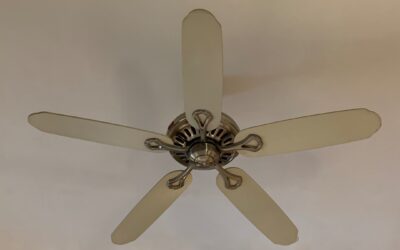
Rooms with low ceilings have a real problem: a standard ceiling fan on a downrod hangs too close to head height, and a bulky light kit only makes it worse. The fix is a low profile ceiling fan no light — a flush-mount “hugger” fan that bolts tight against the ceiling and skips the light fixture entirely for maximum clearance and a clean, minimal look. This guide covers why these fans exist, how to size one, what airflow to expect, and how to choose and install the right hugger for your space.
- What “Low Profile” Really Means
- Who Needs a No-Light Hugger Fan
- Sizing the Fan to the Room
- Understanding Airflow (CFM)
- Motor Types: DC vs. AC
- Don’t Forget Reverse and Blade Pitch
- Installing a Low-Profile Fan
- Choosing the Right One: A Checklist
- The Bottom Line
- Flush-Mount vs. Standard Downrod: The Airflow Trade-Off
- Frequently Asked Questions
What “Low Profile” Really Means
A low profile or flush-mount fan mounts directly to the ceiling with no downrod, so the motor housing sits just a few inches below the surface. Where a standard fan on a downrod might drop 12 inches or more, a hugger fan typically hangs only 6 to 9 inches from the ceiling to the blades. Skipping the light kit removes another few inches of drop and simplifies the fixture, which is exactly what you want when clearance is tight.
Building codes and safety guidance call for at least 7 feet of clearance from the floor to the fan blades. In a room with an 8-foot ceiling, a low-profile fan keeps you safely above that line, while a standard downrod fan can bring the blades uncomfortably — and unsafely — low.
Who Needs a No-Light Hugger Fan
- Rooms with 8-foot or lower ceilings where a downrod fan would hang too low.
- Bedrooms and closets where you want air movement but already have separate lighting.
- Basements, attics, and bonus rooms with limited headroom.
- Bathrooms and laundry rooms that need airflow but not another light source.
- Minimalist interiors where a clean, fixture-free ceiling look is the goal.
Choosing no light also means one less thing to wire, fewer bulbs to replace, and a lower, sleeker silhouette.
Sizing the Fan to the Room
Blade span should match room size so the fan actually moves the air where you need it. A rough guide by room area:
- Up to 75 sq ft (small bath, closet): 29 to 36 inch blade span.
- 76 to 144 sq ft (bedroom, office): 36 to 44 inches.
- 144 to 225 sq ft (living room, large bedroom): 44 to 52 inches.
- 225 to 400 sq ft (great room): 52 to 60 inches.
- Over 400 sq ft: 60 inches or larger, or two fans.
An undersized fan in a big room just stirs the air near the center; an oversized fan in a small room can feel like a wind tunnel and look out of scale. Measure the room and match the span.
Understanding Airflow (CFM)
Airflow is measured in cubic feet per minute (CFM) — the volume of air the fan moves on high. More CFM means a stronger breeze. A quick reference:
- Under 4,000 CFM: small rooms and gentle air movement.
- 4,000 to 6,000 CFM: good for average bedrooms and offices.
- 6,000 CFM and up: strong airflow for living rooms and larger spaces.
Because hugger fans mount close to the ceiling, their blades have less room to draw air from above, so a flush-mount often moves slightly less air than the same-size downrod fan. Look for a hugger with efficient blade pitch and a strong motor to make up the difference, and check the CFM rating rather than assuming size alone tells the story.
Motor Types: DC vs. AC
The motor drives efficiency, noise, and features:
- AC motors are the traditional, affordable choice, usually with pull chains or a basic wall switch and three speeds.
- DC motors cost more but use significantly less electricity, run quieter, weigh less, and typically include a remote with more speeds and a reverse function at the push of a button.
For a bedroom where quiet operation matters, a DC-motor hugger is worth the premium. For a utility space, an AC fan is perfectly adequate.
Don’t Forget Reverse and Blade Pitch
A good fan has a reverse switch so it works year-round. In summer, run it counterclockwise to push air down and create a cooling breeze. In winter, run it clockwise on low to pull cool air up and gently push warm air down off the ceiling, evening out room temperature and trimming heating costs. Blade pitch — the angle of the blades — affects how much air moves; a steeper pitch of 12 to 15 degrees moves more air, which helps a low-profile fan compensate for its tight mounting.
Installing a Low-Profile Fan
A flush-mount fan installs much like any fan, minus the downrod and light wiring:
- Turn off power at the breaker and confirm it is off with a voltage tester.
- Confirm a fan-rated box. The electrical box must be UL-listed for fans and fastened to a joist or brace — a standard light box is not strong enough.
- Mount the bracket to the box; flush-mount fans use a low-profile bracket the housing hugs against.
- Connect the wiring: black to black (hot), white to white (neutral), and green or bare to ground. With no light, there is no separate light wire to worry about.
- Secure the motor housing tight to the ceiling bracket and attach the blades evenly.
- Restore power and test all speeds and the reverse function; check for wobble and tighten any loose screws.
Because the fan sits so close to the ceiling, keeping the blades balanced matters even more, since there is little room to correct a shimmy after the fact.
Choosing the Right One: A Checklist
- Blade span matched to room size.
- CFM rating high enough for the space, remembering huggers move a bit less air.
- Motor type — DC for quiet, efficient bedrooms; AC for budget utility spaces.
- Reverse function for year-round use.
- Control style — remote, wall control, or pull chain to suit your wiring.
- Finish and blade style to match your decor.
- Damp or wet rating if installing in a bathroom, covered porch, or laundry.
The Bottom Line
A low-profile ceiling fan with no light is the right call whenever ceiling height is tight and you already have lighting handled. It preserves headroom, keeps you safely above the 7-foot clearance line, and gives a clean, uncluttered ceiling. Size the blade span to your room, check the CFM so it actually moves enough air, pick a DC motor if quiet efficiency matters, and mount it to a proper fan-rated box. Get those details right and a flush-mount hugger delivers the comfort of a full-size fan without stealing an inch of the headroom you cannot spare.
Flush-Mount vs. Standard Downrod: The Airflow Trade-Off
It is worth being honest about the one downside of going flush-mount. Because the blades sit only a few inches from the ceiling, they cannot pull air from above as freely as a fan hanging on a downrod. That restricted intake means a hugger typically moves somewhat less air than an identical fan on a downrod, and the breeze may feel a little less direct. Manufacturers compensate with steeper blade pitch and stronger motors, so a well-designed hugger still cools a room effectively — but if you have the ceiling height for a downrod fan, a standard mount will generally out-move a flush mount of the same size.
The takeaway is simple: use a low-profile fan when clearance forces your hand, and lean toward a higher-CFM model to make up for the mounting. Where you have 9-foot or taller ceilings, a downrod fan is usually the better performer.
Frequently Asked Questions
What ceiling height needs a low-profile fan?
Rooms with 8-foot ceilings or lower are the classic case. A downrod fan in an 8-foot room can drop the blades below the safe 7-foot clearance line, while a hugger stays comfortably above it.
Can I add a light later?
Some flush-mount fans accept an add-on light kit, but many no-light models are sealed and do not. If there is any chance you will want light, confirm the fan is light-adaptable before buying.
Are hugger fans noisier?
Not inherently. Noise depends on motor quality and balance, not mounting style. A DC-motor hugger runs very quietly; a cheap fan of any type can hum.