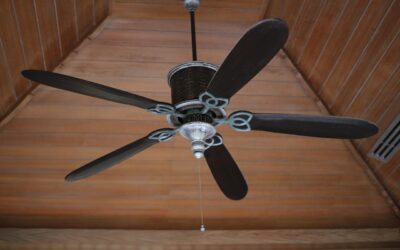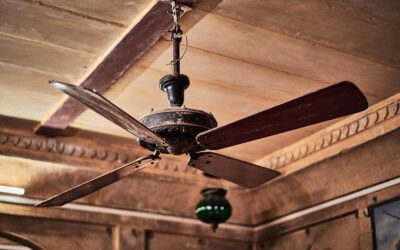
Standard ceiling fans hang from a downrod that drops the blades 12 inches or more below the ceiling, which turns a room with 8-foot ceilings into a headroom hazard. A hugger ceiling fan with light — also called a flush-mount or low-profile fan — mounts the motor housing directly against the ceiling so the blades sit just 7 to 9 inches down, clearing tall guests and doorframes while still moving real air. If your ceilings measure 8 feet or lower, this style is not a compromise; it’s the correct tool for the job. This guide covers sizing, airflow trade-offs, light options, and a clean installation.
What Makes a Fan a Hugger
Building codes require fan blades to clear the floor by at least 7 feet for safe operation. In a room with an 8-foot ceiling, a standard fan with a 6-inch downrod plus a 10-inch motor housing eats into that clearance fast. A hugger design eliminates the downrod entirely, bolting the motor flush so the whole assembly hangs only about 8 to 11 inches from the ceiling.
The integrated light is what makes these fans a genuine two-in-one fixture. Because low-ceiling rooms often can’t spare a separate light fixture, the built-in LED or glass-shade light replaces the ceiling light you’d otherwise lose. You get airflow and illumination from one electrical box.
The Airflow Trade-Off You Should Know
Honesty first: a flush-mount fan moves slightly less air than the same-size fan on a downrod. Pushing the blades tight to the ceiling restricts the air the fan can draw from above, reducing efficiency by roughly 10 to 20 percent. Manufacturers measure this in CFM (cubic feet per minute), and a good 52-inch hugger delivers 4,000 to 5,000 CFM versus 5,000 to 6,000 for a downrod model.
For 8-foot ceilings that difference is invisible in daily comfort. You feel a fan’s breeze based on how close it is to you, and a hugger sits lower in the room where you actually are. Only in rooms with 9-foot or taller ceilings does the downrod’s better airflow justify the lost headroom — and at that height you don’t need a hugger anyway.
Sizing the Blade Span to the Room
Blade span drives how much floor a fan can cover. Match the diameter to your room’s square footage rather than guessing:
- Up to 75 sq ft (bathrooms, laundry rooms): 29 to 36-inch span.
- 75 to 175 sq ft (bedrooms, kitchens, offices): 42 to 48-inch span.
- 175 to 350 sq ft (living rooms, large bedrooms): 52 to 56-inch span.
- Over 350 sq ft: 60-inch span, or two smaller fans spaced evenly.
Leave at least 18 inches of clearance between the blade tips and the nearest wall. Center the fan in the room, or over the primary seating or bed if the room is oddly shaped. A 52-inch hugger is the most common choice because it fits the bedrooms and living rooms where low ceilings are most frequent.
Choosing the Right Light
Modern huggers almost always ship with integrated LED light kits rather than replaceable bulbs. That saves energy and lasts 20,000 to 50,000 hours, but it also means the whole light module gets replaced if it fails, so buy from a brand with parts availability like Hunter, Minka-Aire, Hampton Bay, or Casablanca.
Pay attention to two light specs. Lumens measure brightness — aim for 1,000 to 1,500 lumens in a bedroom and 1,500 to 3,000 in a living room or kitchen. Color temperature, measured in Kelvin, sets the mood: 2,700K glows warm and yellow for bedrooms, 3,000K is a versatile soft white, and 4,000K reads crisp and neutral for task areas. Many newer fans offer selectable color temperature via a switch on the housing, letting you tune the light without swapping anything.
Tools and Steps for Installation
A hugger ceiling fan with light installs much like any fixture, but the fan’s weight and vibration demand a fan-rated electrical box. A standard light box will not hold a fan safely.
- Cut the power at the breaker and confirm it’s dead with a non-contact voltage tester.
- Remove the old fixture and verify the box is UL-listed for ceiling fans — it should be metal and marked “Acceptable for fan support.” If not, install a fan-rated brace box between the joists.
- Attach the fan’s mounting bracket to the box with the provided screws.
- Hang the motor housing on the bracket hook if provided, freeing your hands for wiring.
- Connect black to black (hot), white to white (neutral), and the bare or green wire to ground. If the fan has separate blue (light) and black (fan) leads, wire them to two switches or cap the one you won’t use.
- Bolt the housing flush to the bracket, attach the pre-assembled blades, then install the light kit and shade.
Budget about 60 to 90 minutes for a first-timer. If the room has only a single switch, consider adding a fan-and-light remote control — most huggers include one or accept an add-on kit for $20 to $40.
Balancing and Reducing Wobble
A wobbling fan is annoying and, over time, loosens connections. Wobble almost never means the fan is dangerous, but it signals imbalance. First, confirm every blade screw is tight and all blades sit at the same angle. Check that the mounting bracket is snug against the box.
If it still wobbles, use the balancing kit included in the box: a plastic clip and small stick-on weights. Clip the weight to the middle of one blade, run the fan, and move it blade to blade until the wobble is smallest, then adhere a weight at that spot. Dust buildup on blades also throws off balance, so wipe them a few times a year.
Understanding Fan Direction and Seasonal Use
A feature most homeowners never use is the reverse switch, and it makes a hugger fan useful year-round. In summer, blades should spin counterclockwise when you look up at them, pushing air straight down to create a cooling breeze that can make a room feel 4 to 6°F cooler and let you raise the thermostat a few degrees.
In winter, flip the switch so the blades turn clockwise on low speed. This pulls cool air up and gently pushes the warm air trapped near the ceiling back down along the walls, evening out the temperature without a noticeable draft. In a low-ceiling room the effect is subtle but real, and it can trim heating costs by redistributing the warm air that would otherwise stratify overhead. Most huggers put the reverse switch on the motor housing; newer remote-controlled models let you change direction from the handset.
Energy Use and LED Savings
A ceiling fan is one of the cheapest appliances to run, and the integrated LED makes a hugger even more economical. A typical fan motor draws just 15 to 60 watts depending on speed — far less than an air conditioner — so running one in an occupied room almost always saves money by letting you ease off the AC.
The integrated LED light kit is where the newest models really pull ahead of older fans with incandescent bulbs. A pair of 60-watt incandescent bulbs draws 120 watts; an equivalent LED module delivering the same brightness draws around 20 to 30 watts and lasts 20,000 to 50,000 hours. Over the fixture’s life that’s a meaningful saving on both electricity and bulb replacements. Look for the ENERGY STAR label if efficiency is a priority — certified fans move more air per watt and pair with efficient light kits. Just remember to turn the fan off when you leave the room, since a fan cools people, not air, and running it in an empty room only wastes power.
Where Huggers Shine and Where They Don’t
Flush-mount fans belong in bedrooms, kids’ rooms, offices, kitchens, and finished basements — anywhere the ceiling sits at 8 feet or below. They’re the safe, code-friendly choice that still delivers a comfortable breeze and full room lighting from one box.
Skip the hugger if your ceiling exceeds 9 feet, where a downrod fan hangs the blades into the ideal 8-to-9-foot zone and moves more air. Also reconsider for damp locations like covered porches, where you need a UL “damp” or “wet” rated model regardless of profile. For the millions of American homes built with 8-foot ceilings, though, a well-sized hugger with an integrated LED is the smartest fan you can hang.