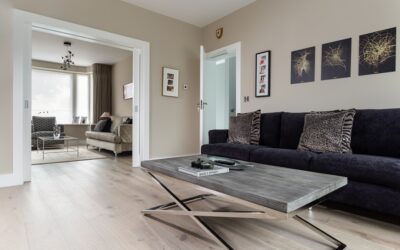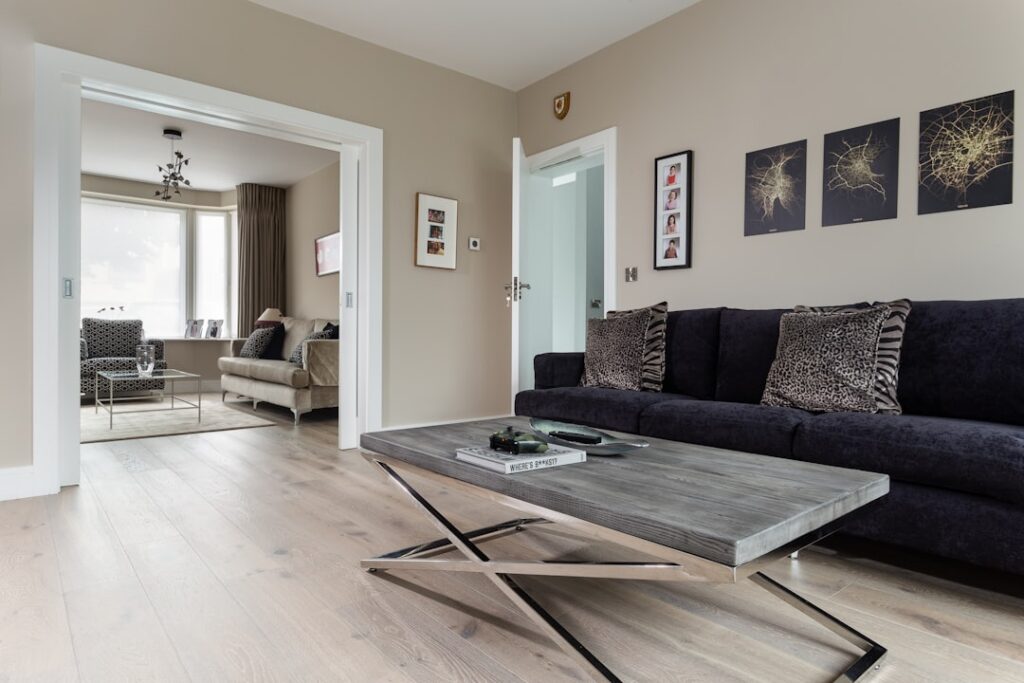
Drive through a 2003-built subdivision in the Midwest and the kitchen floors are almost universally the same warm reddish-brown — Brazilian cherry laminate that defined a decade of homebuilding. Red laminate flooring covers cherry, mahogany, jatoba, redwood, and rosewood looks rendered in melamine-on-HDF planks at $1.49 to $3.99 per square foot. The category fell out of mainstream specifications around 2014 as gray and white-washed looks took over, but red remains popular in traditional homes, lodge-style cabins, and remodels matching original red oak trim.
What Red Laminate Actually Is
Laminate planks are a high-density fiberboard (HDF) core with a printed decor paper and a melamine wear layer pressed under heat and pressure. Red variants use printed decor papers photographed from real Brazilian cherry (jatoba), American cherry, mahogany, or stained red oak boards. The visible color is purely ink — the HDF underneath is gray-brown regardless of the surface tone — which is why edge profiles are colored to match the face.
The richest reds come from Brazilian cherry and African mahogany reproductions, often labeled with names like Imperial Cherry, Heirloom Mahogany, or Royal Jatoba. American cherry runs lighter and pinker. Red-stained oak reads more orange-brown than true red and is the more flexible choice for homes mixing the floor with existing red oak trim.
Where Red Laminate Performs Best
Traditional and craftsman-style homes built between 1990 and 2010 are the natural match. Red trim, oak cabinets, brass hardware, and beige walls call for warm-toned floors, and red laminate ties the existing palette together without the $7 per square foot cost of real Brazilian cherry. Lodge-style cabins, lake houses, and Adirondack-style retreats also work because the deep reddish tones complement log walls and stone fireplaces.
Avoid red laminate in modern minimalist interiors, north-facing rooms with cool gray daylight, and homes scheduled for resale within five years. The current real estate market favors gray and white-washed floors, and red laminate is one of the easiest ways to look dated to a 2026 buyer. For a permanent home you plan to keep, red still works; for a flip, choose a neutral tone.
Pros That Drive the Choice
- Warm traditional aesthetic that complements oak trim, brass fixtures, and earth-tone walls
- Affordable hardwood look at $1.49 to $3.99 per square foot versus $5 to $9 for real Brazilian cherry
- Scratch resistance with AC4 and AC5 wear layers in mid-range and premium lines
- Click-lock installation over almost any flat hard surface, including existing tile
- Dimensional stability at humidity between 30 and 60% with minimal seasonal movement
Drawbacks That Buyers Underestimate
Color stability is the biggest issue. Direct sunlight fades red laminate decor papers faster than gray or neutral colors because red pigments are less photostable than carbon black. Sun-exposed rooms can show visible fading along window paths within 3 to 5 years, and rugs left in place protect the area underneath, creating a visible color difference when furniture is rearranged.
The second issue is style cycling. Red was the dominant warm tone of 1998 to 2012, and homes installing it today commit to a look that will read as “early 2000s” to many viewers. This is fine in a long-term primary home but matters for resale. The third issue is the printed-image artifact — laminate uses a repeating pattern of 4 to 8 unique board images, and red high-character variants show the repeat more visibly than subtle grays.
Cost Breakdown Per Square Foot
- Budget red laminate (7 mm, AC3 rating): $1.49 to $2.29 per square foot
- Mid-range red laminate (10 mm, AC4 rating): $2.29 to $3.29 per square foot
- Premium red laminate (12 mm, AC5 rating, water-resistant core): $3.29 to $3.99
- Foam underlayment with vapor barrier: $0.30 to $0.55 per square foot
- Installation labor: $1.75 to $3.25 per square foot for click-lock floating
A 500 square foot living room and dining room install in mid-range red laminate runs $2,250 to $3,800 turnkey. DIY installation cuts labor and brings the cost down to $1,300 to $2,200 for a competent weekend installer.
How to Choose the Right AC Rating
The AC (Abrasion Class) rating measures durability of the wear layer against foot traffic. AC3 handles residential use including kitchens. AC4 adds light commercial use — home offices with rolling chairs, retail spaces with light traffic. AC5 covers heavy commercial — restaurants, retail entries, public buildings. Most residential buyers should specify AC4 minimum because the price premium over AC3 is small and the durability difference is real.
Wear layer thickness alone does not predict scratch resistance — the layer must also have aluminum oxide particles embedded in the melamine for hardness. Cheap imported laminates skip the aluminum oxide and scratch within months despite the AC rating on the box. Stick to brands with a documented presence in the US warranty system: Pergo, Mohawk RevWood, Mannington Restoration, and Shaw Repel.
Installation Specifics That Matter
Acclimate boxes 48 hours in the install room. Install over a flat subfloor within 3/16 inch deviation per 10 foot radius — concrete and old wood subfloors typically need self-leveling compound to meet this spec. Lay foam underlayment with vapor barrier over concrete, or a thinner foam over plywood. Click-lock with a tapping block and rubber mallet, leaving 3/8 inch expansion gap at every wall.
Plan plank direction along the longest wall of the room for the most visually elongated look. Mix planks from at least three different cartons during installation to randomize the pattern repeats — pulling planks sequentially from a single carton concentrates repeats in one area and exposes the printed image artifact.
Maintenance Routine That Preserves Color
Sweep or vacuum daily with a soft-bristle attachment. Damp-mop weekly with a laminate-specific cleaner like Bona Stone Tile and Laminate Floor Cleaner — never use steam mops, oil-based soaps, or vinegar. Steam forces moisture into the seams and lifts the decor paper from the HDF core. Vinegar etches the melamine over time, dulling the finish.
Install UV-filtering window film on south and west-facing windows to reduce fading. 3M Prestige and LLumar Vista cut about 99% of UV without darkening the glass appreciably, extending the visible life of red laminate from 5 to 7 years to 10 to 15 in sun-exposed rooms.
What to Verify Before You Commit
Confirm three things before buying. First, that the AC rating matches your traffic level (AC4 minimum for kitchens and family rooms). Second, that the warranty explicitly covers fading from indoor light exposure — many laminates exclude this. Third, that the supplier has stock for matching repair planks for at least 5 years, since red laminate lines are discontinued more often than neutral lines as fashion shifts. Red laminate flooring delivers warm traditional charm at budget prices when the buyer accepts the style commitment and the realistic fade-sensitivity of red pigments under sun exposure.
Prefer to explore on your own?
See how new flooring looks in your actual room in seconds — free, no signup.
Try the free Floor Studio →