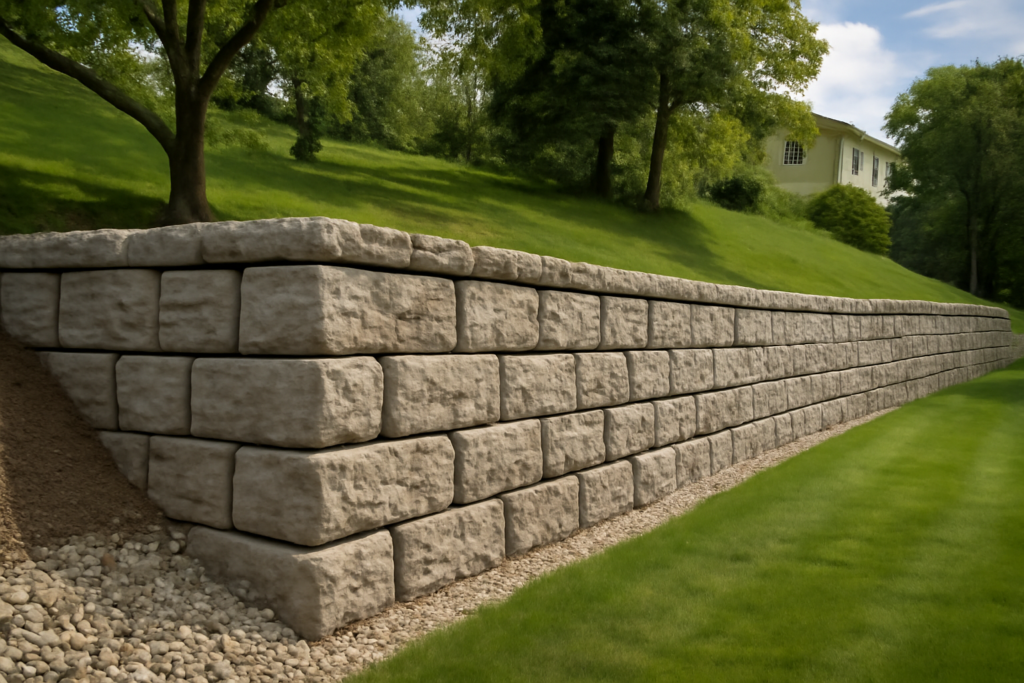
Most retaining wall block fits in your hands. Redi-Rock blocks arrive on a flatbed and get placed by an excavator, one ton at a time. A redi-rock retaining wall is built from massive wet-cast precast concrete blocks — the standard unit is 41 inches wide, 18 inches tall, and 28 to 60 inches deep, weighing 1,500 to 3,400 pounds — that stack like giant Legos on a knob-and-groove connection. Sheer mass is the engineering premise: where small segmental blocks need layers of geogrid reinforcement buried in the backfill to stand tall, Redi-Rock stands on gravity alone to heights small block cannot touch. That single fact drives everything about where this system wins, what it costs, and who should install it.
How the System Works
Redi-Rock Inc., based in Charlevoix, Michigan, licenses its molds and specs to a network of independent precast manufacturers — over a hundred across North America and beyond — so blocks are produced regionally from local wet-cast concrete (4,000+ psi, air-entrained, the same material grade as bridge components, and far denser than the dry-cast mix in pallet-store SRW block). Each course locks to the next via a cast-in knob on top of one block engaging a groove in the block above, which automatically creates the wall’s setback (batter) and shear connection without pins, clips, or mortar.
The product family covers the whole wall: base blocks, standard retaining blocks in several depths (28-inch, 41-inch, and 60-inch bodies — deeper blocks for taller walls), top/cap blocks with finished tops, 90-degree corners, curves handled by the block geometry, freestanding two-sided blocks for parapets and seat walls, and a Positive Connection (PC) series with a hollow core that accepts geogrid wrapped through the block for the tall engineered walls beyond gravity range.
The Key Advantage: Gravity Heights Without Geogrid
This is the reason Redi-Rock exists. Small-block SRW systems (Allan Block, Versa-Lok, Keystone) max out around 3 to 4 feet as pure gravity walls; taller means excavating a wedge behind the wall and laying geogrid into the backfill every couple of courses — which requires cutting far back into the slope. That excavation is often impossible: property lines, existing driveways, buildings, trees, or utilities sit right behind the wall line.
Redi-Rock’s mass changes the math. Depending on soils, loading, and block depth, gravity walls — no geogrid, no reinforcement excavation — routinely reach 8 to 10 feet, and with the deeper 60-inch base blocks and favorable conditions, engineered gravity designs go higher still. The practical consequence: the excavation footprint hugs the wall, construction proceeds from the front, and projects that were unbuildable with small block become straightforward. Walls needing more height run the PC geogrid series and climb well past 20 feet in commercial designs. Speed is the companion benefit — a crew with a mid-size excavator places 400 to 800 square feet of face per day, several times small-block pace, because each placement covers 5.1 square feet.
Faces and the Look
Wet-casting allows deep, realistic face textures that dry-cast block cannot mold. The main options:
- Ledgestone: The flagship — a stacked, layered quarry-stone texture with up to 12 inches of relief, randomized across mold variations so repeats are hard to spot. Reads convincingly as natural stone at any distance.
- Cobblestone: A rounded fieldstone-boulder face, softer and more traditional; popular for residential terraces and waterfront work.
- Limestone: A cleaner split-face architectural texture for commercial settings.
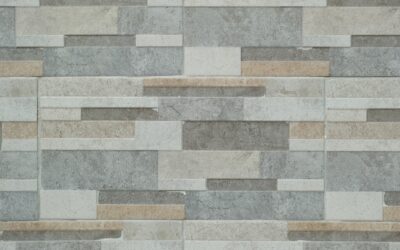
- Kingstone and regional specialty faces vary by manufacturer, as do integral colors — blocks are pigmented through the mix or stained after installation, with gray, tan, and buff blends standard. Because production is regional, available faces and colors depend on your local licensed producer; ask early.
The scale of the texture suits the scale of the block. On a 3-foot garden wall the huge face pattern can look oversized; on a 10-foot highway-grade wall it looks exactly right, which hints at the system’s natural habitat.
The Dealer-Installer Model
You do not buy Redi-Rock at a home center, and this is not a DIY system — a skid steer will not safely place a 2,300-pound block; the work needs an excavator with a lifting eye or grab, an operator with precast experience, and engineered drawings for anything tall. The purchase path runs through the local licensed manufacturer, who sells blocks directly or through hardscape suppliers and maintains a list of experienced installing contractors. That network model has real teeth: the manufacturer’s engineering support (free preliminary wall designs and software-generated cross-sections are standard) plus installers who have placed the product before. Vet contractors on Redi-Rock specifically — ask for two completed local walls at your target height — because the base preparation (a leveling pad of compacted crushed stone, typically 6+ inches, laser-leveled) determines whether a 5-block-tall stack of tons stands plumb for fifty years or creeps out of line in five.
Freight is a genuine line item: blocks ship roughly 20 to a truckload, so distance from the plant adds $500 to $2,000+ per load. Projects far from a licensed producer lose some of the system’s cost logic.
Cost Per Face Foot, Installed
Pricing runs per square foot of wall face. Current realistic numbers: blocks alone $28 to $45 per face foot (deeper blocks and specialty faces at the top), and installed walls $45 to $90 per face foot including excavation, leveling pad, drainage stone and pipe, block setting, and backfill — call it $60 to $75 as a planning midpoint, so a 60-foot-long, 6-foot-tall wall lands around $22,000 to $32,000. Against alternatives: small-block SRW installs at $30 to $60 per face foot but cannot do the tall no-geogrid work; large dry-cast big-block competitors (MagnumStone, Stone Strong, Verti-Block — hollow-core, lighter, often cheaper) undercut Redi-Rock by 10 to 25 percent with less face relief; poured concrete with a form-liner face runs comparable or higher; natural stone boulder walls float on local availability. Redi-Rock consistently prices as the premium big-block, and buyers are paying for the solid wet-cast mass, the face quality, and the engineering network.
Drainage and Base Details
Mass does not exempt Redi-Rock from water physics, and the install spec reflects standard retaining-wall hydrology. Behind the wall goes a minimum 12-inch zone of free-draining crushed stone with a 4-inch perforated drain pipe at the base outletting to daylight, exactly as with any wall; the block-to-block joints also weep, which helps relieve incidental pressure. The leveling pad is the detail that earns the most scrutiny in the field: 6 to 12 inches of well-graded crushed stone, compacted in lifts and screeded flat, because a 1/4-inch error in the first course multiplies visibly by course five when each course weighs a ton and cannot be nudged by hand. Good crews check every base block with a level in both directions and a string line for alignment before the second course arrives. Embedment matters too — bury the first course (typically 6 to 12 inches, more on slopes) per the design, since toe support is part of the gravity math. None of this is exotic; it is ordinary wall discipline scaled up to blocks that offer no forgiveness for shortcuts.
Residential vs Commercial Fit: The Verdict
Where the system is the clear right answer: walls 6 feet and taller, walls with surcharges (driveways, pools, structures above), tight sites where geogrid excavation cannot happen, waterfront and culvert work (the mass and the wet-cast density handle water exposure well), and any project where a 50-plus-year structural life justifies premium cost. Municipalities and DOTs use it for exactly these reasons.
Where it is overkill: the 2-to-4-foot garden terrace. Gravity small-block does that job at half the installed cost with no heavy equipment tracking across the lawn, and the giant face texture gains nothing at knee height. The honest buying test is height and access — under 4 feet with open access behind the wall, buy standard SRW block; over 6 feet, or any height with no room to excavate behind, get a free preliminary design from your regional Redi-Rock manufacturer and price it against an engineered small-block wall including its geogrid excavation. Run that comparison and the big blocks win tall-and-tight projects almost every time, which is precisely the niche they were cast for.