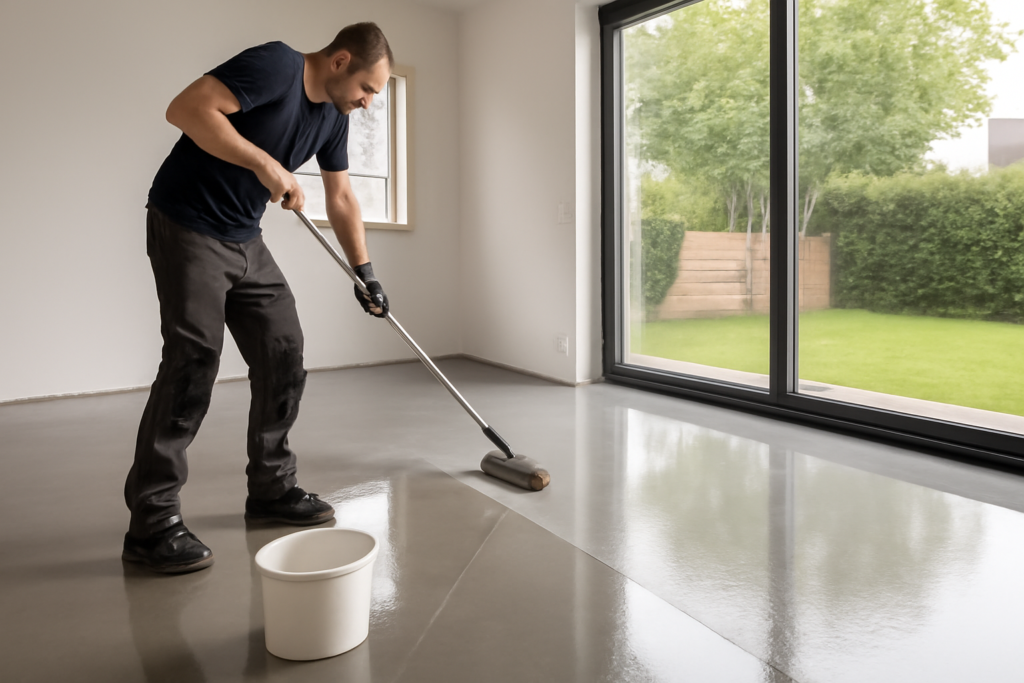
Warwick homeowners and business owners pursuing resin floors face a market that has matured fast over the past five years. Multiple specialist contractors now serve the area with epoxy, polyurethane, polyaspartic, and MMA systems that were strictly commercial-grade a decade ago. Resin flooring Warwick projects range from $1,200 garage refinishes to $40,000+ commercial kitchen installs, but the technical decisions — system chemistry, surface prep, and topcoat selection — are largely the same. The local angle matters mostly for climate, code, and finding installers who actually understand the systems they are selling.
Why Resin Floors Took Off Locally
Two trends drove demand. First, the post-2022 home-improvement spending boom pushed garage and basement renovations to the top of project lists, and resin floors became the default finish over bare concrete. Second, commercial buildings in food service, manufacturing, and healthcare sectors needed seamless, easy-to-clean floors that met evolving health codes.
For Warwick specifically, the climate matters. Cold winters mean install temperatures often fall below epoxy cure thresholds. That has pushed local contractors toward polyaspartic and MMA systems that cure reliably at lower temperatures.
System Types Available Locally
Five resin chemistries dominate the Warwick market:
- 100-percent-solids epoxy: The workhorse. Best for residential garages and light commercial. $4 to $7 per square foot installed. Cure time 12 to 24 hours for foot traffic.
- Polyaspartic urethane: Fast cure (4 to 8 hours), UV stable, slightly more expensive. $7 to $11 per square foot installed. Increasingly the default for high-end residential garages because it does not yellow.
- Polyurethane cement: Heavy-duty industrial. $14 to $22 per square foot installed. Used in commercial kitchens, breweries, and food production.
- MMA (methyl methacrylate): Fastest cure (60 to 90 minutes), works in cold weather, but stronger off-gas during install. $10 to $18 per square foot installed. Premium commercial work.
- Hybrid epoxy-polyaspartic: Two-layer system. Epoxy body coat plus polyaspartic topcoat. $6 to $9 per square foot installed. Increasingly popular for residential garages — gets you the polyaspartic top performance at near-epoxy pricing.
Surface Prep Is Where Quality Lives
Any resin floor lives or dies on substrate preparation. Concrete must be shotblast or diamond-ground to a CSP 3 to 4 profile per ICRI guidelines. Acid etching alone is not enough for modern high-build systems. Power washing afterward removes residual dust and contaminants.
Test concrete moisture per ASTM F1869 (calcium chloride) or F2170 (RH probe). Most epoxy systems tolerate up to 3 pounds per 1,000 square feet per 24 hours or 75 percent RH. Above that you need a moisture-mitigation primer like Mapei Planiseal VS or Sika MoistureGuard.
Repair cracks wider than 1/16 inch with epoxy mortar before applying the body coat. Skip this step and the cracks telegraph through the finish within a year.
Local Climate Considerations
Warwick winters bring 30 to 50°F garage temperatures even when the door is closed. Standard epoxy will not cure properly below 50°F. Polyaspartic and MMA both go down at 35°F and lower, which makes winter installs realistic.
Summer humidity is the other variable. High humidity during install can cause blush — a milky white film on the surface as epoxy cures too fast. Run a dehumidifier in the install space to keep humidity below 75 percent during application.
What Quality Installers Look For
Ask any prospective contractor four questions. First, what is their substrate prep method? Anyone who answers “acid etch” is the wrong contractor for anything except a basic concrete sealer. Second, do they grind or shotblast? Both are valid; the question separates pros from cheap operators. Third, what brand of resin do they use? Sherwin-Williams ArmorSeal, Sika Sikafloor, Stonhard Stonset, Florock Florothane, and Dur-A-Flex are top-tier. Anyone using off-brand “epoxy kits” from a discount supplier is gambling. Fourth, what is the warranty and who backs it?
For commercial projects, ask for evidence of NSF, FDA, or USDA certification on the proposed system if the floor will be in a food-contact area.
Decorative Options
Modern resin floors are not just gray utility surfaces. Decorative options include:
- Vinyl chip broadcasts — multi-color flakes broadcast onto the wet body coat. The classic garage look at $5 to $8 per square foot.
- Quartz aggregate broadcasts — colored quartz sand creates a textured, slip-resistant surface. $8 to $14 per square foot. Common in commercial kitchens.
- Metallic epoxies — pigments suspended in resin create marble-like swirls. $9 to $15 per square foot for showroom-quality work.
- Solid color with anti-slip aggregate added to topcoat — utility look at residential prices, $4 to $6 per square foot.
Real Pricing Examples
A typical 400-square-foot two-car garage in Warwick with mid-grade epoxy and vinyl chip broadcast lands at $1,800 to $2,800 turnkey. Same garage in polyaspartic with chip broadcast runs $2,800 to $4,200. A 600-square-foot basement family room in metallic epoxy runs $5,400 to $9,000.
Commercial work scales differently. A 2,500-square-foot restaurant kitchen in polyurethane cement runs $35,000 to $55,000. A 5,000-square-foot warehouse in solid-color epoxy with quartz broadcast runs $22,000 to $35,000.
Honest Drawbacks
Resin floors are hard. They are not foot-friendly for long standing periods without anti-fatigue mats. Adding anti-fatigue mats around prep stations or workshop areas solves this.
UV exposure yellows epoxy quickly — within 12 to 24 months for direct sun. Polyaspartic, polyurethane, and MMA all hold color much better. For windows and skylight exposure, spec polyaspartic minimum.
Repair work requires the same chemistry as the original. Mixing systems causes adhesion failures.
Long-Term Care
Daily sweep or dust mop. Mop weekly with a neutral pH cleaner like Sika SikaFloor Cleaner. Never use strong acid or solvent cleaners — they degrade the topcoat over time. Inspect annually for chips, gouges, and wear-through to body coat. Touch up minor damage immediately with the manufacturer’s repair kit. Plan a single recoat at year 7 to 10 to extend service life by another decade. Done right, a quality resin floor in Warwick lasts 20 to 30 years in residential service and 10 to 20 years in commercial use.
Prefer to explore on your own?
See how new flooring looks in your actual room in seconds — free, no signup.
Try the free Floor Studio →