
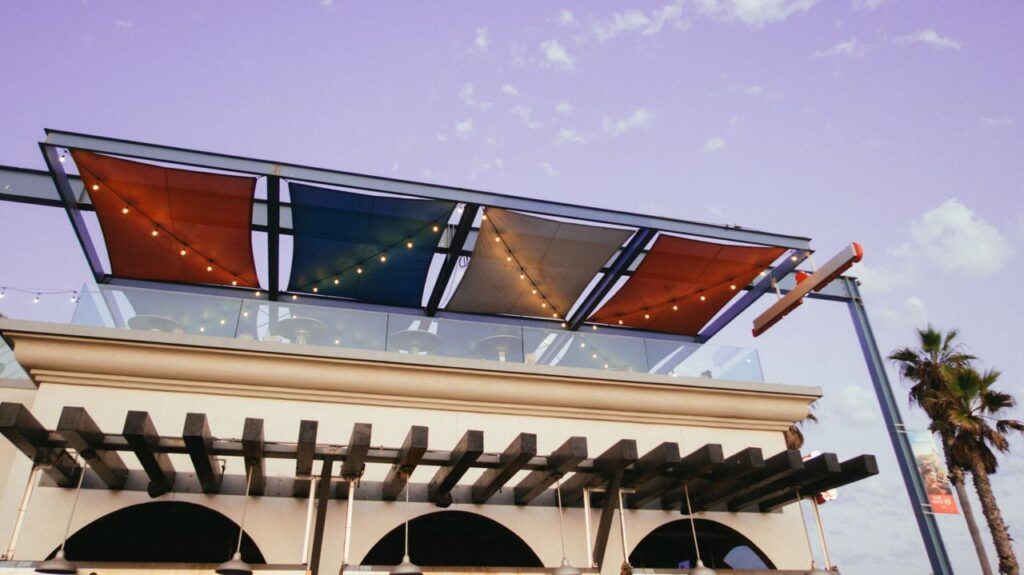
A south-facing deck in July reads 25-35 degrees F hotter than the same deck in shade, according to thermal imaging from the National Renewable Energy Laboratory. That’s the difference between an outdoor space you actually use and one you avoid until 7 PM. Retractable awnings for decks solve the problem without the permanent visual weight of a solid roof or pergola, and they extend the seasonal usefulness of the deck by 2-3 months in most climates. Here’s what separates a $400 weekend disappointment from an $8,000 system that lasts 15 years.
Part of our Decks & Outdoor guide — explore the full guide →
How a Retractable Awning Works
Two arms extend from a roller mounted on the house wall or fascia. The fabric rolls out over the deck, supported by spring-tensioned arms that pull the cloth taut at any extension length. When weather changes or the day ends, the arms retract and the fabric rolls up into a sealed cassette or open hood. Manual versions use a hand crank; motorized models use a 110V tubular motor (typically Somfy or Becker) controlled by remote, app, or wind/sun sensors.
Projection (how far the awning extends from the wall) usually runs 6-13 ft. Width varies from 8 ft to 40 ft for connected multi-section units. Most residential decks are well covered by a 14-18 ft wide awning with a 10 ft projection.
Manual vs Motorized
- Manual crank (SunSetter Manual Retractable, Aleko): $400-1,500 installed. Reliable, no electricity needed, takes 30-60 seconds to deploy. Best for second homes, light use, and budget-conscious buyers.
- Motorized (SunSetter Motorized, Sunesta, Markilux): $1,800-7,000 installed. One-button operation, integrates with smart home systems, optional wind/sun automation. Best for daily use and owners who’ll skip extension if it’s a chore.
- Motorized with full cassette: $4,500-12,000+. The fabric rolls into a sealed aluminum housing that protects from UV, dirt, and moisture. Doubles fabric lifespan and works in coastal environments.
Sizing for Your Deck
Measure the wall width above the deck, then subtract 6-12 inches on each side for clearance. Standard widths in 2 ft increments: 10, 12, 14, 16, 18, 20 ft. Custom sizes from premium brands like Markilux and Erhardt run any dimension up to 40 ft.
For projection, follow this rule: aim for at least 70% of the deck depth shaded. A 12 ft deep deck wants a 9-10 ft projection. The arms angle down 5-15 degrees as they extend, so the leading edge clearance from the deck floor drops with longer projections — verify head clearance for tall guests at full extension.
Fabric Choices That Matter
Awning fabric is the wear point. Three categories dominate:
- Solution-dyed acrylic (Sunbrella, Para-Tempotest): Color-fast for 10-15 years, breathable, mid-range cost. The default choice for most homeowners. Sunbrella’s marine-grade fabrics carry a 10-year limited warranty.
- Vinyl-coated polyester: Waterproof rather than water-resistant, less breathable, prone to mildew if not dried. Best for areas with frequent rain where you need actual rain shelter.
- Solar screen mesh: Blocks 80-95% of UV while preserving visibility. Used in regions like Arizona and Texas where view-through is desired.
Look for UPF 50+ ratings if sun protection matters. Sunbrella products typically rate UPF 70+, blocking 98% of UV radiation.
Wind and Weather Limits
Standard residential retractable awnings are rated for wind speeds up to 20-25 mph (Beaufort scale 4-5). Beyond that, deploy at your peril — gusts can bend arms or tear fabric from the housing. Motorized awnings can be paired with a Somfy Eolis wind sensor ($150-300) that retracts the awning automatically when wind hits a preset threshold.
Snow load is a hard no for most retractable systems. Always retract before any forecasted accumulation; an inch of wet snow on a 14×10 ft awning creates over 1,000 lbs of load.
Installation Considerations
The mounting wall must be solid — typically a 2×6 or larger ledger board on wood-framed homes, or properly anchored brackets on brick, stucco, or stone. Pulling out under load is the failure mode that ruins decks; use 3/8 inch lag screws into studs every 16 inches for the mounting bracket, or epoxy anchors into masonry rated for 1,000+ lbs pull-out.
The mounting height of the roller should be at least 8 ft above the deck and angled so rain runs off the leading edge. Local code in some areas requires a permit for awnings over 24 sq ft or for any unit with electrical motor connections.
Cost Per Square Foot
Material plus install costs roughly:
- Manual basic: $20-40 per sq ft of coverage
- Motorized mid-range: $40-80 per sq ft of coverage
- Premium European motorized cassette: $80-160 per sq ft
For a 14×10 ft (140 sq ft) coverage area, expect $2,800-5,500 motorized at quality mid-range, or $1,400-2,500 for manual.
Top Brands Compared
SunSetter dominates the US mass market with strong dealer networks and fair warranties — solid choice for homeowners who want a known name. Sunesta and Aristocrat occupy the premium American tier with better arm engineering and motor options. Markilux and Weinor lead the European premium segment; they cost more but use fabric and aluminum at a higher spec, with cassette designs that handle coastal salt air and mountain snow runoff much better.
Maintenance Routine
Hose off the fabric quarterly with mild soap and warm water. Let it air-dry fully extended before retracting — wet rolling causes mildew within 2-3 weeks. Lubricate the arm joints with silicone spray annually (avoid petroleum-based lubricants that attract dirt). Inspect mounting hardware every 2 years and re-torque the lag screws if the assembly has moved.
Replace the fabric every 10-15 years. A re-cover from the same manufacturer typically costs 30-40% of the original installed price and refreshes the awning for another decade.
Worth It or Skip It
If your deck gets afternoon sun and you use it more than 20 days a year, retractable awnings for decks pay back through use alone. For occasional users, a $200 cantilever umbrella from Costco delivers similar shade with less commitment. Skip retractables entirely on north-facing decks (no sun problem to solve) and on decks in regions with high wind year-round, where pergola structures with louvered roofs handle the conditions better.
Bottom Line
Match motorization and fabric quality to how often you’ll actually use the deck, mount the unit into solid framing, and respect wind ratings. A well-chosen system runs trouble-free for 15+ years and turns a hot afternoon deck into the most-used room in the house.


