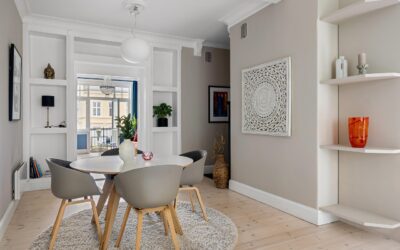
A round area rug softens the hard lines of a room in a way no rectangle can, and it instantly draws the eye to whatever sits on top of it. Designers reach for round rugs to break up boxy furniture, anchor circular tables, and define cozy reading nooks. The challenge is sizing and placement, because a round rug that is even slightly too small can look like an afterthought floating on the floor. Here is how to get it right.
Why Choose a Round Rug
Round rugs introduce curves into spaces that are otherwise full of straight edges, walls, cabinets, and rectangular furniture. That contrast makes a room feel more relaxed and intentional. They also pair naturally with round dining tables, pedestal tables, and circular coffee tables, echoing the shape and reinforcing a clear focal point.
In a small or awkward space, a round rug can soften a tight corner or define an entry without the hard boundary a rectangle creates. They are a favorite in nurseries, reading corners, and under breakfast tables.
Common Sizes and What They Fit
Round rugs are measured by diameter. Knowing which diameter suits which job saves you from ordering blind.
- 3 to 4 feet: Accent size for entryways, under a small accent chair, or beside a bed.
- 5 to 6 feet: Good under a small round dining table for two to four, or to anchor a compact seating nook.
- 7 to 8 feet: Fits a standard round dining table with chairs, or grounds a living room conversation area.
- 9 feet and up: Statement size for large open rooms and big round tables.
Getting Placement Right Under a Table
Under a round dining table, the rug should extend far enough that chairs stay on it even when pulled out. As a rule, choose a rug diameter at least 4 feet larger than the table diameter, so a 4-foot table wants roughly an 8-foot round rug. That extra room keeps chair legs from catching on the rug edge and keeps the arrangement looking balanced.
Center the rug precisely under the table, since any misalignment is glaringly obvious with a circle. Measure from the table center to each wall and adjust until the rug sits true.
Using a Round Rug in a Living Room
In a living area, a round rug works best anchoring a single seating group or a curved sofa. Place it so at least the front legs of the main furniture pieces rest on the rug, or float it entirely in front of the sofa as a defined zone. A round rug under a round coffee table doubles down on the shape for a cohesive look.
Avoid pairing a round rug with strongly rectangular furniture that surrounds it on all four sides, since the leftover corners of bare floor can look awkward. Round rugs shine when they have a little breathing room around them.
Material and Pile Choices
- Wool: Durable, soft, naturally stain-resistant, and a strong choice for dining and living areas. Higher cost but long-lasting.
- Polypropylene: Budget-friendly, easy to clean, and good for high-traffic and indoor-outdoor use.
- Jute and sisal: Natural texture that adds warmth, ideal for a casual or coastal look, though rougher underfoot.
- Cotton flatweave: Lightweight and washable, great for nurseries and kitchens.
Low pile cleans more easily under a dining table where crumbs and spills happen, while plush pile feels best in a lounge or bedroom.
Styling Tips for a Balanced Look
Use a rug pad cut to a circle slightly smaller than the rug to stop sliding and add cushion; many pads can be trimmed with scissors to fit. Match or complement one color already in the room so the rug feels connected rather than random. In a neutral space, a round rug is a low-risk place to add pattern or a pop of color since it draws the eye on its own.
Keep the surrounding floor visible so the circle reads as a deliberate shape. Crowding furniture right up to the edges on all sides defeats the soft, open feeling that makes round rugs special.
Round Rugs in Small and Awkward Spaces
Round rugs are quietly brilliant in tricky spots that rectangles struggle with. In a small entry, a round rug softens the arrival point and works even when the space is too tight for a runner. In a bay window or a rounded reading nook, the curve follows the architecture instead of fighting it. Under a round breakfast table tucked into a corner, a round rug visually carves out a defined dining zone in an open layout.
They also help in rooms where a rectangle would crowd a doorway or traffic path. Because a circle has no sharp corners jutting into walkways, a round rug can sit closer to a busy route without feeling like an obstacle. This makes them a practical pick for compact apartments and condos.
Caring for a Round Rug
Care mirrors any quality rug, with one wrinkle: round rugs can develop ripples or curling at the edge because there is no straight side to keep tension even. A trimmed-to-fit pad helps the rug lie flat, and rotating the rug a quarter turn every few months evens out wear and sun fading. Vacuum regularly and blot spills promptly rather than rubbing, which can spread a stain through the pile.
For wool, occasional professional cleaning preserves the fibers, while many cotton and synthetic round rugs can be spot-cleaned at home. Keep the rug out of constant direct sun where possible, since prolonged exposure fades color unevenly across the circular surface.
Final Thoughts
A round area rug is a simple way to add softness, define a space, and create a focal point, especially when paired with a round table or a single seating group. Size it generously, at least 4 feet wider than the table it sits under, center it carefully, add a trimmed-to-fit pad, and choose a durable material suited to the room. Done right, the curve will make the whole space feel more thoughtful and inviting.