
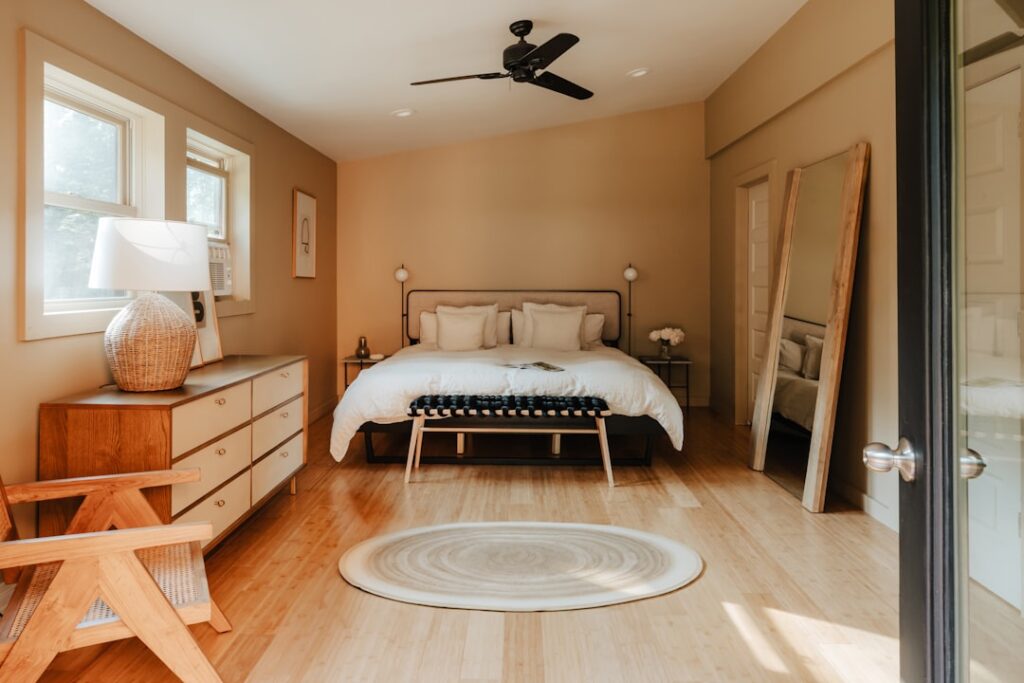
Most bedrooms default to a rectangular rug shoved half under the bed, and the result is often flat and predictable. A round rug in a bedroom breaks that pattern, softening the hard lines of a bed frame, dresser, and squared-off walls while drawing the eye toward a specific spot you want to feature. The catch is that circles are trickier to place than rectangles. Get the size or position wrong and the rug looks stranded, floating in the room with no relationship to the furniture around it.
This guide shows you where a round rug actually works in a bedroom, what size to buy for each spot, and the placement and layering moves that make it look intentional rather than accidental.
Why Choose a Round Rug at All
Bedrooms are full of straight lines. The bed, nightstands, wardrobe, and window frames all reinforce a grid, and a rectangular rug simply repeats it. A circular rug introduces contrast. That single curved shape relaxes the geometry of the space and can make a boxy room feel calmer and more balanced. Round rugs also excel at defining a zone, a reading nook, a seating area, or the space at the foot of the bed, without the visual weight of a big rectangle.
They are especially effective in smaller bedrooms, nurseries, and kids’ rooms, where a full room-sized rug would overwhelm the floor and a soft circle adds personality without crowding it.
Best Placements for a Round Rug in a Bedroom
Because a round rug does not tuck neatly under a rectangular bed the way a standard rug does, placement is everything. A few spots reliably look great:
- At the foot of the bed: a medium round rug just beyond the footboard grounds the bed and gives your feet a soft landing, especially paired with a bench.
- In a reading or seating nook: anchor a chair, floor lamp, and small side table on a round rug to carve out a defined corner.
- Beside the bed: a smaller circle on one side works in place of a runner, adding a soft step-out spot.
- Centered under a chandelier or pendant: echoing a round light fixture with a round rug below creates a satisfying, deliberate symmetry.
- Under the bed itself: a large round rug can sit centered under the bed with the circle extending out on all three open sides, a bolder look that needs generous sizing.
Choosing the Right Size
Sizing is where most round-rug attempts go wrong. Too small and it looks like a coaster; too large and it fights the room. Use these ranges as a starting point and always tape out the circle on your floor before buying:
- 4 to 5 feet: good for a bedside accent, a nursery, or under a single chair.
- 6 feet: the workhorse size for a foot-of-bed placement or a small seating nook.
- 7 to 8 feet: large enough to anchor a reading area with a chair and side table, or to sit partly under the end of a queen bed.
- 9 feet and up: for centering under a full or queen bed so the rug reads as the room’s foundation.
A reliable rule for the foot-of-bed look is to choose a rug diameter close to the width of your bed, so the circle relates visually to the mattress rather than looking randomly sized.
Layering a Round Rug for Depth
One of the easiest ways to make a round rug feel designed is to layer it over a larger flat-weave or jute rug. A round wool or shag rug set on top of a bigger rectangular base adds texture, dimension, and a cozy focal point while solving the awkward-floating problem, because the base rug ties the circle to the rest of the room. This works particularly well in bohemian, farmhouse, and eclectic bedrooms.
If you prefer a single rug, make sure it sits in clear relationship to at least one piece of furniture. A round rug should touch, tuck under, or clearly frame something; a bed, a chair, a bench, so the eye reads it as part of a composition.
Materials, Style, and Color
Bedrooms are low-traffic and barefoot-friendly, so this is the room to prioritize softness. Wool offers durability and a plush hand, shag and high-pile designs deliver maximum coziness underfoot, and cotton or jute rounds suit casual and coastal looks. For nurseries and kids’ rooms, an easy-clean synthetic that handles spills makes more sense than a delicate natural fiber.
On color, a round rug can either blend or pop. A tonal rug close to your wall or bedding color keeps things serene, while a patterned or bold circle becomes an instant focal point in an otherwise neutral room. Because it is a distinct shape, even a subtle round rug draws attention, so choose a color you genuinely want the eye to land on.
Common Mistakes to Avoid
The biggest error is going too small, which leaves the rug looking lost. The second is placing it with no anchor, so it appears to have landed at random. Avoid centering a tiny circle in the middle of a large open floor with furniture pushed to the walls, and skip slippery backings on hard floors; a proper rug pad cut to fit the circle keeps it flat and safe. Finally, respect the room’s traffic path so the rug does not create a trip point where it meets a doorway.
Round Rugs in Small vs. Large Bedrooms
The size of the room changes the whole strategy for a round rug. In a small or narrow bedroom, a round rug is often the better shape choice precisely because it does not push into the corners the way a rectangle does, so it visually opens the floor rather than boxing it in. Place a modest circle beside the bed or under a chair, and the curve keeps the space feeling airy. In a large primary bedroom, you have room to go bold: a nine- or ten-foot round rug centered under a king or queen bed becomes a genuine design statement, with the circle radiating out beyond three sides of the bed and softening an otherwise cavernous floor. The mistake in a big room is using a small rug, which looks marooned in all that space. As a rule, err larger in generous rooms and use restraint in tight ones, and in both cases tape out the circle and live with it for a day before committing, since a round shape reads very differently in a real room than it does on a product page.
Final Thoughts
A round rug in a bedroom is a small change with an outsized effect, softening the room, defining a zone, and breaking up the monotony of straight lines. Anchor it to your bed or a seating nook, size it generously, and consider layering it over a larger rug for depth. Handled that way, a circular rug turns an ordinary bedroom into a space that feels considered and inviting.


