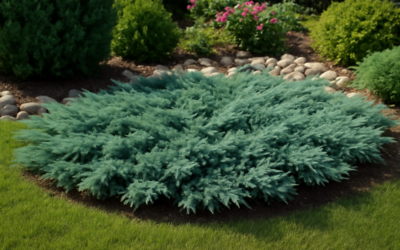
If you’ve got a sunny slope, a hot strip along the driveway, or a bank you’re tired of mowing, rug juniper may be the toughest, lowest-maintenance plant you can put there. Despite the name, this isn’t a floor covering, it’s a low, creeping evergreen groundcover, most famously the “Blue Rug” variety, Juniperus horizontalis ‘Wiltonii’, that hugs the ground and spreads into a dense, silvery-blue carpet. It thrives where grass struggles and asks almost nothing of you once it’s established. For erosion control and water-wise landscaping, few plants beat it.
This guide covers what rug juniper is, the conditions it needs, how to plant and space it, and why it’s such a workhorse for slopes and low-care gardens.
What Rug Juniper Is
Rug juniper is a prostrate, ground-hugging form of creeping juniper. ‘Blue Rug’ is the standout cultivar, growing only about 4 to 6 inches tall but spreading 6 to 8 feet wide, with soft, scale-like, blue-green foliage that takes on a purplish cast in winter cold. It’s an evergreen, so it holds its color year-round, and it forms a thick mat that crowds out weeds and blankets the ground. Because it stays so low and spreads so wide, a few plants eventually cover a large area.
Hardiness and Where It Grows
One of rug juniper’s biggest virtues is its toughness across climates. It’s reliably hardy across a wide range of USDA zones, roughly zones 3 through 9, which covers most of the country. That cold-hardiness paired with real heat and drought tolerance makes it a rare plant that performs from the upper Midwest to the Southwest. Before planting, confirm your USDA zone and you’ll likely find rug juniper well within its comfortable range.
Sun, Soil, and Site Requirements
Rug juniper isn’t fussy, but it does have firm preferences that determine success.
- Full sun: This is non-negotiable. It wants at least six hours of direct sun a day. In shade it thins out, loses color, and grows leggy.
- Well-drained soil: It tolerates poor, rocky, sandy, and even slightly alkaline soil, but it will not abide soggy roots. Good drainage prevents root rot.
- Tolerant of tough spots: Heat, drought, wind, salt, and lean soil don’t bother it, which is why it’s a favorite for harsh roadside and coastal plantings.
If your only sunny spot has heavy clay, amend it for drainage or mound the planting area, because wet feet are the one thing that reliably kills this plant.
Planting and Spacing
Getting spacing right up front saves you money and patience. Since ‘Blue Rug’ spreads 6 to 8 feet wide, plan accordingly.
- Space plants roughly 5 to 6 feet apart for full coverage that knits together over a few seasons; tighten that to 3 to 4 feet if you want faster fill.
- Dig each hole as deep as the root ball and twice as wide, and set the plant at the same depth it grew in the pot.
- Backfill, water in well, and apply a few inches of mulch around (not on top of) the plants to suppress weeds while they establish.
- Water regularly the first season so roots establish; after that, it’s largely on its own.
Slope and Erosion Control
This is where rug juniper truly earns its keep. Its dense, spreading mat of evergreen foliage and its fibrous roots grip the soil and slow runoff, making it one of the best living solutions for stabilizing slopes and banks. Plant it on a hillside you can’t safely mow, along a retaining-wall top, or on an eroding bank, and within a couple of seasons it forms a soil-holding carpet that stops washouts. It’s a far better long-term answer than turf grass on any incline.
Drought Tolerance and Low Maintenance
Once established, rug juniper is about as low-care as a plant gets. It’s highly drought-tolerant and rarely needs supplemental water in normal conditions, making it ideal for xeriscaping and water-wise yards. It needs no mowing, little to no fertilizing in decent soil, and only occasional pruning to keep it in bounds. Its dense growth shades out most weeds. The main thing it asks is good drainage and full sun, give it those and it essentially takes care of itself.
Common Uses in the Landscape
Homeowners reach for rug juniper in a handful of classic situations: covering slopes and banks, edging walkways and driveways, spilling over retaining walls and raised beds, filling hot dry strips where grass dies, and blanketing large low-maintenance areas. It also works in rock gardens and coastal plantings where its salt and wind tolerance shine. Anywhere you want year-round green-blue color with minimal effort, it fits.
Pests, Problems, and Companion Plants
Rug juniper is famously trouble-free, but a few issues are worth knowing. Its biggest enemy is poor drainage, which causes root rot and is the most common reason a planting fails, so always err toward drier, sharper soil. In humid climates with crowded plantings, fungal tip blight can brown out sections; good spacing and air circulation prevent most of it. Spider mites occasionally show up in hot, dry spells and can be hosed off or treated if severe. Bagworms are another occasional pest on junipers and are best removed by hand when caught early. Beyond that, junipers shrug off deer browsing better than most plants, a real plus in rural yards. For companion planting, rug juniper pairs beautifully with ornamental grasses, sedum, black-eyed Susan, and other sun-loving, drought-tolerant perennials that share its low-water needs. Mixing it into a xeriscape or rock garden lets it spread as a living mulch between taller plants, knitting the whole bed together while it suppresses the weeds underneath.
The Bottom Line
For a tough, evergreen, water-wise groundcover that controls erosion and asks almost nothing in return, rug juniper is hard to beat. Give it full sun and well-drained soil, space it for its wide spread, water it through the first season, and then let it do its job. Planted in the right spot, rug juniper will carpet a difficult slope or bare bank with low, silvery-blue evergreen growth for years with very little help from you.