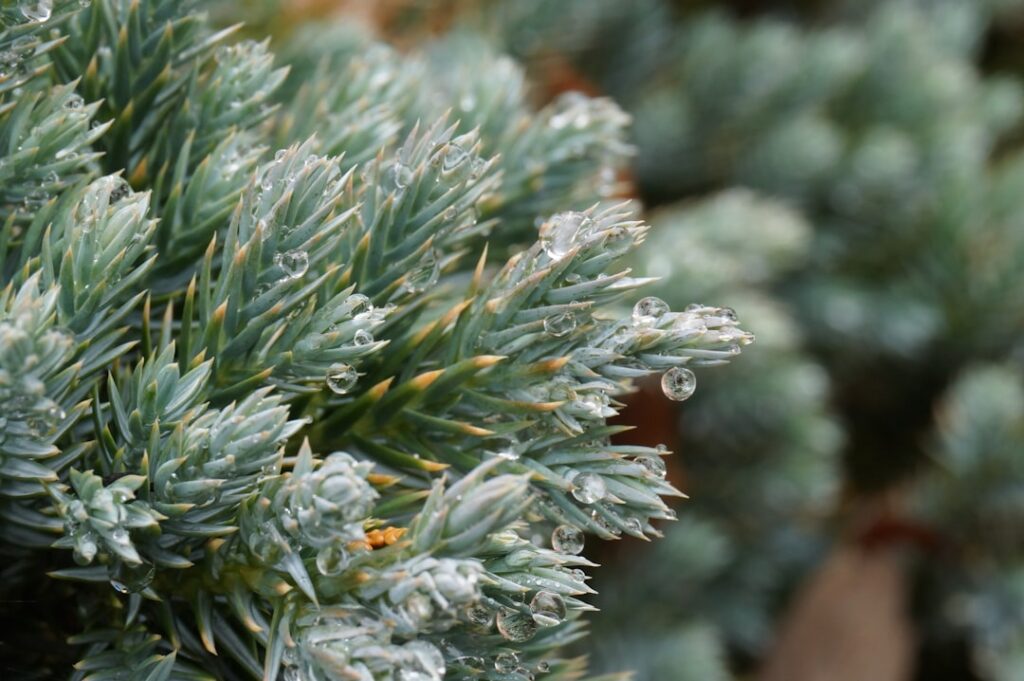
If you want silvery-blue color that holds all winter without any fuss, the blue star juniper shrub belongs on your short list. Botanically it is Juniperus squamata ‘Blue Star’, a low, mounding evergreen that stays compact enough for foundation beds, rock gardens, and container plantings where a full-size juniper would overwhelm the space. The frosted blue needles are the whole reason to grow it, and unlike many blue conifers, this one keeps that cool tone through the hottest summer and the coldest January.
Hardiness and Climate
Blue Star juniper is dependable across USDA zones 4 through 8, which covers most of the country outside the deep South and the frost-free Southwest. It handles winter lows down to roughly minus 30 degrees Fahrenheit without protection, and it takes summer heat well as long as it has good air movement and sharp drainage. In humid climates at the warm end of its range, the biggest threat is not cold but wet, stagnant conditions that invite fungal disease.
This is a slow grower, and you should set your expectations accordingly. Annual growth runs only 2 to 4 inches, so a plant that will eventually spread 3 feet takes several years to get there. That deliberate pace is actually a selling point, because it means very little pruning and a shrub that holds its shape.
Mature Size and Spacing
Expect a mature blue star juniper to reach 2 to 3 feet tall and 3 to 4 feet wide, forming a dense, irregular star-shaped mound. It is wider than it is tall, so give it room to spread rather than crowding it against a walkway.
- As a specimen: allow a 4-foot circle so the mounded form shows
- In a mass planting: space plants 30 to 36 inches on center
- As a low informal edge: space 24 to 30 inches for plants to knit together over time
- In containers: one plant per 14-to-18-inch pot
Sun and Soil Requirements
Full sun brings out the strongest blue color and keeps the plant tight and healthy. Give it at least six hours of direct sunlight a day. In light afternoon shade it survives, but the foliage greens up and the growth loosens. Deep shade is a mistake; the plant thins, and disease pressure climbs.
Drainage is the single most important thing you can get right. Blue Star juniper wants gritty, well-drained soil and actively resents heavy, wet clay. It tolerates a wide pH range from acidic to slightly alkaline and shrugs off poor, rocky, sandy ground that would starve other shrubs. If your native soil is dense clay, plant on a raised mound or amend a wide area with coarse sand and grit to move water away from the roots.
Planting the Right Way
Dig a hole as deep as the root ball and two to three times as wide. Loosen the sides so roots can penetrate, and set the plant so the top of the root ball sits slightly proud of the surrounding soil. Backfill with native soil, water it in to settle air pockets, and add a 2-inch layer of gravel or bark mulch, keeping it back from the base of the plant. Spring and early fall are the ideal planting windows, giving roots time to establish before extreme weather.
Watering and Feeding
During the first growing season, water deeply once a week when rain is scarce, letting the soil dry between drinks. A newly planted juniper drowning in daily water is far more common, and far more fatal, than one that goes a little dry. Once established, blue star juniper is genuinely drought tolerant and needs supplemental water only during extended dry spells.
Feeding is minimal. A light application of a slow-release evergreen or conifer fertilizer in early spring is all it wants. Too much nitrogen forces soft growth that flops and loses the compact star shape. If the plant looks healthy and is holding its color, you can skip fertilizer entirely.
Pruning and Shaping
One of the joys of this shrub is how little pruning it demands. Its natural mound rarely needs correcting. When you do prune, work in spring before the flush of new growth. Trim only into wood that still carries green foliage, because junipers do not reliably resprout from bare, brown interior branches. If you cut back too hard into that dead zone, you are left with a permanent hole.
Use hand pruners or sharp shears to snip stray tips and keep the outline tidy. Wear long sleeves and gloves; the foliage is prickly and can irritate skin. Removing the occasional dead or winter-burned branch as you spot it keeps the plant looking fresh year-round.
Winter Care and Seasonal Color
One of the quiet pleasures of this shrub is how it earns its keep in the cold months. As temperatures drop, the frosted blue foliage often takes on soft purple and plum undertones, giving winter beds a subtle color shift when most plants have gone dormant or brown. That evergreen presence is exactly why so many gardeners tuck a blue star juniper shrub into a foundation planting or a mixed bed of deciduous shrubs; when the neighbors’ borders are bare sticks, yours still has structure and cool color.
In the coldest parts of its range, heavy, wet snow can splay the branches of an older, wider plant, temporarily flattening the mound. Gently brush accumulated snow off after a storm rather than letting it sit and reshape the plant. If you garden in a windy, exposed site at the cold edge of zone 4, an occasional bout of winter burn browns some tips; simply prune those out in spring and the plant recovers. No wrapping or elaborate winter protection is needed for a plant this hardy.
Pests and Diseases
Blue Star juniper is tough, but a few problems are worth watching for, especially in humid regions:
- Phytophthora root rot: the leading killer, caused by wet soil; prevent it with drainage, not treatment
- Spider mites: show up in hot, dry, dusty spells as stippled, fading foliage; a strong hose spray and better airflow help
- Juniper blight (Phomopsis and Kabatina): browning tips in wet weather; prune out affected growth and improve air circulation
- Bagworms: occasional in some regions; hand-pick the spindle-shaped bags before they defoliate a section
Deer tend to avoid junipers, which makes this a solid choice for rural and suburban gardens where browsing is a problem. The prickly, aromatic foliage simply is not appetizing to them.
Using Blue Star Juniper in the Landscape
Because it stays small and holds its color in every season, this juniper is a design workhorse. Plant a row along the front of a foundation bed for an evergreen skirt that never needs replacing. Tuck it among boulders in a rock garden where the blue plays off gray stone. Use it to soften the edge of a raised bed, spill it over a low retaining wall, or feature it in a mixed container with trailing plants. Its silvery tone pairs especially well with the burgundy and gold foliage of companion shrubs and perennials.
Propagation and Longevity
Blue Star juniper is a long-lived shrub that can hold its shape and color for well over a decade with minimal intervention, which is part of what makes it such a good value in the landscape. Because it is a named cultivar, it does not come true from seed, so propagation is done from cuttings. If you want to make more plants, take semi-hardwood cuttings in late summer, dip them in rooting hormone, and set them in a gritty, well-drained rooting medium kept lightly moist; junipers root slowly, so patience is required, but it is a reliable way to expand a planting for free. Most gardeners simply buy additional nursery plants when they want a matched set for a mass planting or low hedge.
As the plant ages, it gradually broadens into a wider, more open star shape, and very old specimens can develop some bare interior wood. Regular light tip-pruning within the living foliage keeps the mound dense and prevents that thinning, extending the plant’s attractive life indefinitely. Unlike fast-growing shrubs that outgrow their space and need replacing, a well-sited blue star juniper simply settles in and improves, needing little more than the occasional trim and a watchful eye on drainage.
Give a blue star juniper shrub full sun and a spot that drains fast, and it will settle in as one of the most dependable, low-maintenance evergreens in your yard. Get the drainage right at planting time, keep your pruning inside the living foliage, and this slow, steady mound of frosted blue will look good decade after decade with almost no work from you.