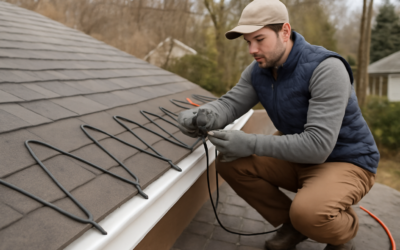
Two products sit side by side on the hardware store shelf, both promising to stop frozen pipes, and they behave very differently once they’re on the pipe. Self regulating heat tape for pipes uses a conductive polymer core that automatically adjusts its heat output along every inch of its length. Constant-wattage tape puts out the same heat everywhere, all the time, and relies on a thermostat to switch it on and off.
For most homeowners protecting water lines in a crawlspace, basement, mobile home skirting, or well house, self-regulating cable is the safer and more forgiving choice, and it’s the one we’d buy for nearly every residential job. Constant-wattage tape still has a place: it’s cheaper up front, comes in pre-cut lengths with a built-in thermostat, and works fine on short, straightforward metal pipe runs when you install it exactly as directed. The rest of this guide explains why, and when the cheaper option is good enough.
How Self Regulating Heat Tape for Pipes Works
A self-regulating cable has two parallel copper bus wires running its full length, separated by a semiconductive polymer core loaded with carbon. When the core is cold, it contracts, the carbon particles touch more, and more current flows between the bus wires, producing more heat. As the pipe warms, the polymer expands, the carbon paths separate, resistance rises, and heat output drops.
That happens independently at every point along the cable. A section lying against a cold, drafty pipe near a vent works hard; a section in a sheltered corner idles. Because output falls as temperature rises, the cable limits itself and is far less likely to overheat, even where it crosses over itself. Many products are sold as bulk cable you cut to length, plus a plug-in kit or connection kit; others come as pre-terminated lengths. Some include a thermostat or a plug-in controller to shut it down entirely in warm weather and save energy.
How Constant-Wattage Heat Tape Works
Constant-wattage tape, sometimes called heat tape with a thermostat or thermostatically controlled heat tape, uses a resistance wire that produces a fixed number of watts per foot, typically around 3 to 8 watts per foot for residential products. The output never changes on its own. A small thermostat sensor, usually a bulb near the plug end, clamps against the pipe and turns the whole tape on when it senses roughly 35 to 40°F and off again once the pipe warms.
The weakness is that the sensor reads one spot. If the sensor sits on a warm stretch while the far end of the pipe freezes in a draft, the tape stays off. If the sensor is in the cold spot, the entire length runs full blast, including sections that don’t need it. And because output doesn’t drop with temperature, any place the tape is overlapped, bunched, or covered wrong can get hot enough to melt insulation or ignite nearby materials. These are fixed-length products; you can’t cut them.
Head-to-Head Comparison
| Factor | Self-Regulating | Constant Wattage |
|---|---|---|
| Heat output | Varies by local temperature | Fixed watts per foot |
| Overlap/crossing | Generally allowed per maker | Never allowed |
| Plastic pipe (PEX, PVC) | Widely rated for it | Often restricted; check label |
| Cut to length | Yes (bulk cable) | No, fixed lengths |
| Upfront cost | Higher | Lower |
| Fire/failure risk | Lower | Higher if misinstalled |
Overlap Rules
This is the single biggest practical difference. Constant-wattage tape must never touch or cross itself, because doubled-up sections double the heat in one spot. That makes wrapping valves, tees, and meters awkward. Many self-regulating cables allow crossing and spiral wrapping, which makes fittings and valve bodies much easier to protect. Always confirm in the instructions, since a few products still prohibit it.
Plastic Pipe Compatibility
PEX, CPVC, and PVC soften at temperatures metal shrugs off. Many constant-wattage tapes either prohibit use on plastic or require wrapping the pipe in aluminum foil tape first to spread the heat. Self-regulating cable is commonly listed for plastic and metal pipe because its surface temperature stays lower. If your home has PEX in a crawlspace, which is common in newer construction and mobile homes, self-regulating cable avoids a lot of guesswork.
Running Cost
On paper, both use similar power at full output. In practice, self-regulating cable often uses less energy over a winter because warmer sections throttle down on their own. Constant-wattage tape runs at 100 percent whenever its thermostat calls, across the whole length. For a typical 12- to 30-foot residential run, either one generally costs somewhere between a few dollars and the low tens of dollars per month in hard cold, depending on length, insulation, and your electricity rate. Adding a plug-in thermostat controller to self-regulating cable, so it shuts off above freezing, usually trims the bill the most.
Failure and Fire Risk
Heat tape fires are a well-documented hazard, and most involve older constant-wattage products that were overlapped, wrapped in the wrong insulation, left running for years, or cracked with age. Self-regulating cable isn’t risk-free, but its self-limiting behavior removes the main overheating path. Both types can fail through physical damage, water entering a damaged end seal, or rodents chewing the jacket.
Which One to Buy for Your Situation
- PEX or PVC water lines: self-regulating, rated for plastic pipe.
- Long runs, fittings, valves, meters: self-regulating, so you can spiral and cross where the maker allows.
- Mobile home water inlet and skirting: self-regulating cable with a plug-in thermostat; this is the most common failure spot for older tapes.
- Uneven exposure (part of the pipe near a vent, part tucked against the foundation): self-regulating, because it reacts section by section.
- Short, straight copper or steel pipe in a protected space, on a tight budget: a UL-listed constant-wattage tape installed exactly per the label is acceptable.
- Replacing a 10-plus-year-old tape: upgrade to self-regulating while you’re at it.
Installation Basics for Either Type
Before you start, gather the cable or tape, fiberglass or foil-backed application tape (not vinyl electrical tape unless the maker specifies it), closed-cell foam or fiberglass pipe insulation rated for use with heat cable, and a GFCI-protected outlet.
- Measure the pipe, adding extra for valves and fittings per the manufacturer’s allowance.
- Clean and dry the pipe. Remove old tape and any brittle insulation.
- Run the cable along the bottom or lower side of horizontal pipe, or spiral it if the instructions call for that.
- Secure every 12 inches or so with the specified application tape.
- Place the thermostat sensor (constant-wattage) directly against the pipe at the coldest point, not in the insulation or open air.
- Insulate over the cable using only insulation the maker approves. Many constant-wattage products specifically prohibit certain foam types.
- Seal cut ends on self-regulating cable with the proper end-seal kit. Never twist the bus wires together; that creates a direct short.
- Plug into a GFCI-protected outlet and check that the indicator light, if present, comes on.
Electrical Safety and When to Call a Pro
All pipe heat cable should be plugged into a GFCI-protected receptacle; crawlspace and outdoor locations especially need it. Buy only UL-listed or ETL-listed products, never splice or shorten constant-wattage tape, and don’t run heat cable through walls or ceilings, under insulation it isn’t rated for, or anywhere it can be crushed. Avoid extension cords and power strips; if there’s no outlet nearby, have one added.
If you need a new receptacle in a crawlspace or under a mobile home, or you’re considering a hardwired heat trace system with its own circuit and controller, hire a licensed electrician. That work involves new circuits, GFCI protection, and usually a permit. When replacing or inspecting an existing outlet yourself, turn off the breaker and confirm power is off with a non-contact voltage tester first. Repairing a pipe that has already split, or rerouting lines out of an exposed space, is plumbing work: shut off the main, relieve pressure, and follow local code or call a licensed plumber.
Troubleshooting Heat Tape Problems
Pipe Froze Despite Heat Tape
Check that the outlet has power and the GFCI hasn’t tripped. With constant-wattage tape, a sensor sitting in a warm spot is the usual culprit. Missing insulation or a gap at a fitting can also let one section freeze.
GFCI Trips Repeatedly
That often means moisture at a damaged jacket or end seal. Unplug, inspect the entire length, and replace the cable if you find cracks, cuts, or chew marks. Don’t bypass the GFCI.
Tape Looks Discolored or Brittle
Replace it immediately. Browning, cracking, or melted insulation are signs of overheating, the exact failure that starts fires.
Frequently Asked Questions
Is self-regulating heat tape better than constant wattage?
For most homes, yes. It adjusts output along its length, can often overlap, is widely rated for plastic pipe, and carries a lower overheating risk. Constant wattage is cheaper but less forgiving of installation mistakes.
Can self regulating heat tape for pipes be left plugged in all the time?
Many products are designed for continuous seasonal use, though adding a plug-in thermostat that shuts the cable off above freezing saves energy. Unplug and inspect it at the end of each winter.
Can you put heat tape on PEX pipe?
Yes, if the product is specifically rated for plastic pipe. Most self-regulating cables are. Many constant-wattage tapes are not, or require a foil wrap first, so read the label.
What is heat trace tape?
Heat trace is the general term for electric cable that keeps pipes above a set temperature. Residential heat tape and self-regulating heat cable are both types of heat trace.
How long does pipe heat tape last?
Quality self-regulating cable can last many years with proper installation, while constant-wattage tapes are commonly recommended for replacement much sooner. Replace any tape showing cracks, discoloration, or damage, regardless of age.