Shaker kitchen cabinets are the most popular cabinet style in America, and they’ve held that spot for years for one simple reason: the clean, five-piece door with a recessed flat panel fits almost any kitchen, from strict modern to cozy farmhouse. They’re the safe choice that rarely looks boring and almost never looks dated.
- What Makes a Cabinet “Shaker”
- Why They’re So Popular
- The One Real Drawback
- Materials and Construction
- Colors and Finishes
- Hardware That Suits the Style
- What Shaker Cabinets Cost
- Shaker vs. Other Door Styles
- Inset vs. Overlay Shaker
- Care and Longevity
- Are Shaker Cabinets Right for You
- Pairing Shaker With Counters and Floors
This guide breaks down exactly what makes a door “Shaker,” which materials and colors to choose, what you should pay, and where the style has real limitations.
What Makes a Cabinet “Shaker”
The name comes from the Shakers, a 19th-century religious community whose furniture prized function and simplicity over ornament. A true Shaker door is a five-piece flat-panel design: four frame rails and stiles surrounding a single recessed center panel. No raised molding, no carving, no beveled edges — just a clean square-edged frame around a flat middle.
That restraint is the whole point. The lack of ornamentation makes Shaker cabinets read as either traditional or modern depending on the color, hardware, and counters you pair them with. It’s a chameleon.
Why They’re So Popular
Shaker cabinets dominate for practical reasons, not just looks:
- Timeless: the simple lines have stayed in style for over a century and won’t date your kitchen.
- Versatile: works in modern, transitional, farmhouse, and traditional kitchens alike.
- Great resale: buyers recognize and like the style, which helps when you sell.
- Wide availability: every cabinet maker offers Shaker, so you can find them at any price point.
- Hardware-friendly: the flat frame is a clean canvas for any knob or pull.
The One Real Drawback
Shaker doors have a recessed panel, and that recess creates a small ledge where the flat center meets the frame. Dust, grease, and crumbs collect in that groove, so Shaker cabinets need slightly more wiping than a completely flat slab door. It’s minor, but if you want the absolute lowest-maintenance surface, a flat slab door beats Shaker on cleaning.
The other consideration is that because they’re everywhere, Shaker cabinets can feel expected. If you want a kitchen that stands out as unusual, this isn’t the boldest choice — though color and hardware can add plenty of personality.
Materials and Construction
Shaker doors get built from a range of materials at different price points:
- Solid hardwood (maple, oak, birch): the premium build, especially for stained finishes. Durable and repairable. Maple takes paint beautifully.
- MDF center panel with wood frame: a common, smart hybrid — the flat MDF panel won’t crack or expand, making it ideal for painted cabinets.
- Full MDF: budget-friendly and stable for painted finishes; won’t show grain.
- Thermofoil or laminate over MDF: the cheapest, wipes clean, but can peel near heat over time.
For painted Shaker cabinets, a wood frame with an MDF panel is often the best value — you get the stability of MDF where cracking would show and the strength of wood on the frame. For a stained wood look, insist on solid hardwood throughout.
Colors and Finishes
Shaker’s plain face is a blank canvas, so color does the heavy lifting:
- White: the classic, bright and safe, still the number-one seller.
- Gray and greige: warm neutrals that feel current without being trendy.
- Navy and deep green: popular for islands or lower cabinets in two-tone kitchens.
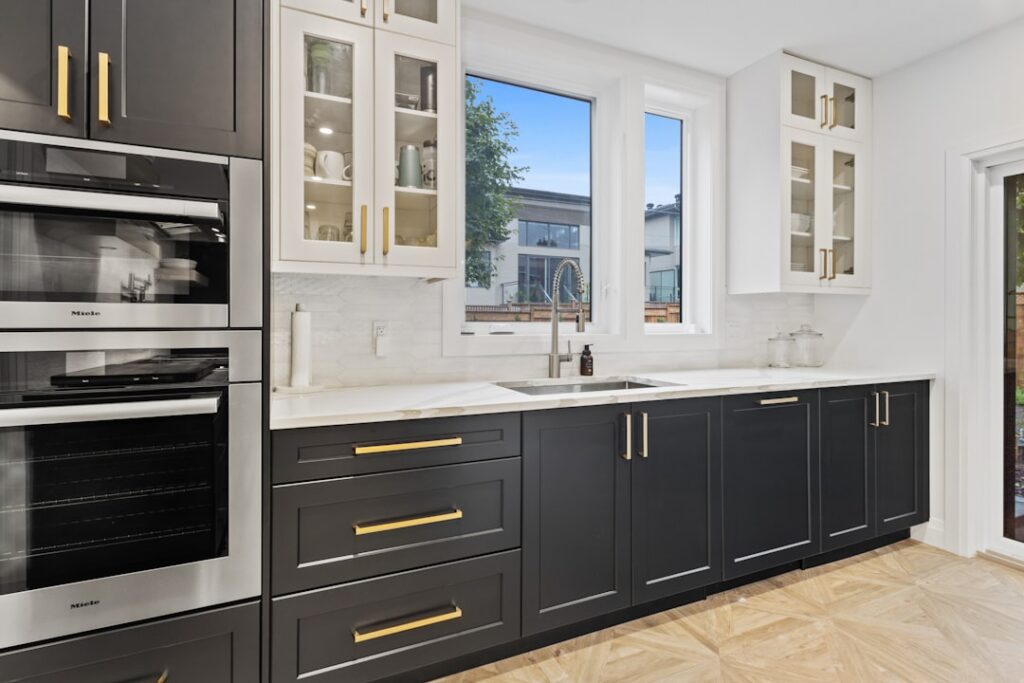
- Black: dramatic and modern, best with plenty of light.
- Natural stained wood: oak and walnut Shaker doors bring back warmth and grain.
Two-tone is a Shaker signature: white uppers with a navy, green, or wood island reads as designed and custom. For finish, a satin or semi-gloss enamel resists kitchen grime and wipes clean far better than a flat sheen.
Hardware That Suits the Style
Because the door is simple, hardware sets the tone. Cup pulls and round knobs lean traditional or farmhouse. Straight bar pulls in matte black or brushed brass push Shaker toward modern. A common approach: knobs on doors, bar pulls on drawers, all in one finish. Keep pull length proportional — roughly one-third the width of the drawer front looks balanced.
What Shaker Cabinets Cost
Because every manufacturer makes them, Shaker cabinets span the full price range:
- Stock (ready-to-assemble or in-stock): $100–$300 per linear foot.
- Semi-custom: $150–$650 per linear foot.
- Full custom: $500–$1,200-plus per linear foot.
For a 25-linear-foot kitchen, that’s roughly $2,500–$7,500 for stock, $4,000–$16,000 for semi-custom, and $12,500-plus for custom. Painted finishes typically add 10–20% over a natural stain because painting is more labor-intensive. Solid-wood construction costs more than MDF but lasts longer under heavy use.
Shaker vs. Other Door Styles
It helps to see where Shaker sits among the alternatives. A flat slab door is fully modern and the easiest to wipe, but it can feel stark and offers no visual texture. A raised-panel door has a contoured center that reads more traditional and formal, but it dates a kitchen faster and collects even more dust than Shaker. A beadboard or inset door leans cottage and costs more. Shaker lands in the middle of all of them — enough detail to feel warm, simple enough to feel current. That center position is exactly why it works across so many kitchens.
One variation worth knowing is the slim or thin-frame Shaker, where the rails and stiles are narrowed to around 1.75 inches instead of the standard 2.5 inches. The tighter frame pushes the classic style toward a cleaner, more modern feel while keeping the recessed panel. It’s a popular update for contemporary kitchens that still want a hint of tradition.
Inset vs. Overlay Shaker
How the door sits on the cabinet box changes both the look and the price. Full overlay Shaker doors cover almost the entire face frame, leaving thin reveals between doors; this is the standard, most affordable mount. Inset doors sit flush inside the frame, like fine furniture, with a precise gap all around. Inset looks the most high-end and traditional but costs 15 to 30% more because it demands exact fitting and the doors can bind if the wood moves with humidity. For most kitchens, full overlay delivers the clean Shaker look without the inset premium.
Care and Longevity
Shaker cabinets are easy to live with if you match your cleaning to the finish. For painted doors, wipe with a soft cloth, warm water, and a drop of dish soap, paying attention to the panel groove where grease settles; avoid abrasive pads that dull the sheen. Keep a small container of the original touch-up paint for the inevitable chips around handles. On stained wood Shaker cabinets, a periodic wood conditioner keeps the finish from drying out. With a durable enamel or factory conversion coating and reasonable care, a quality Shaker kitchen easily lasts 15 to 20 years before it needs refinishing.
Are Shaker Cabinets Right for You
Choose Shaker kitchen cabinets if you want a look that’s proven, flexible, and easy to resell, and you don’t mind a quick wipe of the panel groove now and then. They fit nearly every kitchen style, come at every budget, and give you room to express personality through color and hardware rather than the door shape itself.
If your top priority is the lowest-maintenance, most modern possible surface, compare them against a flat slab door before deciding. For almost everyone else, Shaker remains the reliable choice that will still look right a decade from now.
Pairing Shaker With Counters and Floors
Because the door is so neutral, the surrounding materials define the kitchen’s personality. White Shaker cabinets pair effortlessly with almost anything: warm butcher block for farmhouse, veined quartz for a classic look, or black granite for contrast. Gray and greige Shaker cabinets suit lighter quartz and wood-look flooring, keeping the room soft and current. For navy or deep-green Shaker, brass hardware and a white or marble-look counter provide the light relief the dark color needs.
Flooring ties it together. A warm oak or wood-look vinyl plank floor grounds white or painted Shaker cabinets and adds the natural texture the plain doors lack. If you want a fully traditional feel, a hardwood floor under stained-wood Shaker cabinets keeps the whole room in the same warm family. The point is that Shaker cabinets rarely dictate your other choices — they follow along, which is precisely what makes them so easy to design around and so consistently popular.