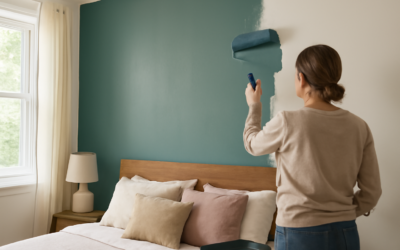
Most bedroom repaints go wrong for one reason: the color was chosen under store lighting at noon and then lived with at 10 p.m. under a warm lamp. Picking from the Sherwin Williams bedroom paint colors that actually hold up starts with mood (calm, cozy or moody), then light reflectance value (LRV), then the direction your windows face. A soft green-gray that looks restful in a south-facing room can turn flat and chilly in a north-facing one.
Part of our Paint & Walls guide — explore the full guide →
The short answer: for a calm room, look at Sea Salt, Comfort Gray, Silver Strand and Lullaby. For a cozy, warm room, Accessible Beige, Kilim Beige, Malabar and Shoji White are dependable. For a dark, enveloping bedroom, Naval, Iron Ore, Urbane Bronze and Rosemary are the colors designers reach for most. Every number quoted here comes from the manufacturer’s own color data, rounded to the nearest whole LRV point.
- Sherwin Williams Bedroom Paint Colors at a Glance
- How Light Direction Changes Bedroom Colors
- Calm Bedroom Picks: Greens, Grays and Soft Blues
- Cozy Bedroom Picks: Warm Neutrals
- Dark and Moody Bedroom Picks
- How to Test Bedroom Colors Before You Commit
- Sheen, Trim and Ceiling Choices
- Troubleshooting Common Bedroom Color Problems
- Cost to Paint a Bedroom
- When to Hire a Painter
- Frequently Asked Questions
LRV runs from 0 (absorbs all light) to 100 (reflects all light). Bedrooms used mostly at night can handle lower LRVs than kitchens or home offices, but a room with one small window still needs something in the 50s or higher if you want it to feel airy during the day.
Sherwin Williams Bedroom Paint Colors at a Glance
Use this table as a shortlist. The undertone column is what you will notice most once the paint is on four walls, and the light column tells you which exposure flatters each color.
| Color (number) | Mood | LRV | Undertone / family | Best light |
|---|---|---|---|---|
| Sea Salt (SW 6204) | Calm | 63 | Muted green with blue undertones | South or east |
| Comfort Gray (SW 6205) | Calm | 54 | Cool green-gray | South or west |
| Silver Strand (SW 7057) | Calm | 59 | Green-gray with cool cyan undertones | South or west |
| Lullaby (SW 9136) | Calm | 65 | Light blue with slate gray undertone | South |
| Accessible Beige (SW 7036) | Cozy | 58 | Beige with gray undertones | North or east |
| Kilim Beige (SW 6106) | Cozy | 57 | Soft warm beige | North |
| Shoji White (SW 7042) | Cozy | 74 | Warm, creamy white bordering on greige | Any, best north |
| Evergreen Fog (SW 9130) | Moody | 30 | Green-gray with a hint of blue | South or west |
| Naval (SW 6244) | Moody | 4 | Deep blue, cool gray-green undertone | Well-lit rooms |
| Urbane Bronze (SW 7048) | Moody | 8 | Brownish gray | Any, warm lamps help |
Values were checked against the maker’s color data in late 2026. Formulas and color data occasionally change, so confirm the current LRV on the color’s official page or fan deck chip before buying gallons.
How Light Direction Changes Bedroom Colors
North-facing rooms get indirect, bluish light all day. Cool colors like Silver Strand or Lullaby can read gray or even slightly gloomy there, while warm beiges and creamy whites balance the blue cast. If your bedroom faces north, Kilim Beige, Accessible Beige and Shoji White are the safer calm options.
South-facing rooms get warm, strong light for most of the day. That warmth can push yellow-leaning colors toward gold, so cooler greens and blues look their best here. Sea Salt and Comfort Gray, which can look washed out in weak light, come alive in a south-facing bedroom.
East-facing rooms are bright and warm in the morning and cooler by afternoon. Because most people are out of the bedroom in the afternoon, judge an east room in the morning and at night under lamps. West-facing rooms are the opposite: cool in the morning, golden in the late afternoon. A green-gray balances both ends of the day well.
Artificial light matters as much as windows in a bedroom. Bulbs labeled 2700K (warm white) make every color warmer. If you plan to use 3000K or higher bulbs, expect blues and grays to look crisper and beiges to look slightly less golden.
Calm Bedroom Picks: Greens, Grays and Soft Blues
Sea Salt (SW 6204)
Sherwin-Williams describes Sea Salt as a cool, muted green with blue undertones. With an LRV of 63, it stays light enough for small rooms. In bright light it reads as a pale spa green; in dim light it drifts toward gray. Pair it with a soft white trim such as Spare White (SW 6203), one of the maker’s suggested coordinating colors.
Comfort Gray (SW 6205)
One step deeper on the same strip, Comfort Gray (LRV 54) is a cool green-gray the manufacturer specifically calls ideal for bedrooms and bathrooms. It has more body than Sea Salt, which makes it a good choice when your furniture is white or light oak and you want the walls to frame it.
Silver Strand (SW 7057)
Silver Strand (LRV 59) leans gray first and green second, with cool cyan undertones that give it a misty look. It works well with gray carpet or light vinyl plank floors that have a cool cast.
Lullaby (SW 9136) and Drift of Mist (SW 9166)
Lullaby (LRV 65) is a light blue softened by slate gray, so it avoids the nursery feel of brighter blues. For a calm neutral that is not green or blue at all, Drift of Mist (LRV 69) is an airy gray that the maker notes won’t appear too dark in rooms lacking natural light. Repose Gray (SW 7015, LRV 58) is a slightly deeper alternative.
Cozy Bedroom Picks: Warm Neutrals
Warm neutrals suit bedrooms with wood furniture, brown or honey-toned hardwood floors and lots of textiles. They also hide the cool cast of north light.
- Accessible Beige (SW 7036), LRV 58: a beige with gray undertones, so it feels warm without turning yellow. A dependable whole-house color that also works in a primary bedroom.
- Kilim Beige (SW 6106), LRV 57: warmer and slightly pinker than Accessible Beige. Strong in north light; can look peachy in bright south light.
- Malabar (SW 9110), LRV 53: a sandy beige with a soft golden side. Good with cream bedding and rattan.
- Shoji White (SW 7042), LRV 74: a warm, creamy white that borders on greige. Use it when you want a light bedroom that does not feel stark.
- Redend Point (SW 9081), LRV 30: a soulful, earthy red-brown. Better as an accent or headboard wall than all four walls in a small room.
Agreeable Gray (SW 7029, LRV 60) also belongs here. The manufacturer calls it its best-selling color, and its beige undertone keeps it warm. If you already have it in the rest of the house, carrying it into the bedroom keeps the flow consistent.
Dark and Moody Bedroom Picks
Dark bedrooms can feel calm in a different way: they make the walls recede at night and help the room feel enclosed. The trade-off is daytime. With LRVs under 10, these colors absorb most of the light that hits them, so they work best in rooms with good windows or in rooms used only at night.
- Naval (SW 6244), LRV 4: a deep blue with a cool gray-green undertone. Classic with white trim and brass hardware.
- Iron Ore (SW 7069), LRV 6: a cool, deep charcoal. Looks soft rather than harsh in a matte finish.
- Urbane Bronze (SW 7048), LRV 8: a brownish gray that feels earthy and warm under lamp light.
- Rosemary (SW 6187), LRV 14: a deep organic green with a cool gray undertone, good with natural wood.
- Evergreen Fog (SW 9130), LRV 30: a mid-tone green-gray for people who want depth without going dark.
- Perle Noir (SW 9154), LRV 8: a deep purple that reads almost black; best as an accent wall.
Among the darker Sherwin Williams bedroom paint colors, these six cover the main directions: blue, charcoal, brown, green and plum. A common approach is to paint only the wall behind the bed in one of these and use a lighter color from the same family elsewhere. For example, Evergreen Fog on the headboard wall with Silver Strand on the rest keeps the room tied together.
How to Test Bedroom Colors Before You Commit
- Narrow to three colors. Pick one from each mood or three from the same mood at different LRVs.
- Use large samples. Peel and stick paint samples, or a sample quart painted on poster board, should be at least 12 by 12 inches. Tiny chips exaggerate undertones.
- Place samples on two walls. Put one on the window wall and one on the wall opposite. The window wall will always look darker.
- Check at three times. Look in the morning, late afternoon and at night with your actual lamps on. Night is the most important view for a bedroom.
- Compare against fixed elements. Hold samples near the floor, bedding and any furniture you are keeping. A beige that looks clean on a white wall can look pink beside oak.
- Live with it for 2 to 3 days. First impressions change once your eye adjusts.
Sheen, Trim and Ceiling Choices
Most bedrooms look best in a matte or eggshell finish on walls. Matte hides drywall flaws and gives dark colors a soft, velvety look. Eggshell is slightly easier to wipe clean and suits rooms where kids or pets brush against walls. Satin or semi-gloss is better saved for trim and doors, where durability matters more.
For trim, a clean white keeps calm and cozy colors crisp. Extra White (SW 7006, LRV 86) is cool and bright; Pure White (SW 7005, LRV 84) has a slight yellow undertone that softens it; Alabaster (SW 7008, LRV 82) is warmer still and pairs naturally with beiges. With dark walls, you can either use a bright white trim for contrast or paint the trim the same color as the walls in a higher sheen for a drenched look.
Ceilings in bedrooms are often overlooked. A flat white ceiling is standard, but a ceiling tinted to a quarter or half strength of the wall color makes a room feel more finished and reduces the hard line where wall meets ceiling.
Troubleshooting Common Bedroom Color Problems
The green-gray looks blue. Cool light, often from north windows or 4000K bulbs, is exaggerating the blue undertone. Switch to warmer bulbs or move one step warmer, such as from Silver Strand to Repose Gray.
The beige looks pink or peach. Kilim Beige and similar warm beiges can lean pink in strong south or west light. Try Accessible Beige, whose gray undertone controls the warmth.
The dark color looks patchy. Deep colors usually need two full coats over a tinted primer, and touch-ups flash more in eggshell than matte. Roll each wall in one continuous session and keep a wet edge.
The room feels smaller than expected. That is the trade-off with LRVs under 20. Lighten the ceiling, add a light rug, or move the dark color to one accent wall.
Cost to Paint a Bedroom
A typical 12 by 12 foot bedroom with 8-foot ceilings has roughly 350 to 400 square feet of wall area. Two coats usually take 2 gallons of wall paint, plus about 1 quart to 1 gallon for trim and doors. Premium interior paint generally runs in the mid to upper range per gallon, so materials for a DIY job, including rollers, tape and drop cloths, often land in the low hundreds of dollars.
Hiring a painter for a standard bedroom commonly costs a few hundred dollars up to around $1,000 or more depending on your region, ceiling height, wall repairs and whether trim, doors and ceilings are included. Dark colors and big color changes can add a coat, which adds labor.
When to Hire a Painter
DIY is very doable for most bedrooms. Consider a pro when walls need significant drywall repair, the ceiling is vaulted or higher than about 10 feet, you are switching from a very dark color to a very light one, or you want a crisp two-tone or color-drenched look with sharp lines. A good painter will also spot-prime patches so they don’t flash through matte paint.
Frequently Asked Questions
What is the most relaxing Sherwin Williams color for a bedroom?
Soft green-grays and muted blues are the most common choices for relaxing bedrooms. Sea Salt (SW 6204), Comfort Gray (SW 6205) and Lullaby (SW 9136) all have cool, low-saturation undertones that read calm in good light. In a north-facing room, a warm neutral like Accessible Beige often feels more restful.
What LRV is best for a bedroom?
For a light, airy bedroom, aim for an LRV of about 50 to 75. For a cozy but not dark room, 30 to 50 works well. Below 15, the room will feel deliberately dark and enclosed, which can be intentional for a moody look.
Should a bedroom be painted matte or eggshell?
Matte gives the softest look and hides wall flaws, which is why many people prefer it in bedrooms. Eggshell has a slight sheen and is easier to wipe clean, so it is a better fit for kids’ rooms or high-contact walls.
Is a dark paint color a good idea in a small bedroom?
It can be, as long as you accept that the room will feel enclosed rather than bigger. Dark colors blur corners at night, which some people find restful. Keep the ceiling lighter and use warm lamps to avoid a cave-like feel.
How many paint samples should I test in a bedroom?
Two to three large samples is the sweet spot. More than that makes comparisons confusing. Place each sample on at least two walls and check them in the morning and at night under your usual bedroom lighting.