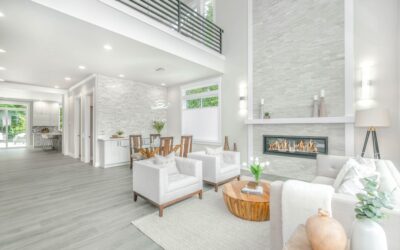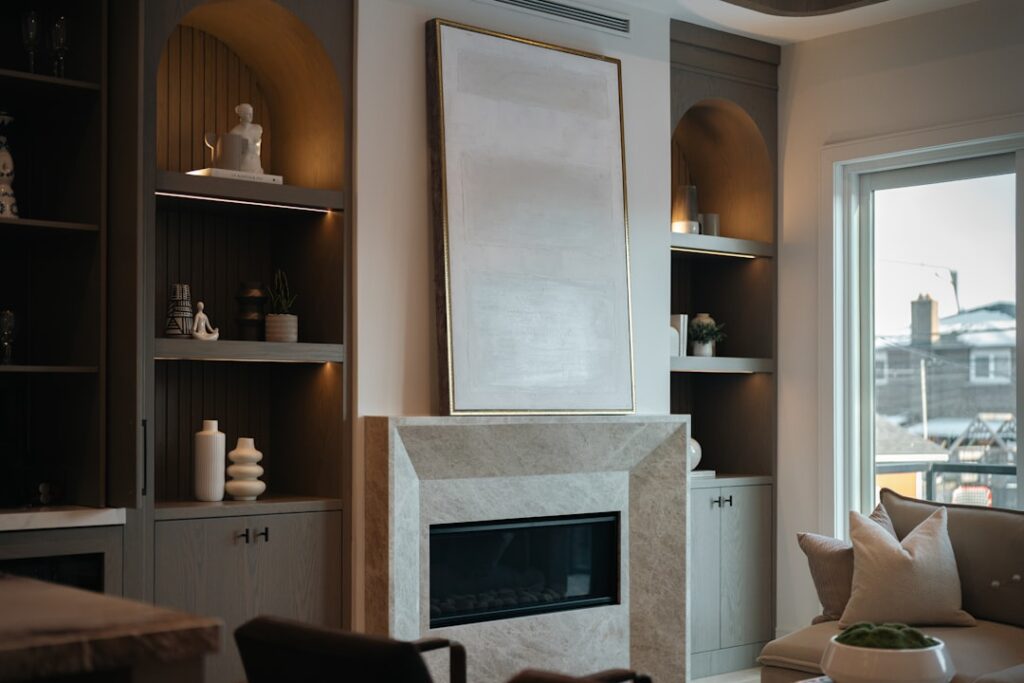
A brick fireplace from 1985 drags down every room it touches, and replacing it with stone or tile can easily cost $4,000 to $12,000. The cheaper and often better-looking solution is shiplap cladding, which runs $300 to $900 in materials and transforms the focal wall in a weekend. These shiplap fireplace ideas cover floor-to-ceiling installs, painted colors beyond plain white, and the hybrid designs that are replacing Joanna-era farmhouse with something more durable. Each option here can be built DIY with a miter saw, nailer, and a weekend.
Floor-to-Ceiling Shiplap
Extending shiplap from the floor baseboard to the ceiling line is the single biggest visual upgrade you can make to a small or mid-size living room. It draws the eye up, makes ceilings feel taller, and gives the fireplace a modern gallery-wall feel instead of a short stubby chimney breast.
Materials for a typical 10 ft wide by 9 ft tall wall:
- 1×6 or 1×8 primed MDF shiplap: 20 to 25 boards at $12 to $22 each, so $240 to $550
- Pine 1×2 corner trim and baseboard coverage: $45 to $80
- Construction adhesive, 18-gauge brad nails, paintable caulk
- Two gallons of paint plus primer
Keep a 1/8 inch reveal between boards (a credit card works as a spacer). For gas inserts, check your manufacturer’s clearance specs; combustible cladding usually needs to stay 6 to 12 inches from the firebox opening, filled with non-combustible board or tile.
Painted Black Shiplap
Black shiplap around a fireplace is having a moment and for good reason. A deep near-black color like Benjamin Moore Black Beauty, Sherwin-Williams Tricorn Black, or Iron Ore grounds the room and makes a television mounted above practically disappear.
Two application tips make the difference. First, prime the MDF with Zinsser Cover Stain before painting; otherwise the face grain telegraphs through even three coats. Second, use a matte or flat finish, never satin. Glossy black reflects light in patchy streaks that ruin the clean-line look.
Natural Wood Shiplap
Stained or oil-finished wood shiplap in white oak, walnut, or rift-sawn cedar reads contemporary rather than farmhouse. Unlike painted MDF, you need real solid wood for this one because stain on cheap tongue-and-groove pine turns orange fast.
Budget $6 to $14 per linear foot for decent quarter-sawn white oak shiplap from a specialty lumber supplier. Finish with Rubio Monocoat or Osmo Polyx for a natural matte hand feel. Skip shiny polyurethane; it makes the wood look plastic and highlights every dust particle under a TV.
Two-Tone Hybrid: Shiplap Above, Tile Below
Combining shiplap on the upper wall with stone, brick, or large-format tile around the firebox splits the fireplace surround into a sophisticated tiered design. The tile handles heat and durability; the shiplap adds texture and height.
Typical layout: tile or stone veneer from the floor or hearth up to about 54 to 60 inches, then shiplap from that transition to the ceiling. Run a 1×4 horizontal band painted the shiplap color at the transition to hide the seam. This is the most durable fireplace design on this list because no combustible material touches the firebox.
Board and Batten Mixed with Shiplap
Running horizontal shiplap up the main wall and then stacking a tall vertical board-and-batten section above the mantel breaks up the surface and adds architectural depth. Think of it as two patterns meeting at a 1×6 shelf.
This works especially well in older homes where the fireplace chimney breast bumps out from the main wall. The shiplap covers the recessed flanking walls and the batten pattern sits on the projecting chimney mass, highlighting the 3D geometry instead of flattening it.
Vertical Shiplap for Short Ceilings
Traditional shiplap runs horizontally, but vertical installation is the underused variation that rescues rooms with 7 to 8 ft ceilings. The long vertical lines pull the eye up and make the wall feel taller.
Use narrower boards for vertical runs, typically 1×4 or 1×6 rather than 1×8 or 1×10. Wider boards overpower a short wall. Keep the reveal tighter too, around 1/8 inch, so the shadow lines don’t chop up the wall into thirds.
Colored Shiplap Beyond White
Painted colors other than white and black are the fastest way to date-proof a shiplap fireplace. Some combinations that read intentional in 2025 and beyond:
- Sherwin-Williams Evergreen Fog SW 9130 (muted sage)
- Farrow and Ball Inchyra Blue 289 (deep blue-gray)
- Benjamin Moore Hale Navy HC-154 (traditional navy)
- Sherwin-Williams Urbane Bronze SW 7048 (warm brown-gray)
- Benjamin Moore Caliente AF-290 (deep red for a historic look)
Saturated colors look best with a matched or slightly lighter ceiling, a dark-stained mantel, and warm brass hardware.
Floating Mantel Integration
A chunky floating wood mantel is the single best accent for any shiplap fireplace. Source a solid 4×8 or 6×8 piece of rough-sawn oak, cedar, or pine from a local mill. Wedge-shape the back with a circular saw so it slips onto hidden steel mantel brackets lag-bolted into studs.
Install the mantel after the shiplap goes up, not before. Otherwise the boards have to be cut to fit around it and the lines never look as clean as a mantel floating in front. Standard mantel height is 54 to 60 inches from the floor.
Cost and Time Summary
Rough total for each approach, assuming a 10 ft wide focal wall:
- Basic white horizontal shiplap, mantel-high: $250 to $400, one weekend
- Floor-to-ceiling painted shiplap: $400 to $800, two weekends
- Two-tone shiplap plus tile: $900 to $2,200, three to four weekends
- Natural white oak shiplap: $1,100 to $2,500, two weekends
- Vertical shiplap plus floating mantel: $500 to $950, two weekends
Factor in a gallon of primer for $30, a miter saw rental if you don’t own one ($45 per day), and a brad nailer rental ($35 per day). A finished shiplap fireplace wall easily returns double to triple its material cost in home value and staging appeal.