A broken towel bar can make a $1,000 glass door feel like junk, and the replacement part usually costs less than dinner. The shower door towel bar is one of the most misunderstood pieces of bathroom hardware — part handle, part towel storage, and mounted to tempered glass that cannot be drilled, which means the bar must match the existing holes exactly. Order right and this is a 20-minute swap with a hex key. Order wrong and you learn why glass shops keep a drawer of orphaned hardware. Here is how the systems work and how to replace yours without drama.
- The One Rule of Glass-Mounted Hardware
- Types of Shower Door Towel Bars
- Through-Glass Single Bars
- Back-to-Back Combination Sets
- Ladder-Style and Handle-Combo Pulls
- Framed-Door Bars
- Measuring for a Replacement
- Replacing a Through-Glass Towel Bar, Step by Step
- How Much Weight Can It Hold?
- Costs and Where to Buy
- Maintenance That Prevents the Next Replacement
- Upgrading Finish and Style Without Replacing the Door
- Bottom Line
The One Rule of Glass-Mounted Hardware
Start with the fact that governs everything: tempered glass is finished glass. The mounting holes were drilled and polished before tempering, and no one — not you, not a glass shop — can add, move, or enlarge a hole afterward without shattering the panel. Every towel bar decision therefore flows from the holes you already have: their diameter (typically 1/2 inch), their center-to-center spacing, and whether they are single holes (bar on one side, caps on the other) or paired for back-to-back hardware. Measure these three things first and the rest of the shopping is easy.
Types of Shower Door Towel Bars
Through-Glass Single Bars
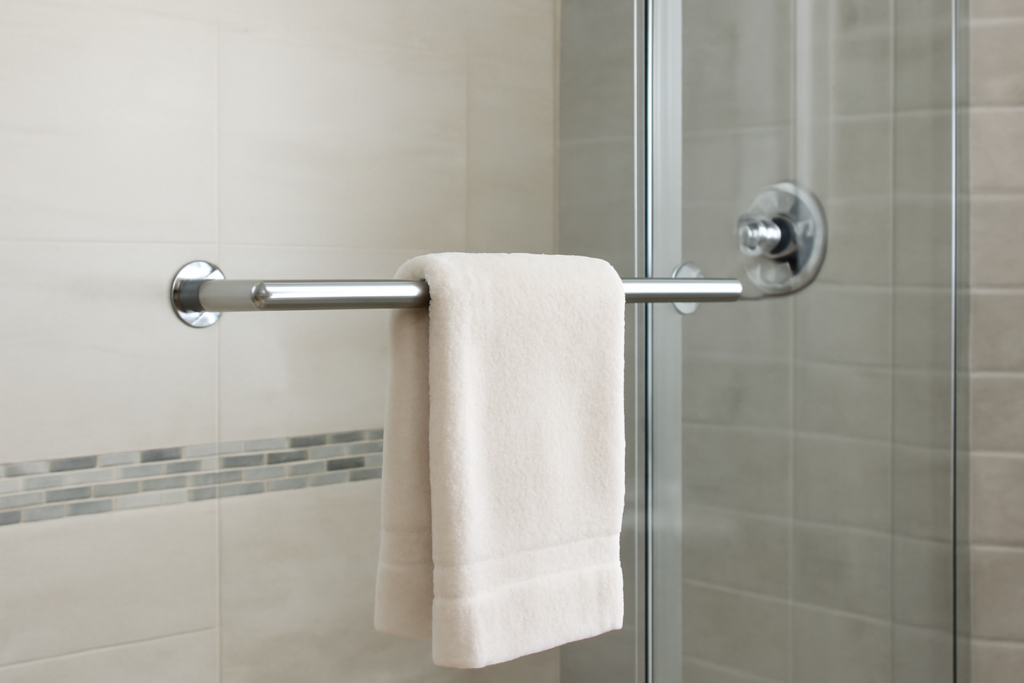
The standard on frameless doors: a straight bar standing off the glass on two posts, bolted through the panel with gaskets on both faces and low-profile caps on the far side. Common center-to-center lengths are 12, 14, 18, and 24 inches. Diameter runs 3/4 inch on most residential hardware. Cost: $30 to $90 in standard finishes.
Back-to-Back Combination Sets
Two bars sharing the same through-glass bolts — a full towel bar on the outside face paired with either a matching bar or a small knob/pull on the inside. This is the most common configuration on frameless sliders and hinged doors because it gives you a handle on both faces. Sets run $50 to $150, and the critical spec is still hole spacing, plus the combined grip clearance on each side.
Ladder-Style and Handle-Combo Pulls
On barn-style sliding doors, the towel bar is often integrated with the door pull as one vertical or horizontal assembly. These are more brand-specific — DreamLine, VIGO, and Delta each use proprietary spacings — so replacement usually means ordering from the door manufacturer or matching dimensions from a hardware specialist like C.R. Laurence (CRL), the industry’s parts bible.
Framed-Door Bars
Older framed sliders mount the towel bar to the aluminum frame with screws or snap-in brackets rather than through the glass. Replacement parts are cheap ($10 to $30) and generic — brands like Prime-Line cover most framed-door bars and the plastic end brackets that always crack first.
Measuring for a Replacement
- Center-to-center: measure between the centers of the two glass holes (or existing posts). This number is non-negotiable — a 24-inch bar will not fit 18-inch holes.
- Hole diameter: 1/2 inch is standard on frameless doors; some imports use 12mm, close enough for most universal hardware with the supplied gaskets.
- Glass thickness: 1/4, 5/16, 3/8, or 1/2 inch. Through-glass fasteners come sized to a thickness range, and gasket kits handle small differences.
- Configuration: note what is on the inside face — caps, a knob, or a second bar — and buy the matching set.
- Finish: chrome, brushed nickel, matte black, or oil-rubbed bronze. Photograph your hinges and match to them; mixed finishes on one door read as a repair, not a choice.
Replacing a Through-Glass Towel Bar, Step by Step
Total time: 15 to 30 minutes. Tools: hex keys, painter’s tape, a helper for peace of mind.
- Lay a towel on the floor inside and outside the door — dropped hardware chips tile, and dropped hex screws find drains.
- Hold the bar while loosening the set screws or unthreading the inside caps. Support the hardware so nothing torques against the glass edge of the hole.
- Remove the old gaskets. If they are fused to the glass, soften them with a hair dryer and peel; never scrape glass with metal.
- Install the new bar with fresh gaskets on both faces of the glass. The rubber is what actually protects the panel — metal must never touch glass directly.
- Tighten to snug plus a quarter turn. Overtightening through-glass hardware is the classic way to explode a tempered panel; the bar should be firm with zero glass stress.
- Recheck after a week of use and re-snug once. Done.
How Much Weight Can It Hold?
Treat a glass-mounted bar as a towel holder and a steadying handle, not a grab bar. Quality through-glass hardware on 3/8-inch glass comfortably carries a few wet towels — call it 10 to 15 pounds of static load — and tolerates the incidental pull of opening the door. What it is not rated for is arresting a falling adult; that job belongs to a properly blocked, ADA-style grab bar mounted to the wall studs, rated at 250-plus pounds. If someone in the house genuinely needs support getting in and out, install the real thing on the wall and let the towel bar be furniture.
Costs and Where to Buy
- Generic through-glass single bar: $30 to $60
- Back-to-back combination set: $50 to $150
- Manufacturer-specific ladder pulls: $80 to $200
- Framed-door replacement bars and brackets: $10 to $30
- Gasket and washer refresh kits: $8 to $15
For anything nonstandard, CRL’s catalog (sold through glass shops and online) covers nearly every spacing and thickness combination made in the last 40 years. When the door brand is known, check its parts page first — DreamLine and VIGO both sell direct replacements for their handle-bar assemblies, and matching the original saves every measuring headache.
Maintenance That Prevents the Next Replacement
Towel bars rarely wear out; they loosen, corrode, or get overloaded. Twice a year, snug the set screws gently and inspect the gaskets for cracking — hardware that rocks even slightly works the glass holes and eventually chips them. Rinse soap residue off the posts when you clean the glass; dried surfactants are what pit cheap finishes. In hard-water homes, dry the bar’s underside occasionally, since mineral crust forms at the post joints first. And keep the habit honest: hang towels, do not chin-up on the door. A shower door towel bar treated within its job description outlives the door’s rollers, seals, and probably your interest in the bathroom’s color scheme.
Upgrading Finish and Style Without Replacing the Door
Hardware swaps are the sleeper move in bathroom refreshes. A dated gold-framed look often lives entirely in the accessories: swap the towel bar, hinge covers where the manufacturer offers them, and the door knob for matte black or brushed nickel, and a mid-2000s enclosure reads a decade newer for under $200. When restyling, keep three practical points in view. Match undertones — brushed nickel and stainless mix acceptably, but chrome next to polished nickel looks like a mistake at arm’s length. Buy all the pieces from one finish batch when possible, because “matte black” varies noticeably between manufacturers, from soft charcoal to true jet. And weigh living finishes carefully: oil-rubbed bronze is often a chemically darkened surface that wears through at grip points within a few years in a daily shower, which some homeowners love as patina and others log as damage. Powder-coated and PVD finishes hold up best against daily water and cleaning chemicals; PVD in particular is effectively the finish equivalent of tempered glass and worth the $10 to $20 premium on a bar you touch every day. If your door is a common DreamLine, VIGO, or Delta model, the manufacturer’s accessory page frequently sells current-finish versions of the original hardware, which guarantees the hole spacing and saves the caliper work entirely.
Bottom Line
Replacing or upgrading a towel bar is the cheapest meaningful refresh a glass door can get — $30 to $150 and half an hour. Measure the hole spacing, match the glass thickness, never let metal touch glass, and stop tightening at snug. Get those four things right and the new bar will be the most reliable part of the enclosure.