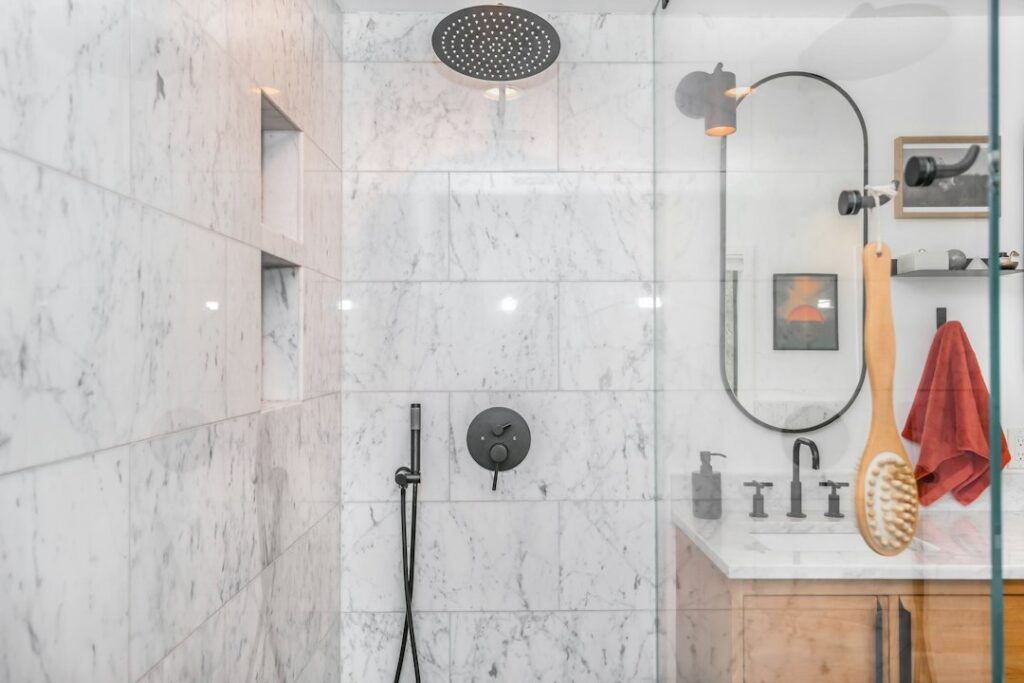
Most bathroom exhaust fans are not allowed directly over a tub or shower, and that surprises a lot of homeowners. Shower fans with lights are a specific class of fixture that carries a listing for wet or shower locations, which means the housing, lens, and wiring compartment are built to handle direct spray and dense steam. If a fan sits inside the tub or shower footprint, it needs that rating, and the circuit often needs GFCI protection as well.
Part of our Bathroom Remodeling & Flooring guide — explore the full guide →
The short answer to “can I put a fan and light over my shower?” is yes, as long as the unit is listed for that location, the manufacturer’s instructions allow it, and the duct runs all the way outside. Get those three things right and a fan light shower combo is one of the most effective moisture tools you can add to a bathroom. It pulls steam out at the source, before it spreads to the mirror, ceiling paint, and drywall.
Placement matters more than raw power. A fan mounted over the vanity has to drag humid air across the whole room, while a unit centered over the shower captures it right where it is generated. That is why many remodelers now treat the over-shower position as the default when the ceiling framing allows it.
What Makes Shower Fans With Lights Different
Standard combo units are typically listed for damp locations, meaning they tolerate humidity but not direct water. Shower fans with lights go further. Look for packaging or a label stating the fixture is suitable for wet locations or for installation over a tub or shower when connected to a GFCI-protected branch circuit. That wording is the key detail; a general “bathroom fan” description is not enough on its own.
Several design features usually separate a true over-shower unit from an ordinary one:
- Sealed lens and gasket so spray cannot reach the lamp or LED board.
- Enclosed wiring box separated from the airflow path.
- Corrosion-resistant grille, often plastic or coated metal, that will not rust in constant steam.
- Integrated LED modules rather than replaceable screw-in bulbs, which reduce heat and failure points.
- Clear installation instructions naming tub and shower enclosures as an allowed location.
If you are shopping, a wet-rated shower exhaust fan with light is the product category to search for. Many also include a humidity sensor that turns the fan on automatically and runs it until the room dries out, which solves the problem of family members switching the fan off too early.
Sizing CFM for a Steamy Shower
Airflow is measured in cubic feet per minute (CFM). The common rule for bathrooms up to about 100 sq ft is 1 CFM per square foot of floor area, with a minimum of 50 CFM. A 7 x 9 ft bathroom (63 sq ft) would call for at least 63 to 70 CFM. For larger rooms, a fixture-based method adds roughly 50 CFM for each toilet, shower, and tub, and about 100 CFM for a jetted tub.
Long, hot showers produce more steam than the basic formula assumes. If your household takes back-to-back showers or you have a steam-style rain head, step up one size. Keep these adjustments in mind:
- Ceilings above 8 ft increase room volume, so calculate by cubic feet and aim for about eight air changes per hour.
- Long duct runs, multiple elbows, and roof caps with tight dampers all reduce real-world airflow.
- Enclosed showers with a full-height glass door benefit from a unit inside the enclosure plus a second fan in the main room.
- Quiet ratings matter: look for 1.0 sone or less if you want the fan to actually get used.
Rated CFM is measured at a standard static pressure. Once you add 20 feet of flex duct and three bends, a 110 CFM fan may perform like an 80 CFM fan. Short, straight, rigid duct keeps performance close to the label.
Tools and Materials
Replacing an existing listed fan with a new bathroom shower fan in the same spot is a reasonable DIY project for someone comfortable with basic electrical work. New locations, attic access, or new circuits are different, and belong with a licensed electrician. For a like-for-like swap, gather:
- Wet-location-listed fan/light combo with humidity or timer control as desired
- Non-contact voltage tester
- Drywall saw, oscillating tool, or jab saw
- Screwdrivers, wire strippers, and approved wire connectors
- Rigid or semi-rigid metal duct in the fan’s outlet size (commonly 4 or 6 inches)
- Foil HVAC tape and mastic or clamps for joints
- Insulated duct sleeve for runs through unconditioned attic space
- Exterior roof or wall cap with a backdraft damper
- Safety glasses, dust mask, and a stable ladder
Installing a Fan Light Over the Shower: Step by Step
These steps describe replacing an existing fan with a wet-rated combo. Follow the manufacturer’s instructions wherever they differ, because the listing depends on installing the unit exactly as tested.
- Kill the power. Switch off the breaker feeding the bathroom fan and light. Then confirm the power is off at the fixture with a non-contact voltage tester, checking every conductor. Do not rely on the wall switch alone, and never work on or test wiring that is still energized.
- Remove the old unit. Take off the grille, unplug the motor, disconnect the wires, and detach the housing from the joist and the duct.
- Check the opening and framing. Compare the new housing dimensions with the ceiling hole. Enlarge the opening if needed, keeping it clear of joists and plumbing.
- Inspect the duct. If the old duct dumps into the attic, ends near a soffit vent, or is crushed flex, replace it. The exhaust must terminate outside through a proper cap, never into the attic, a soffit cavity, or a wall space.
- Mount the housing. Secure it to framing with the supplied brackets so it sits flush with the finished ceiling.
- Connect the duct. Attach metal duct to the collar, seal with foil tape or clamps, and slope horizontal runs slightly toward the exterior so condensation drains out instead of back into the fan.
- Make the electrical connections. Match conductors per the wiring diagram, including the equipment ground. The circuit must be GFCI-protected where the listing or local code requires it, which is typical for over-shower units.
- Install the motor, LED module, and grille. Seat the gasket evenly so the lens seals against spray.
- Restore power and test. Turn the breaker on, run the fan and light, and press the GFCI test button to confirm it trips and resets.
If fitting an extractor fan in a bathroom means cutting a new hole in the roof, running a new switch leg, or adding a circuit, stop at the planning stage and bring in an electrician and, if needed, a roofer.
Moisture, Mold, and Ducting Mistakes
A fan only protects the bathroom if the moist air leaves the house. Venting into the attic is the most common and most damaging mistake: warm, wet air condenses on cold roof sheathing, rots wood, and grows mold across insulation. Always duct to a dedicated exterior termination.
Run the fan during the shower and for 15 to 20 minutes afterward. A humidity-sensing control or countdown timer takes the guesswork out of that. Also give the room a source of makeup air; a 3/4-inch gap under the door usually lets the fan draw air effectively.
If you already see mold, fix the moisture source first, then clean small areas with a detergent solution and let the surface dry fully. Mold covering more than about 10 sq ft, mold inside wall cavities, or mold that returns after cleaning calls for a professional remediation contractor.
Troubleshooting Common Problems
- Mirror still fogs: The fan is undersized, the duct is restricted, or the unit is too far from the shower. Measure airflow with a simple tissue test and inspect the duct run.
- Water dripping from the grille: Condensation is forming in an uninsulated duct. Insulate the run and slope it toward the exterior cap.
- GFCI keeps tripping: Moisture may be reaching the connections, or the fixture may be failing. Turn off the breaker and have an electrician inspect it rather than resetting repeatedly.
- Loud rattling: Check that the housing is screwed tight to framing and the damper flap is not fluttering.
- Light flickers: The LED driver may be incompatible with a dimmer. Use a control the manufacturer lists as compatible.
Typical Costs
Wet-rated fan/light combos generally cost more than basic damp-rated models, ranging from budget units to premium quiet fans with humidity sensing, night lights, and higher CFM. A straight swap using existing duct and wiring is usually the least expensive path. Costs climb when you add new ductwork, an exterior roof or wall penetration, a GFCI circuit, drywall and paint repair, or attic insulation work. Get two or three written quotes that list the fixture model, duct material, termination type, and electrical scope so you can compare them fairly.
When to Call a Licensed Professional
Hire a licensed electrician if the job involves a new fixture location, adding GFCI protection, running a new circuit, wiring in an attic, or any doubt about the existing wiring. Attics hold hazards that are easy to underestimate, including buried wiring, poor footing, heat, and loose insulation. A roofer or experienced contractor should handle new roof penetrations so flashing stays watertight. Many jurisdictions require a permit for new electrical work, and an inspector will verify the fixture rating, GFCI protection, and exterior ducting.
Bring in a remediation company for mold beyond roughly 10 sq ft or any sign of hidden growth behind tile or drywall. Installing properly rated shower fans with lights is the prevention step, but it does not undo damage already in the structure.
Frequently Asked Questions
Can any bathroom fan be installed directly over a shower?
No. Only fans listed for wet or shower locations, and whose instructions allow installation over a tub or shower, should go there. Many require the circuit to be GFCI-protected. A damp-rated fan belongs outside the shower footprint.
How many CFM do I need for a bathroom shower fan?
Plan on at least 1 CFM per square foot of floor area for bathrooms up to 100 sq ft, with a 50 CFM minimum. Increase capacity for high ceilings, long duct runs, or heavy shower use.
Is it okay to vent a shower fan into the attic?
No. Venting moist air into the attic leads to condensation, wood rot, and mold. The duct must end outside through a roof or wall cap with a backdraft damper.
Do shower fans with lights need a GFCI?
Most over-shower fixtures are listed for use only on a GFCI-protected circuit, and local codes commonly require it. Check the fixture label and instructions, and ask your electrician or local inspector.
How long should the fan run after a shower?
Run it for about 15 to 20 minutes after the water stops, or use a humidity-sensing control that shuts off automatically once moisture levels drop.