Most attic conversions start with optimism and end with a room nobody wants to sleep in. The slope hits headboards, the knee walls eat up usable floor space, and the lone dormer window leaves half the room in permanent shadow. The good news is that the constraints which make these rooms feel cramped also make them genuinely cozy when designed right. The slanted ceiling low ceiling attic bedroom ideas below come from rooms I have helped clients renovate in old Victorians, Cape Cod-style homes, and 1920s bungalows where the attic was the only place to add a usable bedroom without an addition. Each idea targets a specific challenge: light, headroom, storage, or that off-balance feeling that comes from a sloped ceiling above your bed.
- Place the Bed Where the Ceiling Is Lowest
- Paint Walls and Ceiling the Same Color
- Use the Knee Wall for Built-In Storage
- Add a Dormer If You Can
- Skylights: Get the Size Right
- Light the Slope Itself
- Mirror the Light
- Window Treatments That Work
- Furniture That Disappears Into the Wall
- Color and Texture for Coziness
- HVAC and Insulation Matter More Than Decor
Place the Bed Where the Ceiling Is Lowest
Counterintuitive but proven. The bed only needs three feet of vertical clearance from the mattress top, and that is the area where you spend most of your time horizontal. Tucking the bed under the lowest part of the slope frees up the higher-ceilinged section for furniture you actually use standing up: a dresser, a chair, a desk. This single layout decision converts dead space into the heart of the bedroom and feels intentional rather than apologetic.
Pick a low platform bed under 14 inches tall to give yourself an extra few inches of clearance when sitting up to read. The Tuft & Needle Wood Frame Bed at 13 inches and the Floyd Platform Bed at 14 inches are both standout choices for slanted-ceiling rooms.
Paint Walls and Ceiling the Same Color
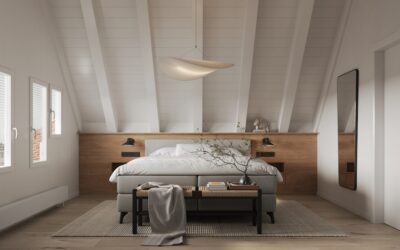
The eye reads ceiling-to-wall transitions and uses them to measure room volume. When the slope and the walls are the same color, that visual transition disappears, and the brain stops trying to calculate the awkward angles. Soft whites work, but creamy off-whites like Benjamin Moore White Dove or Sherwin-Williams Greek Villa add warmth without the clinical feel of stark white.
For more drama, consider deep moody colors painted edge-to-edge. Farrow & Ball Hague Blue or Studio Green wrapped on every surface, including the ceiling slope, makes a small attic bedroom feel like an intentional cocoon rather than a leftover space. The dark color hides the awkward geometry by removing visual contrast altogether.
Use the Knee Wall for Built-In Storage
The 36 to 42 inches between the floor and the start of the slope, called the knee wall, is wasted space in most attics. Building it out with cabinets, drawers, or open shelving recovers usable storage without sacrificing floor area. A 12-inch-deep run of pull-out drawers along a knee wall holds three times the clothing of a freestanding dresser and uses zero additional square footage.
- Pull-out drawers for clothing storage
- Open shelving for books and decor
- Bench seating with hinged lift-up tops
- Secret door access to attic crawl space behind
- Built-in window seat under a dormer
Add a Dormer If You Can
If the budget allows, a single shed dormer or gable dormer added to the side of the roof transforms an attic bedroom from “guest room only” to “primary bedroom.” A typical 8-foot shed dormer runs $12,000 to $25,000 installed and adds 60 to 100 square feet of full-height usable space, plus daylight from a real window rather than just a skylight. The structural and permitting cost makes this only worth it if the room is intended for daily use.
Skylights: Get the Size Right
Most attic bedrooms benefit from at least one Velux fixed or operable skylight. The general rule is one square foot of skylight per 20 square feet of floor area for adequate daylight. A 12-by-14-foot bedroom needs roughly 8 square feet of skylight, which is one large or two medium units. Operable skylights also vent heat in summer; an attic bedroom without one becomes 90+ degrees Fahrenheit by 4 p.m. on summer afternoons.
Position skylights in the slope above the bed for a starlight-watching effect at night. The Velux Solar Powered Fresh Air Skylight runs $1,800 to $2,400 installed and pays for itself in summer comfort within a few seasons.
Light the Slope Itself
Standard ceiling lights do not work in slanted ceilings. Either the fixture hangs at an awkward angle or it ends up too close to a wall. The fixes are recessed slope-rated cans, surface-mounted directional fixtures, or wall sconces in place of overhead lighting entirely.
Slope-compatible 4-inch recessed cans like the HALO RL406 trim install at angles up to 45 degrees and provide even ambient light. Combine with a single statement pendant in the center, hung perpendicular to the floor with a sloped ceiling adapter, and you get layered lighting that flatters the room geometry rather than fighting it.
Mirror the Light
A large mirror placed opposite the main window or skylight effectively doubles the daylight in the room. Lean a 60-inch full-length mirror against a knee wall, or hang an oversized framed mirror on a vertical interior wall opposite the dormer. The mirror also helps a slanted ceiling read as taller because the reflected ceiling adds visual depth.
Window Treatments That Work
Standard curtain rods do not bridge slanted ceilings cleanly. The two solutions: a flexible curve rod that follows the angle of the slope, or a tension wire system from companies like Daltile or IKEA that runs corner-to-corner regardless of ceiling angle. For dormer windows, top-down/bottom-up cellular shades are the practical choice because they fit precisely into deep window pockets and offer privacy and light control independently.
Furniture That Disappears Into the Wall
For very small attic bedrooms under 100 square feet, furniture that mounts directly to the wall preserves precious floor space. A wall-mounted floating nightstand, a fold-down desk, and wall-hung swing-arm reading lamps eliminate three pieces of floor furniture. Floating shelves replace bookcases. The IKEA EKBY shelving system at $20 per shelf handles books and decor without the visual mass of a bookcase.
Color and Texture for Coziness
The lower the ceiling, the more you can lean into a deeply textured, layered look. A nubby wool throw, a chunky knit pillow, an oversized vintage rug, and a wood-tone bed frame combine to make the slanted ceiling read as enveloping rather than oppressive. This is one of the rare rooms where designers genuinely encourage you to mix patterns; the constrained shape grounds the visual chaos.
HVAC and Insulation Matter More Than Decor
An attic bedroom that hits 88 degrees Fahrenheit in summer or drops to 55 degrees in winter is not livable regardless of how attractive it looks. Spray-foam insulation in the rafter bays (R-49 minimum), a dedicated HVAC zone with its own thermostat, and a proper cold-air return are non-negotiable for year-round attic bedroom use. Skipping these turns even the prettiest of slanted ceiling low ceiling attic bedroom ideas into a room that gets used three months a year.